Ha Long Bay cruise excursions are often presented as a list of must-do activities: kayak through a lagoon, climb into a cave, visit a floating community, or swim from a quiet beach. The better question is whether each stop fits your pace, balance, knees, confidence on the water, and willingness to handle stairs or uneven ground. A slower traveller can have an excellent bay cruise, but the itinerary needs to be read as a sequence of effort levels rather than a collection of attractions.
This guide explains how to compare Ha Long Bay cruise excursions for seniors, travellers with limited mobility, families travelling with grandparents, and anyone who prefers scenic experiences without rushing. It focuses on practical choices before booking: how to read activity wording, what to ask the operator, and how to build a day with enough time on deck to enjoy the landscape.
Start with the real question: what kind of effort suits you?
Activity labels are not always precise. “Visit a cave” may mean a short walk from a tender boat, or it may involve a steep approach and many steps. “Kayaking” may be calm paddling near the boat, but getting into a low kayak and climbing out again can be more demanding than the paddling itself. “Beach stop” can include a tender transfer, a landing on wet sand, and a walk over rocks.
Before comparing itineraries, describe your comfortable effort in practical terms:
- Can you manage stairs steadily, and how many flights would feel uncomfortable?
- Are you comfortable stepping between a cruise boat, a tender, a pier, or a kayak?
- Can you walk on uneven paths without a handrail?
- Do you need shade, frequent seating, a slower group, or access to a toilet?
- Would you rather watch an activity from the boat than join every stop?
Choose excursions by effort level, not popularity
Low-effort options: scenery and deck time
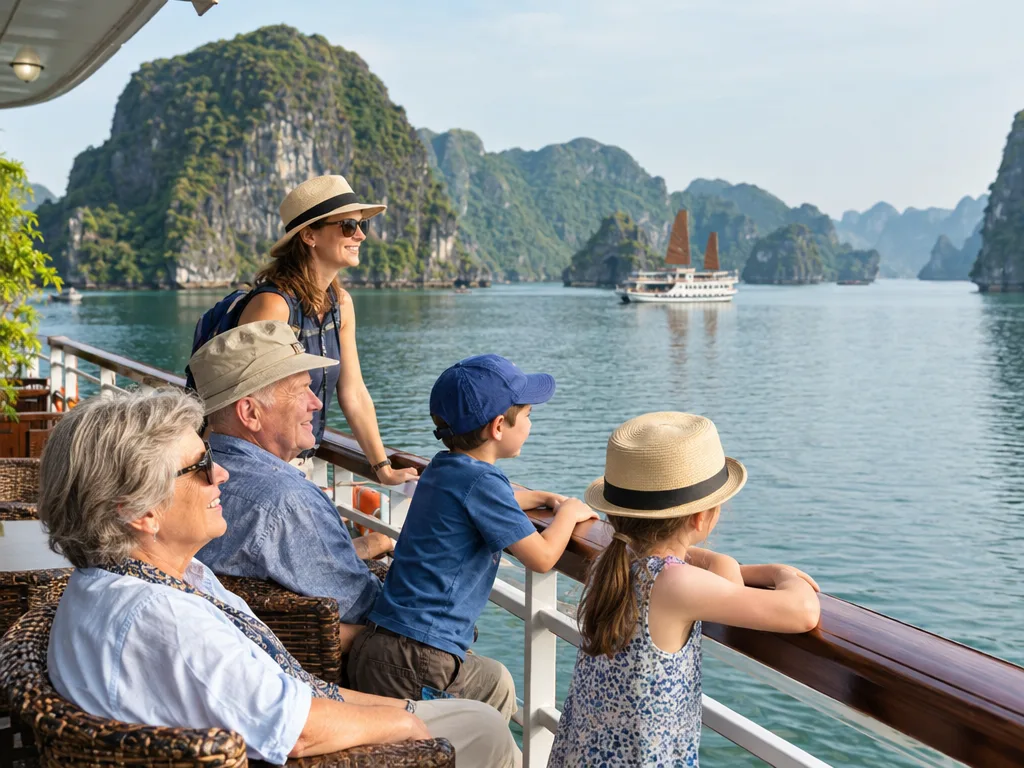
The easiest bay experience may be the one that keeps you on the main vessel. Cruising between limestone islands, watching the light change, and using the sun deck or indoor lounge can be the central activity rather than “free time” between excursions. Vietnam’s official tourism guide describes Ha Long as a seascape of karsts, caves, and water-based communities, so a scenic sailing day is a genuine way to experience the destination.
Short visits by tender boat can also work when the landing is close and the operator provides clear boarding assistance. Ask whether you can remain aboard while other guests leave, and whether the ship will return to the same area soon. This helps groups with different abilities: one person can join the stop while another enjoys the view without feeling left behind.
Moderate-effort options: kayaking and floating communities
Kayaking is attractive because it brings you close to karsts, quiet water, and sometimes floating communities. The official tourism guide notes that small kayaks can move between islands, through caves, and around floating villages. For slower travellers, the key questions are stability and transfers. Ask whether tandem kayaks are available, whether a guide remains nearby, and whether guests can use a sampan or stay on the support boat instead.
A floating-village visit can be moderate rather than strenuous, but the exact experience varies. You may spend most of the time in a small boat, or you may walk on a pier or around a community area. Confirm the distance from the landing point, the availability of a seat, and how long the group remains ashore.
Higher-effort options: cave stairs and active water time
Caves are among the most memorable Ha Long Bay cruise excursions, but they should be assessed carefully. The official destination guide says that some caves require walking and that access can include a steep path. Its activity guide also describes Sung Sot Cave as reached by a steep hike. That does not make a cave visit unsuitable; it means the approach may be more important than the cave interior.
Ask for the number and type of steps, handrails, surface underfoot, and whether there is a viewpoint or resting area before the entrance. If the answer is vague, treat the excursion as more demanding than the brochure suggests. Swimming, rock climbing, and longer kayaking sessions also belong in the higher-effort group because they combine movement, transfers, and exposure to sun or changing weather.
How to compare cave excursions without guessing
Two cave stops can feel completely different. One may be a short walk into a broad chamber; another may require a climb followed by a long route on uneven flooring. Names alone are not enough, especially when an itinerary lists several caves as if they were interchangeable.
Use this cave-visit checklist:
- How do guests reach the entrance: direct pier, tender, or beach landing?
- Is the approach mostly level, or does it climb immediately?
- Are stairs continuous, irregular, wet, or narrow?
- Are handrails and rest points available?
- How long is the guided route, and can a guest turn back early?
- Is the cave lit and surfaced, or does it require a more natural walk?
It is reasonable to choose a cruise where the cave is optional. A companion can join the guide while you stay aboard, or the group can divide for one stop and reunite later. Confirm the plan in advance rather than relying on an improvised decision at the pier.
Kayaking and tender transfers: the overlooked part
Many travellers focus on whether they can paddle but overlook the entry and exit. A kayak sits low on the water, and boarding may involve a floating platform, a narrow step, or assistance from staff. A tender boat may move gently in calm conditions but still require a careful step across a gap.
Ask the operator specific questions:
- Is tandem kayaking available for a guest who does not want to paddle alone?
- Can a guide or crew member steady the boat during boarding?
- Is there a non-kayaking alternative that follows the same route?
- What happens if wind, rain, or waves make the activity uncomfortable?
- Can a guest return to the main ship without waiting for the whole group?
The official tourism guide presents kayaking as a way to approach karsts, caves, and floating villages, but suitability depends on the launch point and conditions. Treat the activity description as a reason to ask better questions, not as a guarantee that every boat uses the same equipment or access arrangements.
Build an itinerary with recovery time
A comfortable excursion schedule is not the one with the greatest number of stops. It is the one that leaves time to recover between transfers, stairs, sun exposure, and meals. This matters on a day cruise, when road transfers and embarkation already consume part of the day, and on an overnight itinerary.
Look for a rhythm such as:
- scenic cruising before the first active stop;
- one main shore excursion rather than several demanding visits in succession;
- a return to the vessel for lunch, shade, and a bathroom break;
- optional kayaking or swimming only when energy and weather allow;
- quiet deck time around sunset instead of another rushed transfer.
Ha Long’s official destination page describes autumn and spring as bringing clearer, calmer cruising days, while summer can be hot with a chance of storms. You do not need a rigid seasonal rule, but it is a reminder to protect flexibility. A plan that works in cool weather may feel excessive in heat, humidity, or rain.
Questions to ask before booking
Reliable excursion planning starts with the itinerary’s small print. Ask for answers in writing when possible, especially if one traveller has mobility, balance, medical, or confidence concerns:
- Which activities involve stairs, steep paths, uneven surfaces, or swimming?
- How long are guests away from the main vessel at each stop?
- Are there seats, shade, toilets, and drinking water at the location?
- Can a guest skip one activity and remain safely aboard?
- Does the boat offer tandem kayaks, sampans, or a sightseeing alternative?
- What assistance is available during tender and kayak boarding?
- Are activity changes possible if weather or sea conditions affect the plan?
- Is the itinerary shared by a large group or managed at a slower pace?
Be precise about the need. “Not very fit” is open to interpretation; “comfortable with level walking but not steep stairs” gives the operator something useful to confirm. If the response only repeats “easy,” “relaxing,” or “suitable for everyone,” ask for route and transfer details again.
Plan for companions with different preferences
Mixed-ability groups do not have to choose between an active cruise and a passive one. The best arrangement often combines one shared scenic experience with optional activities. Everyone can enjoy the cruise and lunch, while only some travellers kayak afterward. A companion can join the guide, take photographs, or return early without turning the day into a negotiation.
Choose a boat with comfortable common areas, clear meeting points, and an itinerary that returns to the main vessel regularly. A spacious deck, shaded seating, and an indoor lounge can be more valuable than an extra excursion headline. If travelling with older adults or children, agree on a simple rule: no one is pressured to complete a stop just because it appears on the schedule.
Families should also consider supervision and heat. A child who can manage a cave stairway may still tire after a tender ride and a hot walk. Older travellers may prefer an early scenic outing followed by lunch and rest. A private or smaller-group arrangement can offer more flexibility, but it cannot remove natural surfaces, changing weather, or the need to follow crew instructions.
Pack for transitions, not one activity
Lightweight clothing, sun protection, secure footwear, and a small day bag are practical starting points. Shoes with a stable sole are preferable for wet piers, cave paths, and tender boarding. Bring prescribed medication in your personal bag rather than leaving it in luggage stored elsewhere on the boat.
- lightweight rain protection for sudden showers;
- a hat and sun protection for open decks and beaches;
- water in a reusable bottle if the operator permits it;
- quick-drying clothing for spray or kayaking;
- a small towel and dry bag for valuables;
- prescription medication and essential personal items.
Do not pack as though every excursion must happen. A light bag makes it easier to step between boats, and spare capacity lets you store a wet layer without making the return transfer awkward.
A simple decision framework
When two itineraries look similar, score each activity against four questions: Can I reach it comfortably? Can I leave or turn back if needed? Is there a meaningful alternative? Will I still have energy to enjoy the cruise afterward? This keeps the decision grounded in the whole day rather than in a single photograph.
For many slower travellers, a strong itinerary includes one memorable active excursion, one short cultural or scenic stop, and generous time on the ship. That might mean kayaking with a companion and skipping a steep cave, or visiting a cave while choosing deck time instead of swimming. The right combination is personal, but the principle is consistent: prioritize access, clarity, and enjoyment over collecting stops.
Final checklist before you confirm
Before paying a deposit, save the final activity description and check that it answers the practical questions above. Confirm embarkation and return points, activity alternatives, the weather plan, and what assistance is realistically available. Then tell companions which parts are essential, optional, or off the table.
Ha Long Bay is rewarding when you move slowly. Its defining experience is the relationship between water, limestone islands, caves, sky, and changing light. Choose excursions that let you experience that landscape with confidence, leave room for rest, and make the main cruise part of the itinerary—not merely transport between attractions.
JOIN THE CONVERSATION
Comments (0)
No comments yet. Be the first to share a thought.