
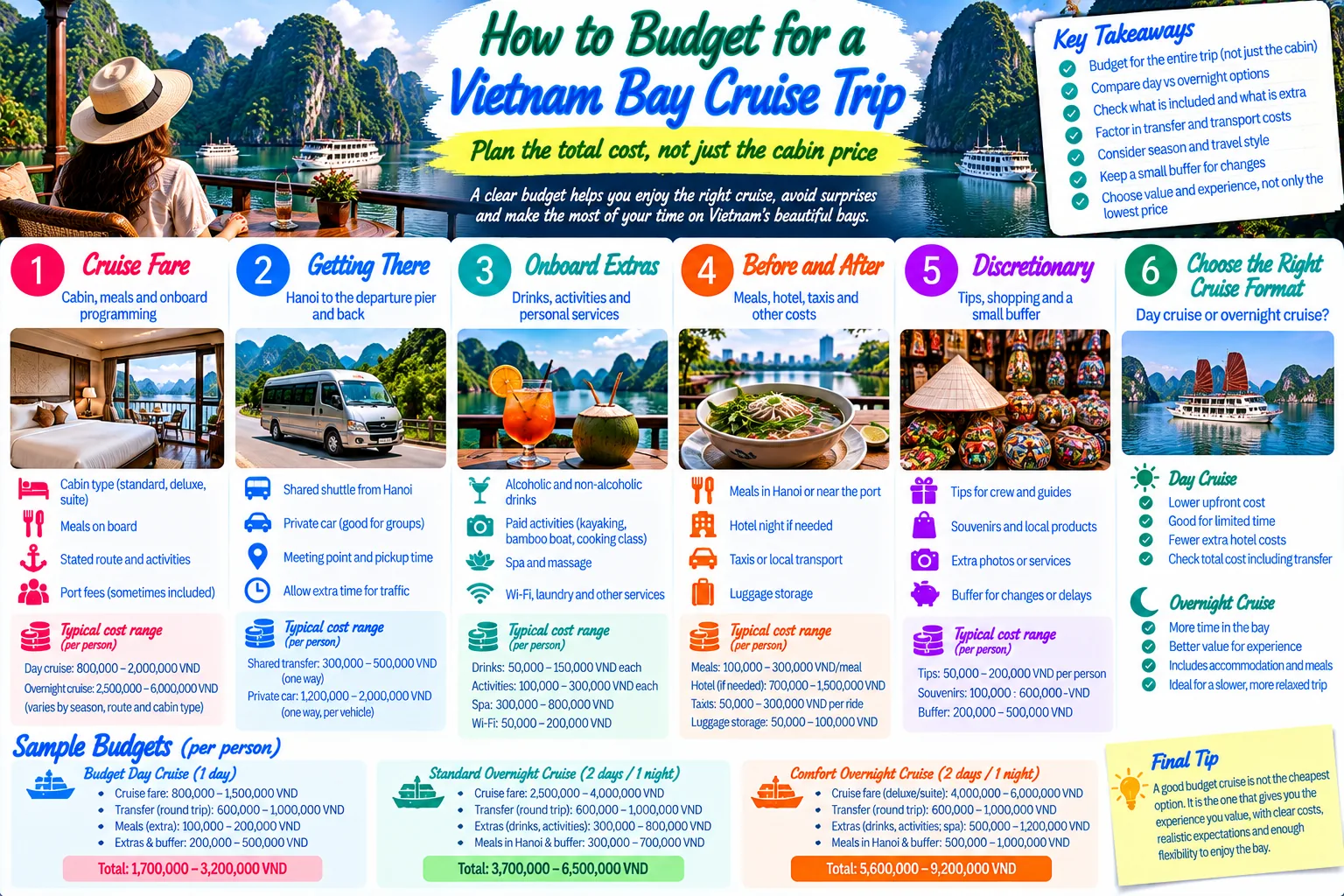
A low cruise fare is only useful when you know what it covers. For a budget Ha Long Bay cruise, the headline price may describe the cabin and sailing, while transfers, port fees, drinks, excursions, or schedule changes sit elsewhere. The smartest comparison is not simply “Which cruise is cheapest?” but “What will this cruise cost me for the experience I actually want?”
Ha Long Bay is known for cruises through emerald water, karst islands, caves, and viewpoints. Vietnam’s official tourism site also notes that the bay is about two and a half hours by road from Hanoi, with cruise transfers commonly connecting through Tuan Chau and Bai Chay ports. That means a realistic budget must include the journey to the port, not just time aboard. Use the checklist below to compare budget cruises clearly without paying for features you will not use or sacrificing essentials that matter.
Start with the total trip cost, not the advertised fare
Before comparing boats, write down every cost that could affect your decision. A cruise offer can be inexpensive because it excludes a service you expected, or because the itinerary is shorter and leaves more of the day to transfers. Neither is automatically bad, but the difference should be visible before you book.
- Cruise fare: Check whether the quoted amount is per person, per cabin, or based on two people sharing.
- Port and service charges: Ask whether mandatory fees are already included or added at confirmation.
- Transport: Separate Hanoi pickup, return transfer, private car, shared shuttle, and self-arranged travel. The official tourism guidance describes road access as a normal part of reaching Ha Long, so do not treat the transfer as an afterthought.
- Food and drinks: Confirm which meals are included, whether water is supplied, and whether soft drinks, coffee, or alcohol are extra.
- Activities: Ask if kayaking, cave visits, swimming stops, cooking demonstrations, or other excursions are included or optional.
- Onboard spending: Budget for drinks, spa services, tips if customary for the operator, and any paid activities.
Then calculate a simple “real price”: cruise fare plus mandatory charges, transport, and the activities you would actually choose. This number is more useful than a ranking based on the first price you see online.
Read the inclusions line by line
Budget cruise descriptions often use broad phrases such as “full board,” “activities included,” or “free transfer.” Treat these as prompts for questions rather than complete explanations. A good comparison sheet should have one row for each cruise and separate columns for what is included, optional, unclear, or excluded.
Meals and basic drinks
“Full board” may mean meals at set times, but it may not include drinks with lunch and dinner. Confirm whether breakfast, lunch, and dinner are served onboard, whether a vegetarian or allergy-sensitive meal can be arranged, and whether bottled water is provided in the cabin. If the itinerary includes a transfer or a long embarkation period, ask whether lunch on the first day and brunch on the final day are both part of the package.
Excursions and equipment
Ha Long Bay tourism guidance highlights kayaking, cave visits, floating-village experiences, and time on the water as common ways to experience the landscape. A budget itinerary may include one of these, offer a shared excursion, or charge for equipment and tickets separately. Ask exactly what “kayaking included” means: a kayak, a guided paddle, a tender transfer to the activity area, and the time allocated can all be different parts of the arrangement.
Cabin and onboard facilities
Compare the cabin category, not just the number of stars in the listing. Check whether the room has a private bathroom, a window or balcony, air conditioning, storage, and the bed configuration you need. Also ask where the cabin is located. A lower-deck interior cabin may be good value for travelers who plan to spend most of the trip outside, while a balcony can be worthwhile for people who want private views and quiet time.
Choose the right cruise length for your budget
A day cruise can reduce the cost of a cabin, but it can also create a longer travel day once transfers and port procedures are added. An overnight cruise costs more upfront, yet it gives you more time to wake up on the water, use the deck, and spread the journey over a calmer schedule. The better choice depends on what your budget is meant to buy: the lowest possible price, the most scenery per hour, or a more comfortable pace.
For a day cruise, compare the actual time afloat with the time spent getting to and from Hanoi. Check the embarkation point, return time, and how much of the itinerary is devoted to a single activity. For a one-night cruise, confirm when boarding starts, which afternoon activities are realistic, and whether the final day includes a morning excursion before disembarkation. A low fare is less attractive if the schedule leaves you rushed or requires an expensive private transfer to make the timing work.
A two-night option should be judged differently. Its value may come from a slower middle day, extra time for swimming or kayaking, and less pressure to fit every activity into one afternoon. It is not automatically better for every traveler, but it can be a sensible use of money when the priority is time on the bay rather than a quick overview.
Compare routes without assuming “more stops” means better value
Ha Long Bay’s appeal is the seascape itself: karst formations, water views, caves, and changing light. An itinerary with many named stops may look impressive, but each stop can involve a tender, a walk, a transfer to an activity area, or time waiting for a group to assemble. Compare the character of the day rather than counting attractions.
- Scenery-first itinerary: Useful if you want deck time, photography, and a relaxed rhythm.
- Activity-first itinerary: Better for travelers who want kayaking, caves, swimming, or village visits and are comfortable with a fuller schedule.
- Short sailing itinerary: May suit a tight trip, but check how much time is spent in port and on transfers.
- Flexible itinerary: Worth considering when weather could affect outdoor plans and the operator explains how alternatives work.
Do not pay extra for a route label without checking the practical details. Ask where the boat boards, what time it leaves the port, how long the main excursion takes, and whether the route is shared with a large number of vessels. The right budget choice is the itinerary that matches your priorities, not the one with the longest list of stops.
Protect the essentials before cutting comforts
There are reasonable ways to save money. You can choose a smaller cabin, travel outside your preferred peak dates, arrange your own transfer when the timing is straightforward, or skip paid drinks and optional treatments. Be more cautious about savings that make basic information unclear.
Before payment, ask for the operator’s cancellation terms, weather procedure, emergency contact, embarkation instructions, and a written list of inclusions. Vietnam’s official tourism guidance warns that northern weather can vary by season, and its Ha Long Bay page notes that summer can bring storms while autumn and spring often have clearer, calmer conditions. A budget booking should explain what happens if unsafe weather changes the sailing, not leave you guessing after the forecast shifts.
Also check whether the published cabin photos represent the category you will receive, whether the boat name is confirmed, and whether a shared transfer has a fixed pickup window. “Budget” should describe the price level, not excuse vague terms or missing safety information.
Use weather and transfer flexibility as part of value
Seasonal timing can affect both comfort and risk. Vietnam Tourism describes December to March in Ha Long Bay as cool to cold, misty, and cloudy; April to June as warm to hot with clearer skies; June to August as stormy, hot, and humid; and September to November as a mix of sun and cloud. These are planning patterns, not guarantees, but they help you decide how much flexibility to build into the trip.
If your schedule is tight, ask whether the cruise can be moved to another date, shortened, or converted into a day experience if weather disrupts the plan. Confirm the deadline for changes and whether the transfer is refundable. If your schedule is flexible, a lower fare on a shoulder date may be more attractive because you have room to move the sailing without losing the whole trip.
Transfer choices deserve the same attention. A shared shuttle may be economical when you are comfortable with a longer pickup window. A private car may be worth the difference for a group, an early flight connection, or travelers who need a precise arrival time. Compare convenience with the actual risk of missing embarkation; the cheapest transfer is not a saving if it creates an expensive last-minute problem.
Questions to send before booking
Copy this short checklist into your message to the cruise operator or booking agent:
- What is the exact total price for our dates and cabin?
- Which mandatory fees, meals, drinks, transfers, tickets, and activities are included?
- Where is the embarkation port, and what pickup time should we expect from Hanoi?
- Which cabin category and bed configuration are confirmed?
- What happens if weather affects the route, and what are the refund or rebooking terms?
- Are kayaking, cave visits, and other excursions included, optional, or weather-dependent?
- What is not included that travelers commonly assume is included?
- When is the remaining balance due, and what is the cancellation deadline?
Save the written answer with your booking details. If the reply is vague about the total cost or weather procedure, compare another operator before sending payment.
A simple decision rule for a budget Ha Long Bay cruise
Choose the lowest total cost only when it still provides the route, pace, cabin, and essential policies you need. Choose the cheapest cabin when the itinerary and onboard spaces matter more to you than private views. Choose a day cruise when your priority is an introduction to the bay and the transfer time is acceptable. Choose overnight when you want sunrise, sunset, more deck time, or a less compressed experience. Choose flexibility when weather or flight connections make disruption expensive.
The most reliable budget cruise is not the one with the smallest headline number. It is the one whose final cost is understandable, whose inclusions match your plans, and whose transfer and weather terms leave no costly surprises. Compare those details first, then choose the boat that gives your money a clear job to do.

JOIN THE CONVERSATION
Comments (0)
No comments yet. Be the first to share a thought.