
Travelling alone does not mean choosing between an expensive private cabin and a rushed day trip. A budget Ha Long Bay cruise for solo travellers can work well when you compare the full journey rather than the headline fare. The key questions are how the cruise prices single occupancy, what is included, how you reach the port, and whether the itinerary gives enough time on the water.
Ha Long Bay is known for cruises among karst islands, caves, floating communities and sheltered corners. Vietnam Tourism describes autumn and spring as favourable periods for clearer, calmer cruising, while summer can bring heat and storms. Flexibility therefore belongs in the budget: a cheap booking is not good value if a change or cancellation leaves you paying twice.
Start with the solo-traveller cost
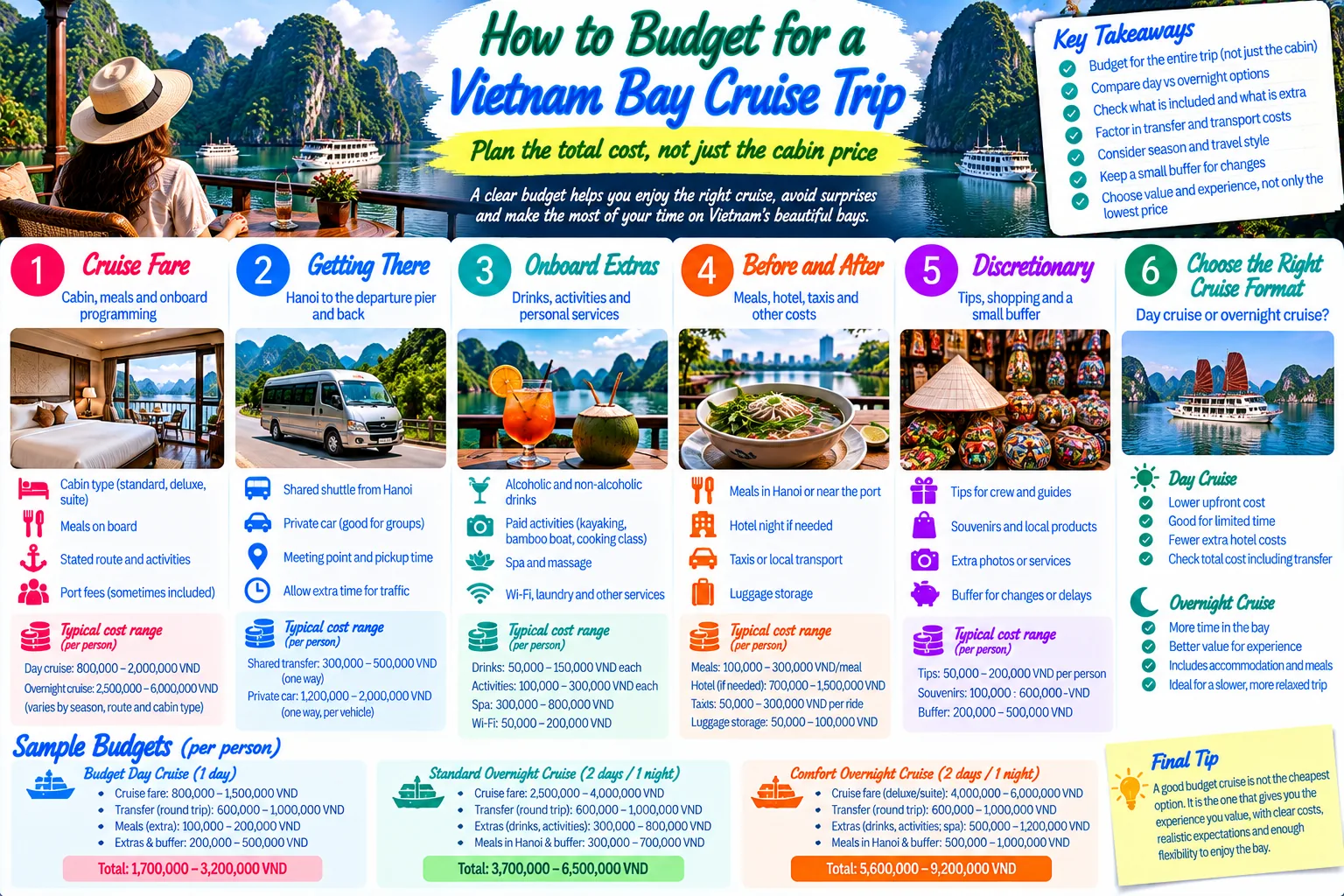
Many cruise prices are presented per person on the assumption that two people share a cabin. Ask for the actual single-occupancy total before comparing operators. A lower per-person rate can disappear once a single supplement, compulsory transfer or port-related charge is added.
Build a comparison sheet with these lines:
- Cabin fare for one person, including any single supplement.
- Transport between Hanoi, your hotel and the embarkation point.
- Meals and scheduled activities included in the programme.
- Drinks, optional excursions, spa services and other onboard extras.
- Travel insurance, payment fees and a small weather contingency.
Do not compare one operator's package total with another operator's room-only figure. Ask each company to confirm the same basis: number of nights, cabin category, transfer arrangement, meals, activities and fees. If the answer is vague, the apparent bargain is not yet a reliable price.
Choose the cruise length that fits
A day cruise may look cheapest because it avoids a cabin, but the value depends on how much of your day is spent travelling to and from the bay. Vietnam Tourism notes that Ha Long is roughly two and a half hours by road from Hanoi and that cruise transfers commonly use Tuan Chau or Bai Chay ports. For a solo visitor, the transfer is part of both the cost and the experience.
A one-night cruise can be a practical middle option if you want a cabin, an evening onboard and a sunrise view without giving up several days. A two-night itinerary may offer a slower middle day and more time for activities, yet the extra cabin night, meals and transfers need to be weighed against the rest of your Vietnam itinerary.
Use this test:
- Choose a day cruise when you want a short introduction and can tolerate a long travel day.
- Choose one night when you want a balanced first cruise with limited time away from Hanoi.
- Consider two nights when avoiding a rushed schedule matters more than the lowest total cost.
The cheapest format is not automatically the cheapest useful experience. Count your time, not only your cash.
Compare routes by experience
“Ha Long Bay cruise” can describe different routes and departure arrangements. Some itineraries emphasise iconic karst scenery and caves; others may spend more time around quieter corners, lagoons or nearby bay areas. Vietnam Tourism highlights cruising, floating communities, kayaking and caves as possible ways to experience the destination. These activities appear in different combinations, so read the daily schedule instead of relying on a route label.
For a solo traveller, look for a clear balance between guided activities and unstructured time. A packed schedule may make it easier to meet people, but it can also leave little time to enjoy the deck. Ask:
- Which bay or waterway does the boat actually visit?
- How long is the boat underway compared with time spent in transfers?
- Are kayaking, cave visits or other stops included, optional or weather-dependent?
- What happens if the advertised activity cannot operate?
Keep the answers in writing. They give you a fair basis for comparing budget cruises with different schedules.
Decide between shared and private transfers
Transport is an easy place for a solo booking to become more expensive than expected. A shared transfer can spread the vehicle cost across several passengers, but it may involve hotel collection windows and extra stops. A private car offers more control but can be poor value for one person unless you have a tight schedule or a convenient cost-sharing arrangement.
Vietnam Tourism presents buses, trains, taxis and other transport modes as part of the wider travel network and advises travellers to plan around distance and road conditions. For a cruise connection, confirm the pickup area, meeting time, luggage allowance and late-arrival policy. A low cruise fare is not useful if you need an emergency taxi because the transfer details were unclear.
Check whether the quoted service is:
- Hotel-to-port and port-to-hotel, or only one way.
- Shared, private or a meeting-point service.
- Charged per person, per cabin or per vehicle.
- Available from your actual Hanoi address.
- Flexible if your hotel is outside the normal pickup zone.
If you arrive in Hanoi on the same day, leave a generous buffer. A solo traveller has no second person to manage check-in or luggage while solving a delay.
Pick a cabin that protects value
Judge a budget cabin by the sleep and privacy it provides, not by photographs alone. Ask for the deck location, approximate size, window or balcony arrangement, bed configuration and bathroom details. A lower deck may be cheaper, but engine noise, movement or a less appealing view could make it a false saving on an overnight trip.
Ask whether the operator offers a genuine single cabin, a single supplement in a standard double, or a shared-cabin arrangement. Sharing may lower the price, but it is only suitable if you accept the policy and the operator explains how the roommate is assigned. Never assume “single occupancy” means a private room until the confirmation says so.
- Choose the lowest tier if you mainly want a clean place to sleep and will use public areas.
- Pay more for a better location when motion or noise is a concern.
- Consider a balcony only if you will use it and the difference fits the whole-trip budget.
- Ask whether solo guests receive the same meal and activity access as double-occupancy guests.
For a one-night trip, a well-located standard cabin can be better value than an upgrade that removes money from your Hanoi stay or later travel plans.
Protect essentials while cutting extras
Budget does not mean accepting unclear safety or service information. Before booking, check that the operator provides a named vessel, a contact point, a written itinerary and clear cancellation or weather terms. Ask how schedule changes are communicated and what support is available if the cruise is shortened or cancelled.
Reduce optional spending without reducing the core experience. Decide in advance whether you need paid drinks, premium dining, spa treatments, private transfers or additional excursions. Keep enough money for essentials and do not treat every onboard upsell as part of the advertised cruise.
Check these details:
- Is drinking water included, and are other beverages charged separately?
- Are meals fixed menus, set meals or partly optional?
- Are entrance fees, equipment and guides included for scheduled activities?
- Is there a card surcharge or cash-only payment for extras?
- Are cancellation, postponement and weather policies written before payment?
A good budget booking is transparent about what it does not include. Clear exclusions help you decide; vague exclusions create risk.
Plan activities for one person
Solo travellers often have more flexibility, so choose activities that match your energy instead of filling every slot. Kayaking can offer a closer view of lagoons and fishing boats, while caves provide a walking-based alternative. Vietnam Tourism also describes rock climbing in parts of Ha Long Bay and Lan Ha Bay, but a cruise itinerary may not include it; treat specialist activities as a separate question.
Ask whether activities are guided, whether equipment is supplied, and how strenuous the access is. If you do not want to join every excursion, confirm that you can remain onboard or use another public area safely. Pack quick-drying clothes, comfortable footwear, sun protection, a waterproof pouch and essential medication. Keep valuables organised because solo travel leaves you responsible for them during transfers and shore stops.
Use timing and flexibility to lower the total
Seasonality can affect demand and the likelihood of weather disruption. Vietnam Tourism identifies September to November as a favourable period on its Ha Long destination page and notes that summer may be hot with a chance of storms. Treat that as broad planning guidance, not a promise of conditions on your sailing date.
When your schedule allows, compare several departure dates. Ask whether the fare is refundable, changeable or tied to a particular transfer. A flexible booking can be worth more than a small discount if a storm, transport delay or personal change affects your plans.
Keep your pre-cruise and post-cruise nights realistic. A late return from the bay may not pair safely with a tightly timed flight or train. One night in Hanoi before embarkation can cost more, but it may protect the cruise fare and reduce stress. For a solo itinerary, reliability is part of value.
A solo budget-cruise checklist
Before paying, you should be able to answer every question below without guessing:
- What is the final single-occupancy price?
- Which port, route and cruise length are included?
- What does the transfer cover, and where is pickup?
- Which meals, activities, equipment and fees are included?
- What cabin type and location will I receive?
- What are the weather, cancellation and change terms?
- How will I pay for optional extras?
- What is the plan if I arrive late or the itinerary changes?
If a salesperson cannot answer these points, keep comparing. If two cruises remain close in price, choose the one with clearer terms, a suitable pace and a transfer arrangement that creates fewer risks.
Final advice
The best budget Ha Long Bay cruise for a solo traveller is not simply the lowest advertised number. It is the option whose single-occupancy price, route, transfer, cabin and inclusions remain understandable after every compulsory cost is added. Start with the total, protect safety and flexibility, then spend only on the activities and comfort upgrades that matter to you.
For a first solo sailing, also consider how you want to spend time between excursions. A communal dining room, shared activity groups and an approachable crew can make a modest cruise feel more rewarding than a larger cabin upgrade. Read recent reviews for consistent comments about communication, cleanliness and itinerary clarity, but treat isolated praise or complaints cautiously. Your goal is a dependable trip, not the most decorated listing.
That approach lets you enjoy the scenery, caves, water and open deck without turning a low fare into an expensive surprise. A little comparison before booking is usually the most useful budget tool you have.
JOIN THE CONVERSATION
Comments (0)
No comments yet. Be the first to share a thought.