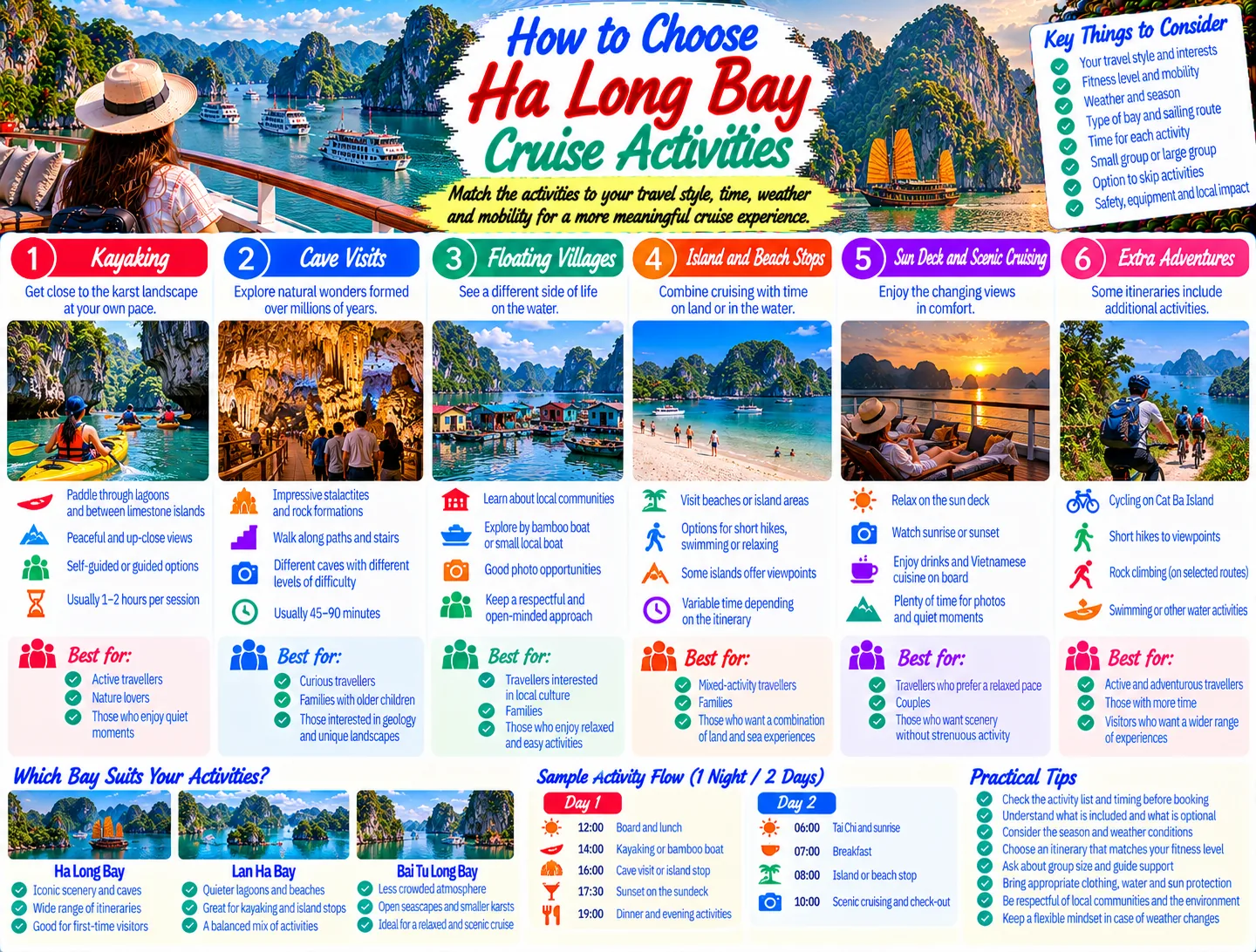
Choosing the right Ha Long Bay cruise activities is less about ticking every excursion box and more about matching the day on the water to your pace, weather, mobility, and appetite for adventure. The same bay can feel completely different from a kayak, a bamboo boat, a cave path, a quiet sun deck, or a short island outing. This guide helps you compare those choices before booking, so your itinerary feels coherent rather than crowded.
Start with the kind of cruise day you actually want
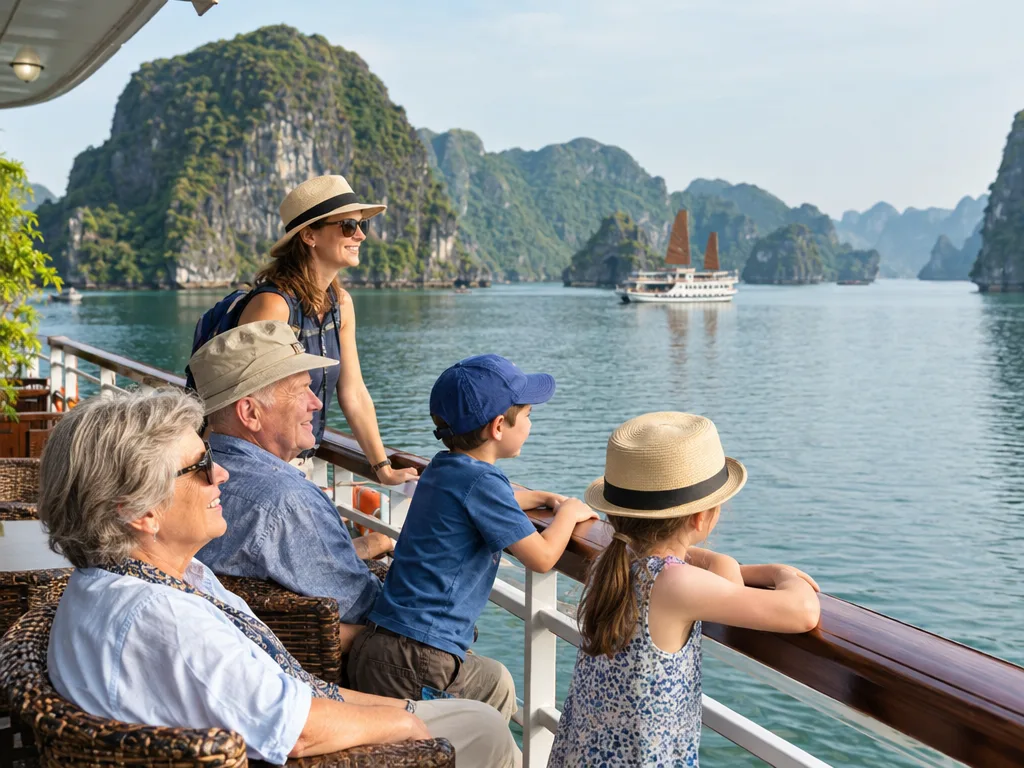
Before comparing activities, decide what you want the cruise to deliver. An active traveller may be happiest with kayaking, cave walking, and a short climb ashore. A first-time visitor may prefer a balanced plan that combines scenery with one easy excursion. Someone travelling with older relatives, young children, or a mixed-mobility group may value sheltered viewing, a tender boat, and flexible time on board more than a strenuous stop.
Ha Long Bay cruises commonly combine several experiences in one itinerary, but “more included activities” does not automatically mean better value. Transfers between the ship and shore, changing weather, waiting for a group, and the time needed to get ready can make a full schedule feel rushed. Read the excursion list as a sequence: how many times will you leave the main boat, how long is each stop, and can you opt out without losing the best scenery?
For a broader framework on judging operators, use this checklist for comparing cruise operators. Then narrow your search to the Cruise Activities & Excursions category for activity-specific planning.
Match the main activity to your travel style
For paddlers: kayaking and quiet lagoons
Kayaking gives you the closest, slowest view of the karsts. Vietnam Tourism describes options such as early paddling around floating villages and pearl farms, late-afternoon outings, and quieter lagoons in Lan Ha Bay. The appeal is not simply exercise: a kayak lowers your viewpoint, lets you notice rock faces and small inlets, and creates a stronger sense of moving through the landscape rather than watching it pass.
Ask whether the excursion is self-guided, guided, or conducted in a larger group. Confirm the expected paddling time, whether the route includes a narrow cave or lagoon, and what happens if conditions change. If you are not a confident swimmer, ask about the life jacket policy and how the guide manages the group. These are sensible questions, not signs that you need to avoid kayaking.
For scenery without exertion: the sun deck and tender boat
A relaxed cruise day can still be activity-rich. Watching the karsts from the sun deck, photographing changing light, and taking a short tender or bamboo-boat trip can provide variety without demanding a long walk. This is often the best choice for travellers who want the landscape to remain the main event.
Look for an itinerary that leaves unstructured time around the excursion. A quiet hour on deck can be more memorable than adding a second rushed stop, especially when the route includes an early start or a sunset viewing period.
For curious explorers: caves and floating communities
Cave visits add a geological dimension to a bay cruise. Official tourism guidance notes that Ha Long’s karsts contain caves shaped by rain and water currents, ranging from tight passages to large chambers. A cave stop can be rewarding, but it is not a single type of experience: stairs, uneven surfaces, humidity, and crowd flow matter.
Floating-village visits offer a different lens. Instead of focusing on rock formations, they introduce the human story of communities connected to the water. Treat the stop as a brief cultural encounter rather than a performance designed solely for photographs. Check how the cruise describes the visit, how long you stay, and whether the activity uses a small local boat or only a viewing loop.
Choose between Ha Long, Lan Ha, and Bai Tu Long activities
The three bays are often discussed together, but an itinerary can feel different depending on where it spends its activity time. Vietnam Tourism presents Ha Long, Lan Ha, and Bai Tu Long as distinct ways to experience the Gulf of Tonkin: classic scenery and caves in Ha Long, quieter lagoons and island options around Lan Ha, and less-explored seascapes in Bai Tu Long.
Ha Long Bay suits travellers who want the iconic first-cruise combination: karst views, a cave, a floating-community or bamboo-boat stop, and a strong choice of day or overnight products. If this is your only visit, give priority to the exact stops rather than assuming every Ha Long itinerary is interchangeable. The route, timing, and shore access can change the feel of the day.
Lan Ha Bay is a useful match for people who picture themselves paddling through lagoons, visiting beaches, or adding an island-based adventure. The official tourism guide highlights kayaking in quieter lagoons and activities on Cat Ba such as hiking, cycling, and rock climbing. If those are your priorities, compare the sailing area and shore programme, not just the words “Lan Ha Bay” in the headline.
Bai Tu Long Bay may appeal to travellers who want a calmer visual rhythm. Vietnam Tourism describes it as a less-explored alternative northeast of Ha Long, with open views, smaller karsts, birds, and long stretches of sea and sky. That does not mean every sailing is empty or silent, but it does suggest a stronger fit for people who value space, deck time, and a less checklist-driven experience. For more route context, read the guide to considering a quieter Bai Tu Long route and browse Lan Ha Bay cruise options if lagoons and island time are your priority.
Use weather to select activities, not just travel dates
Weather affects both comfort and the possibility of a particular excursion. Vietnam Tourism’s Ha Long climate guide divides the year into broad patterns: December to March can be cool, misty, and cloudy; April to June is warmer with clearer skies; June to August is hot, humid, and stormier; and September to November brings a mix of sun and cloud with temperatures becoming cooler.
The practical lesson is to choose a flexible activity mix. In clearer, calmer conditions, kayaking, cave walks, and longer time on deck can work well. In mist, the landscape may become atmospheric, but photographs and distant views will be less predictable. In hot weather, an early paddle or a shaded cave may be more comfortable than a midday open-water stop. During stormier periods, cruise cancellations or itinerary changes can occur, so do not build your entire trip around one exact activity.
Ask the operator what the fallback plan is. A good answer will explain whether a missed kayak becomes a bamboo-boat ride, a longer onboard programme, or simply free time. Avoid promises that imply weather can be controlled. A cruise can offer alternatives, but it cannot guarantee a particular sunset, visibility, or shore landing.
Check the real effort behind each excursion
Questions for mobility and comfort
How many stairs or uneven paths are involved?
Do you transfer from the cruise to a smaller boat, and how stable is that transfer likely to be?
Can you remain on the main vessel if you decide not to join the stop?
Is there shade, seating, drinking water, or a place to pause?
Will the group return at a fixed time, or can the stop be shortened?
Descriptions such as “easy,” “short,” or “suitable for everyone” are not precise enough on their own. Ask for the walking time and surfaces in plain language. A cave with a short route may still involve stairs; a kayak may be technically simple but uncomfortable for someone with shoulder or back problems. If you are travelling as a family or private group, the planning advice in this family and private-group cruise guide can help you compare flexibility, supervision, and pacing.
Comfort also includes what happens before and after the activity. A dawn paddle followed by a long transfer may be tiring even if the paddle itself is gentle. Conversely, a short cave walk followed by open deck time can create a satisfying balance. Think in blocks of energy, not isolated attractions.
Build a better one-day activity sequence
On a one-day cruise, time is the scarce resource. The strongest schedule usually has one headline activity, one lighter secondary experience, and enough viewing time to appreciate the bay. For example, a morning cave visit can be paired with a relaxed lunch and deck viewing, while a late-afternoon kayak can be paired with a short floating-village loop rather than another demanding walk.
Read the start and end times carefully. A road transfer from Ha Noi, port check-in, boarding, lunch, and the return journey all shape how much time is genuinely spent on the water. Vietnam Tourism notes that modern road access can make a day trip practical, but practicality is not the same as unlimited excursion time. If you are choosing a day cruise, compare the water-time promise and the activity schedule together.
For more detail on pacing a day itinerary, see this one-day bay cruise planning guide. A useful rule is to protect the final scenic stretch: do not select so many shore activities that you miss the return views, changing light, or the chance to sit quietly before disembarkation.
Compare activity inclusions before you book
Two cruises may advertise the same activity while delivering different experiences. Compare whether kayaking is included or optional, whether equipment and a guide are provided, whether the cave or village visit is part of the base itinerary, and whether meals occur during the excursion or back on the main boat. Also check whether the route is fixed, weather-dependent, or subject to the captain’s operational decision.
Do not judge value only by the number of stops. A cruise with three well-timed experiences may suit you better than one with five brief visits. Look for clear descriptions, realistic durations, and a plan for guests who prefer not to participate. If the operator is vague about transfers, activity level, or alternatives, treat that uncertainty as part of the comparison.
For a quieter, more comfort-led holiday, compare the activity schedule with the standards discussed in what luxury should mean on a Vietnam cruise. Luxury is not just a larger cabin; it can also mean better timing, smaller groups, thoughtful briefings, and enough space to enjoy the scenery without being hurried.
A simple decision checklist for your final shortlist
Choose your primary activity: kayak, cave, village, island, or scenic relaxation.
Choose your preferred pace: active, balanced, or mostly on board.
Choose the bay or route that best matches that preference.
Check the season and identify at least one weather-friendly alternative.
Confirm walking, stairs, transfers, group size, and opt-out arrangements.
Compare included activities by time and quality, not by quantity alone.
Leave room for unplanned deck time, meals, and the views between stops.
This process also helps you avoid a common booking mistake: selecting a cruise because its activity list looks impressive, then discovering that the experience is too rushed, too strenuous, or too dependent on conditions for your travel style.
Conclusion: choose the activity mix you will remember
The best Ha Long Bay cruise activities are not necessarily the most adventurous or the most numerous. They are the ones that fit your energy, interests, companions, and the weather you are likely to encounter. Use kayaking, caves, floating communities, island time, and quiet deck views as building blocks. Then compare the route, timing, effort, and fallback plan before you book. A well-matched itinerary leaves you with more than a list of stops: it gives you time to notice the bay.
JOIN THE CONVERSATION
Comments (0)
No comments yet. Be the first to share a thought.