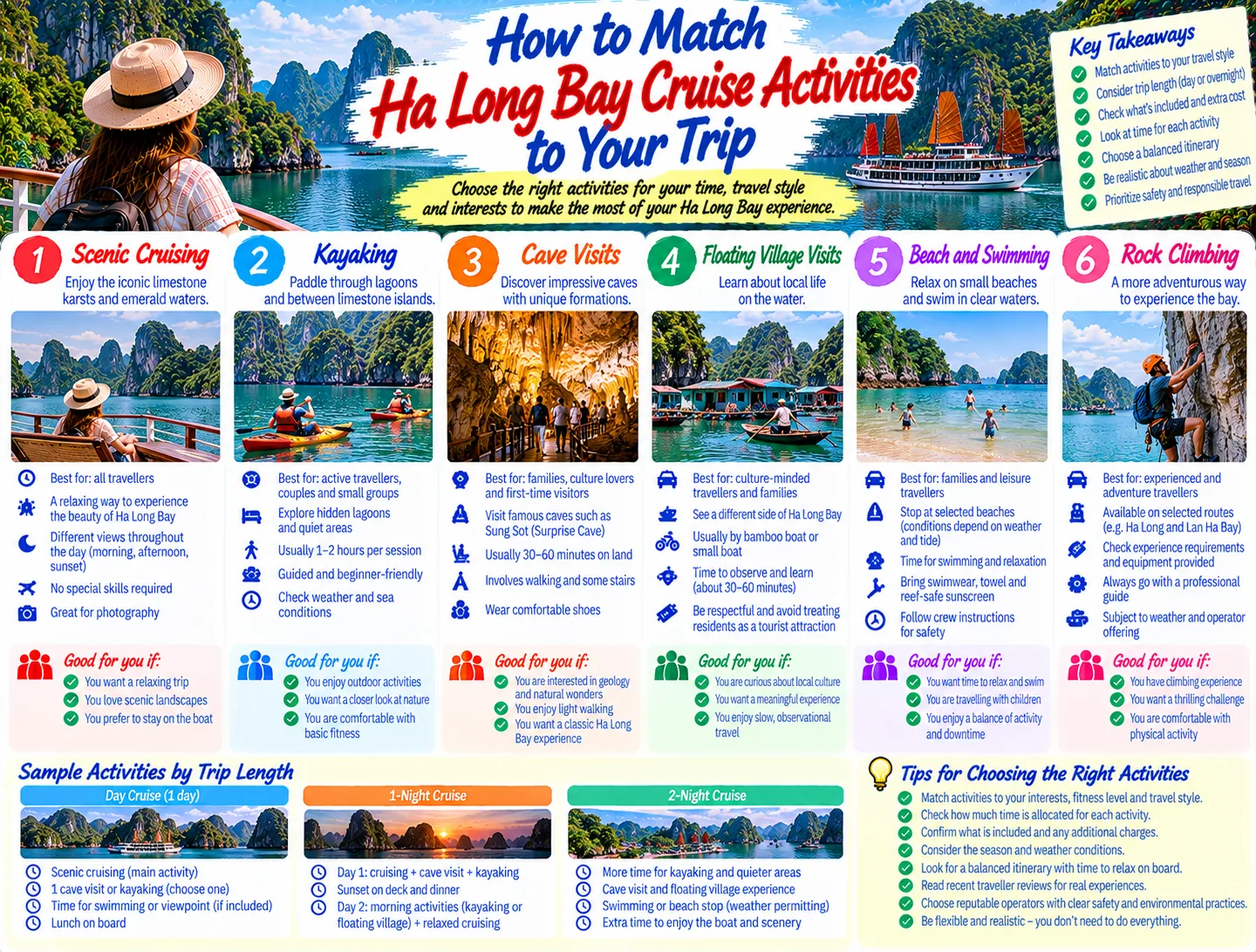
Choosing cruise excursions in Ha Long Bay is less about collecting every possible stop and more about finding the right rhythm for your trip. A two-night sailing can combine active paddling, a cave visit and a quiet sunrise, while a day cruise may require sharper choices. The best itinerary depends on who is travelling, how much time you have off the boat, and whether you want movement, scenery, culture or rest.
Vietnam Tourism describes Ha Long Bay as a seascape of emerald water, rugged islands and caves, with cruises, floating-village visits, kayaking, cave walks and rock climbing among the main ways to experience it. That range is useful, but it can also make cruise planning confusing. This guide gives you a simple framework for choosing activities without treating a cruise itinerary as a checklist.
Start with the experience you want from the bay
Before comparing excursions, decide what you want to remember. If your priority is the classic landscape, choose activities that keep you close to the water and allow time to look around. If you are curious about geology, a cave visit deserves more attention than a second scenic transfer. If you want local perspective, look for an itinerary that includes a community or floating-village encounter rather than only viewpoints.
It also helps to separate “on-board pleasures” from shore activities. A cruise may include a sun deck, meals, a cooking demonstration or a quiet period between landings, but these are not substitutes for an excursion that gets you into a lagoon or cave. Conversely, a packed list of stops can leave little time to enjoy the vessel and the changing light on the karsts.
Use the existing guide on comparing kayaking, caves and cruise stops when you want a side-by-side look at common excursion types. For a broader operator decision, the cruise operator comparison checklist can help you ask whether the advertised activities are actually included and how much time is allocated to each.
Match activities to your travel style
For scenery-first travellers
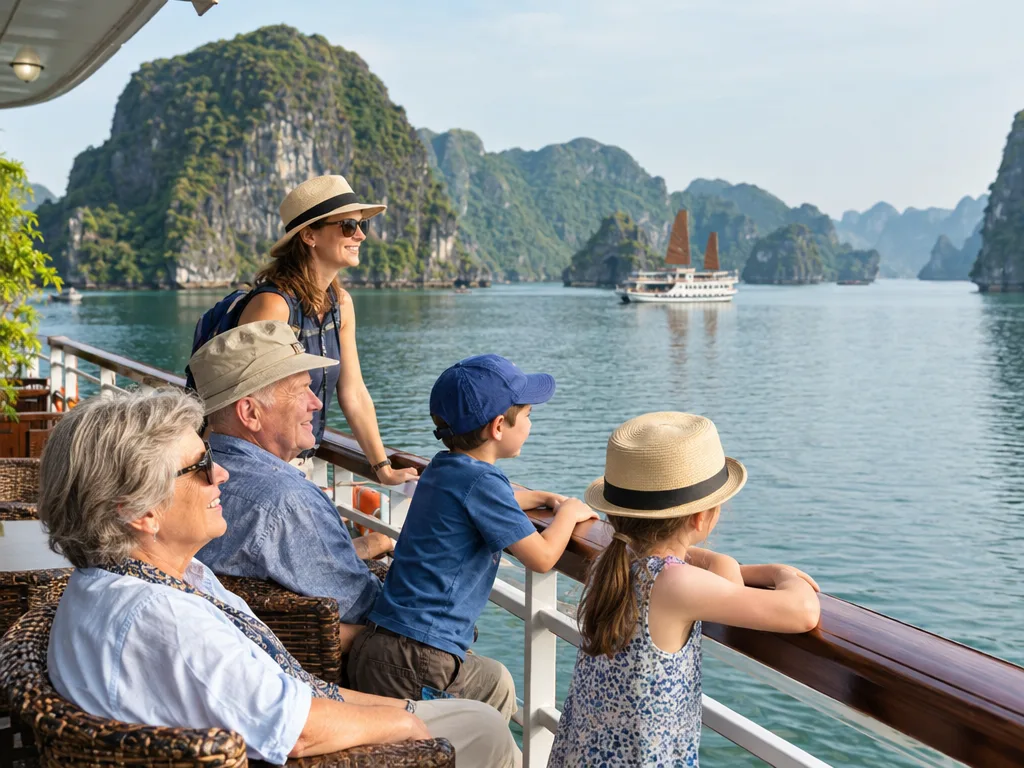
Choose a route with generous sailing time, a good observation area and one or two carefully selected landings. Cruising itself is an activity in Ha Long Bay: the islands appear from different angles, and the mood changes with sun, cloud and mist. A short cave walk or a gentle village visit can add variety without taking over the day.
Ask how long the boat remains at the scenic area, not only which landmark appears in the brochure. A named stop may involve a transfer, a queue or a brief photo opportunity. A quieter stretch of water can be more satisfying if you value atmosphere over collecting names.
For active travellers
Prioritise kayaking or another small-boat activity, then check the practical details. Find out whether paddling is guided, how long it lasts, whether the route enters a lagoon or passes between karsts, and what happens if weather changes. A strong active itinerary gives you one meaningful water-based session rather than several rushed activity boxes.
Rock climbing and deep-water soloing are specialist options mentioned by Vietnam Tourism for Ha Long and Lan Ha Bay. Treat them as operator-specific activities, not automatic features of every cruise. Ask about experience requirements, equipment, supervision and the exact location before booking. If you are new to climbing, a standard kayak outing may offer the adventure you want with a simpler preparation burden.
For culture- and community-minded travellers
Look for an itinerary that explains the place rather than merely passing it. A floating-village visit can provide a different view of life on the water, but the quality depends on how the operator conducts the stop. Ask whether the visit is a guided observation, a short boat loop or a structured interaction, and whether the schedule leaves room to listen rather than hurry through.
Keep expectations realistic. A cruise excursion is an introduction, not a complete account of local history or livelihoods. Choose an operator that describes the community respectfully and avoids presenting residents as scenery. This is one reason to read the itinerary wording carefully instead of relying on a list of activity names.
Choose activities by time available
If you have a one-day cruise
Pick one anchor activity and one supporting experience. For many travellers, the anchor will be kayaking or a cave, while the supporting experience is scenic sailing or a short viewpoint stop. Trying to fit every option into one day can turn the journey between stops into a series of deadlines.
Read the timetable in sequence. A morning cave visit followed by an afternoon kayak may be appealing, but the real question is how much time remains for sailing, lunch and transfers. Check the meeting points for tender boats or smaller craft, especially if anyone in your group moves slowly or dislikes repeated boarding.
The site’s guide to making the most of a one-day bay cruise is a useful companion for judging how much can fit into a shorter schedule. Use it alongside the Day Cruises category when comparing shorter itineraries and deciding whether an activity deserves the limited time ashore.
If you have one or two nights
An overnight cruise gives you more flexibility to balance effort and recovery. Consider placing the most active excursion when you are fresh, then leaving a slower experience for later. A cave walk, for example, can pair well with scenic sailing, while kayaking can be followed by time on deck rather than another demanding landing.
Look for the difference between “available” and “included.” Some itineraries mention a possible activity but make it dependent on the route, weather or a separate transfer. Ask for the planned sequence, the expected duration and what the fallback is if the activity cannot run. The Overnight Cruises category can help you compare the wider shape of overnight trips, not just their excursion headlines.
Plan around fitness, mobility and group needs
Excursion descriptions often use friendly phrases such as “easy walk,” but travellers can experience the same landing very differently. Ask how many steps, slopes, uneven surfaces or boat transfers are involved. A cave may be fascinating but less suitable for someone who is uncomfortable with stairs or dim, enclosed spaces. A kayak may be peaceful for one guest and tiring for another after a long day on the water.
Families should ask whether children can join each activity, whether adults must stay in the same craft, and how much waiting is involved. A short, flexible activity may work better than the most ambitious option. Build in a no-excursion period so children can rest, swim if permitted by the operator, or simply enjoy the boat.
For older travellers or anyone with limited mobility, ask about boarding arrangements before paying a deposit. The relevant question is not only whether an activity is offered, but whether the entire chain—from the main vessel to a tender, landing and return—is manageable. If you are travelling as a private group, the advice in planning a bay cruise for families or private groups can help you turn individual needs into questions for the operator.
Use weather as a planning filter
Weather should influence your expectations, not just your packing list. The official Vietnam Tourism climate guide says Ha Long Bay is cool to cold and often misty from December to March, warmer with clearer skies from April to June, hot and storm-prone from June to August, and changeable from September to November. It also notes that tropical storms can sometimes cause cruise cancellations.
That seasonal pattern affects the feel of each activity. Clear conditions can make kayaking and distant viewpoints more rewarding, while mist may create a dramatic atmosphere but reduce visibility. Wet weather can make steps and surfaces less comfortable, and a wind change may alter the day’s route. Ask how the operator communicates changes and whether a cancelled activity is replaced with another plan.
Do not treat a “best time” label as a guarantee. Confirm the latest forecast close to departure, then choose clothing and footwear that can handle both a damp landing and a warm deck. If a particular excursion is the main reason for your trip, ask what the realistic alternative will be if weather prevents it.
Compare the details behind the activity label
Two cruises can advertise “kayaking” while offering very different experiences. Use these questions when reading an itinerary:
Is the activity guided, independent or done from a larger support boat?
How long is the actual activity, excluding transfers and instructions?
Does the route enter a lagoon, pass a cave or stay in open water?
What equipment and safety briefing are provided?
What fitness, age or confidence level is expected?
What is the weather-related alternative?
Is the activity included in the quoted fare or treated as an extra?
Do the same for caves and viewpoints. Ask about stairs, lighting, walking time and crowd management rather than assuming every cave visit is alike. For a village stop, ask what you will see, how long you will stay and how the visit is organised. Specific answers are more useful than a long activity list with no timings.
Build a balanced cruise day
A satisfying day usually has contrast: movement followed by rest, close-up detail followed by wide scenery, and a scheduled stop followed by unstructured time. One practical pattern is an active morning, a relaxed meal and sailing period, then a short cultural or scenic stop. Another is to make the cave or village the centrepiece and keep the rest of the day intentionally light.
Leave room for the bay itself. The official destination guide highlights sunset sailing, quiet lagoons and sunrise views as part of the experience, not merely gaps between excursions. When comparing itineraries, count scenic time as a feature. A cruise that gives you fewer formal activities may be the better choice if it lets you stay on deck, photograph changing light and enjoy the landscape without watching the clock.
For route-specific comparisons, browse the Lan Ha Bay Cruises category and Ha Long Bay Cruises category. These pages can help you place an activity choice in the context of the wider route, rather than judging a kayak, cave or village stop in isolation.
Questions to ask before you book
Send the operator a short, precise list rather than asking only whether activities are “available.” Confirm the planned route, the time spent at each stop, the physical demands, the weather policy and the fallback plan. Ask whether the excursion is shared with other boats, whether the guide stays with the group, and whether you can opt out without disrupting everyone else.
Also check what you need to bring. Comfortable footwear, sun protection and a light layer are sensible starting points, but the operator should explain any equipment, clothing or personal restrictions that matter for the specific activity. Do not assume that a brochure’s photograph represents the exact route or conditions on your sailing date.
If the answers are vague, treat that as useful information. A cruise operator may not be able to promise a fixed route because conditions and access can change, but it should still explain how decisions are made. Clear communication is part of the excursion quality.
Conclusion: choose the right mix, not the longest list
The best Ha Long Bay cruise activities are the ones that fit your group, schedule and preferred pace. Start with the experience you want, select one or two anchor excursions, check the physical and weather details, and protect time for sailing without a formal agenda. Kayaking, caves, villages, viewpoints and quiet deck time can all belong in the same trip, but they do not all need equal space.
A thoughtful itinerary will feel varied rather than hurried. Compare the details behind each activity label, ask what happens when conditions change, and choose a route that makes room for both discovery and rest. That is how a cruise becomes more than a sequence of stops: it becomes a well-shaped experience of the bay.
JOIN THE CONVERSATION
Comments (0)
No comments yet. Be the first to share a thought.