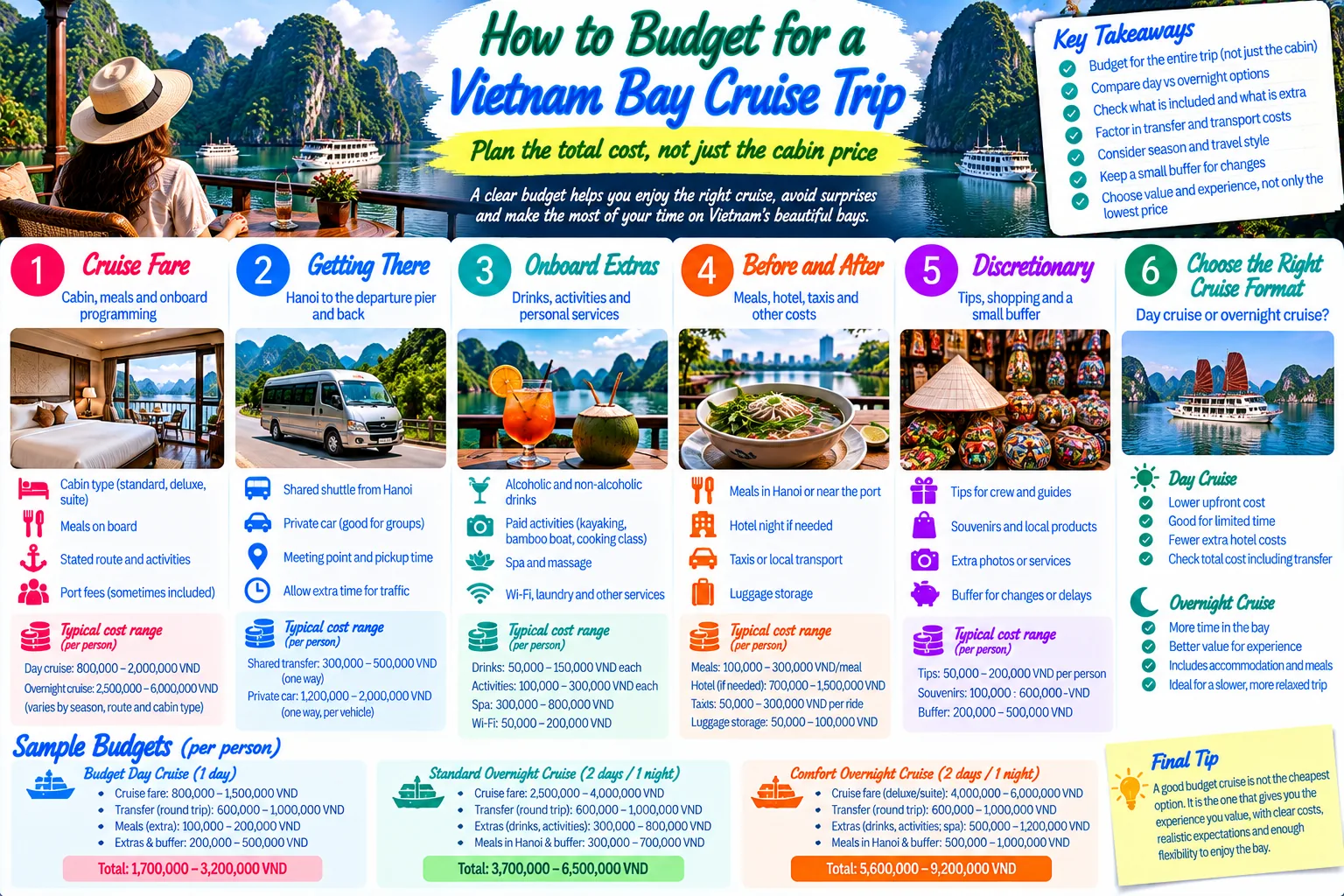
A Vietnam bay cruise can look affordable until the price of the cabin is joined by transfers, meals before boarding, port fees, drinks, tips, and the cost of getting back to Hanoi. A better budget cruise plan prices the whole experience from your hotel door to the final pier, then protects the activities that matter most. This guide gives you a practical way to compare options without pretending that one fixed daily budget fits every route or season.
Start with the full cost of a budget cruise
The first useful question is not “What is the cheapest cruise?” It is “What will this cruise cost me in total?” A low headline fare may cover the cabin and scheduled meals but leave transport, drinks, excursions, and optional services outside the package. Those extras are not automatically bad value; they simply need to be visible before you commit.
Make a simple trip budget with five lines:
Cruise fare: the cabin, meals, onboard programming, and any stated route or port charges.
Getting there: your Hanoi hotel-to-pier transfer, return transfer, or an overnight stay near the departure point.
Onboard extras: drinks, specialty meals, spa treatments, Wi-Fi, laundry, and paid activities.
Before-and-after costs: meals in Hanoi or near the port, luggage storage, taxis, and a buffer for delays.
Discretionary spending: tips, souvenirs, drinks ashore, and a cushion for changes.
This whole-journey approach is more reliable than comparing cabin prices alone. Vietnam Tourism describes the country as a value-oriented destination but also notes that actual costs vary by location, season, and provider. Treat any published example as an orientation point, not a promise for a particular Ha Long Bay, Lan Ha Bay, or Bai Tu Long Bay sailing.
For a second opinion on what a fare should be checked against, read Finding a Good-Value Bay Cruise Without Surprises. Use that broader checklist alongside the more specific door-to-dock calculation here.
Choose the cruise format that fits your budget
Day cruises: lower commitment, not always lower total cost
A day cruise can be attractive when you have limited time or do not want to pay for a cabin. It may also reduce the cost of an extra hotel night. However, a day itinerary can create a long transfer day, and a cheap ticket becomes less compelling if you add private transport, rushed meals, and paid upgrades.
Compare the complete day-cruise total with the complete overnight total. Include the value of what you would otherwise pay for accommodation and meals. If you choose a day sailing, the site’s Day Cruises category is a useful place to compare planning considerations without assuming that every operator includes the same services.
Overnight cruises: pay for time, not only a room
An overnight cruise costs more upfront, but it can spread transport effort across a longer experience and give you more time for the bay. The sensible budget question is whether the additional night adds activities, scenery, and rest that you would otherwise purchase separately. Check the schedule carefully: a longer label does not necessarily mean every hour is spent moving through new scenery.
For preparation details such as what to clarify before boarding, use Your First Overnight Cruise: A Simple Preparation Guide. Then browse the Overnight Cruises category when you want to compare the format itself.
Price the route and transfer before you book
For many travellers, the largest hidden budget risk is not the cruise fare but the connection between Hanoi and the embarkation point. Ask where the boat actually departs, whether the advertised transfer is shared or private, how many stops it includes, and what happens if traffic makes you late. A shared coach may be economical, while a private car can make sense for a group when the cost is divided among several people.
Vietnam Tourism lists flights, trains, buses, taxis, and cycling among the country’s transport options, but a bay cruise has a narrower practical choice: a cruise-arranged transfer, a reputable shared shuttle, a private vehicle, or a self-planned combination. Faster travel may protect your time; slower overland travel may reduce the fare or suit an itinerary that already includes Hanoi or another northern destination. Compare both money and time.
Do not use an old timetable or a remembered transfer duration as a guarantee. Ask the operator for the current meeting point, pickup window, luggage policy, and contingency plan. If you arrive independently, leave enough margin for traffic and check-in rules. A budget is only useful if it also protects the booking from an avoidable missed departure.
A practical transfer worksheet
Hotel pickup or meeting-point transport.
One-way and return prices, including any per-person or vehicle minimum.
Late arrival, early departure, or port-change policy.
Extra meal or hotel cost if your flight or train does not connect comfortably.
Emergency reserve for a taxi or replacement transfer.
Keep this worksheet separate from the fare so you can compare a “cheap” cruise with an apparently more expensive option that includes a better-connected transfer.
Separate included experiences from paid extras
Budget cruise shopping becomes clearer when you divide the itinerary into three groups: included, optional, and uncertain. Included items should be written in plain language on the quote or booking page. Optional items should have a price or a clear instruction for where the price is confirmed. Uncertain items deserve a question before payment.
Typical questions include: Is kayaking included, and is it available to every passenger? Are cave visits, cooking demonstrations, or sunset activities included in the published itinerary? Are drinks at meals included, or only water? Is a service charge already added? Are port, entrance, or shuttle fees included? The point is not to demand that every cruise include everything. The point is to compare like with like.
Use the site’s Kayaking, Caves, and Stops guide to think about activity value rather than counting stops mechanically. Two itineraries may list the same number of excursions but provide very different amounts of time, flexibility, or physical effort.
Protect one or two priority experiences
Most travellers do not need every upgrade. Decide which one or two experiences justify spending: perhaps quiet time on deck, a specific activity, a better cabin location, or a transfer that avoids a stressful connection. Cut low-value extras first, not the features that made you choose a bay cruise in the first place.
Build a realistic onboard spending plan
Cash flow matters even when the cruise is prepaid. Vietnam Tourism explains that cards are commonly accepted by hotels, tour operators, restaurants, and other larger establishments, while cash remains useful for small purchases and street vendors. On a cruise, ask what payment methods are accepted onboard and whether bills are settled in Vietnamese dong, another currency, or by card at the end.
Keep a modest amount of Vietnamese dong available for small purchases before boarding, local transport, and any shore-side spending. Vietnam Tourism also advises travellers to protect valuables, keep wallets close in crowded places, and use a hotel safe when appropriate. These are simple habits, but they belong in a budget plan because replacing cards, cash, or documents is expensive and disruptive.
Make a daily onboard allowance for drinks, tips, souvenirs, and optional services. Do not assume that a minibar, premium coffee, spa treatment, or special meal is included because standard meals are included. If the operator cannot give a clear price list, set aside a conservative buffer and decide in advance what you will decline if the total rises.
Handle tips thoughtfully
Tipping practices vary. Vietnam Tourism notes that there is no single set rule and that tipping is increasingly common in some situations, including private guides and beauty services, while it is not generally expected in casual restaurants and cafés. Ask the cruise operator how gratuities are handled: individually, through a shared pool, or as a listed service charge. That prevents both under-budgeting and paying twice.
Compare cabins by sleep quality and value
The cheapest cabin is not automatically the best budget choice if it creates a poor night’s sleep or makes you pay for an upgrade later. Compare location, window or balcony type, bathroom arrangement, bed configuration, and proximity to engines, stairways, or shared areas when the operator provides that information.
Think about your actual use of the cabin. If you plan to spend most of the sailing on deck and the room is mainly for sleeping, a basic cabin may be sensible. If you are travelling with a child, have limited mobility, or expect to spend more time inside, practical layout may be worth more than a small headline saving. A slightly higher fare can be good value when it prevents a second booking decision or a costly change.
For a structured way to check operators, use A Clear Checklist for Comparing Cruise Operators. It pairs naturally with a budget comparison because reliability, communication, and transparent inclusions affect the real price of a trip.
Use a simple comparison table before paying
Put each candidate in one row and use the same columns for every quote. Include the cruise fare, transfer, cabin type, meals, activities, drinks, taxes or fees, cancellation terms, and estimated extras. Then add a final column called “cost per useful day” or “cost per priority experience.” This discourages false precision while helping you see what you are actually buying.
Mark each figure as confirmed, estimated, or unknown. A confirmed figure appears in the operator’s current quote or policy. An estimate is your own allowance. An unknown is a question that needs an answer. Do not average unknowns into a neat total; unresolved costs are a reason to contact the operator or choose a clearer offer.
Also compare the booking conditions. A non-refundable fare may be cheaper but risky if your wider Vietnam itinerary is not fixed. A flexible fare may cost more yet protect a flight connection or a family plan. Read the change and cancellation wording, especially around weather-related route changes, and keep the policy with your booking record.
Make the final decision without chasing the lowest number
Once the totals are visible, choose the cruise that gives you the best balance of clarity, time, comfort, and the experiences you value. A genuine budget cruise is not defined by the smallest advertised fare. It is the option that fits your total trip budget without surprise charges or compromises you already know you will regret.
Before paying, confirm the departure point, pickup instructions, what is included, the payment method onboard, activity availability, gratuity policy, and the name of the person or company handling changes. Save the written answer. If the quote remains vague, move to a clearer option rather than trying to make an uncertain deal look affordable.
Price the full journey, keep a modest contingency, and spend deliberately on the moments that matter. That method lets you enjoy a Vietnam bay cruise with control over your money, even as fares and operating conditions change.


JOIN THE CONVERSATION
Comments (0)
No comments yet. Be the first to share a thought.