For travellers who want to see Vietnam’s famous limestone seascape without turning the trip into a luxury splurge, a budget cruise can be a smart choice. The challenge is that the lowest advertised fare is not always the lowest real cost. A useful comparison looks at the route, time on the water, cabin standard, transfers, meals, activities, port arrangements, and cancellation terms together. This guide explains how to choose a budget Ha Long Bay cruise that feels good value rather than merely cheap.
Start with the kind of budget cruise you actually need
“Budget cruise” can describe several very different products. A day boat may offer the lowest headline price and still be the right option if your schedule is tight. An overnight vessel costs more because it includes a cabin, more meals, and a longer experience, but it may reduce the temptation to add separate sightseeing days. A shared boat usually costs less than a private charter, while a smaller group may be worth a modest premium if you care about quiet spaces and flexible conversations with the crew.
First decide which outcome matters most:
- The lowest total spend: compare a day cruise with transport and meals included, not just the boat fare.
- The best scenery per hour: prioritise the route and time spent in the bay over decorative cabin features.
- A comfortable overnight: check cabin size, private bathroom, bedding, and whether the itinerary feels rushed.
- Simple logistics: choose a package with clear pickup, port meeting instructions, and a stated return time.
For a broad picture of what the destination offers, the site’s Ha Long Bay Cruises category is a useful starting point. It helps separate destination questions from the narrower question of how much to spend.
Compare the full price, not the promotional number
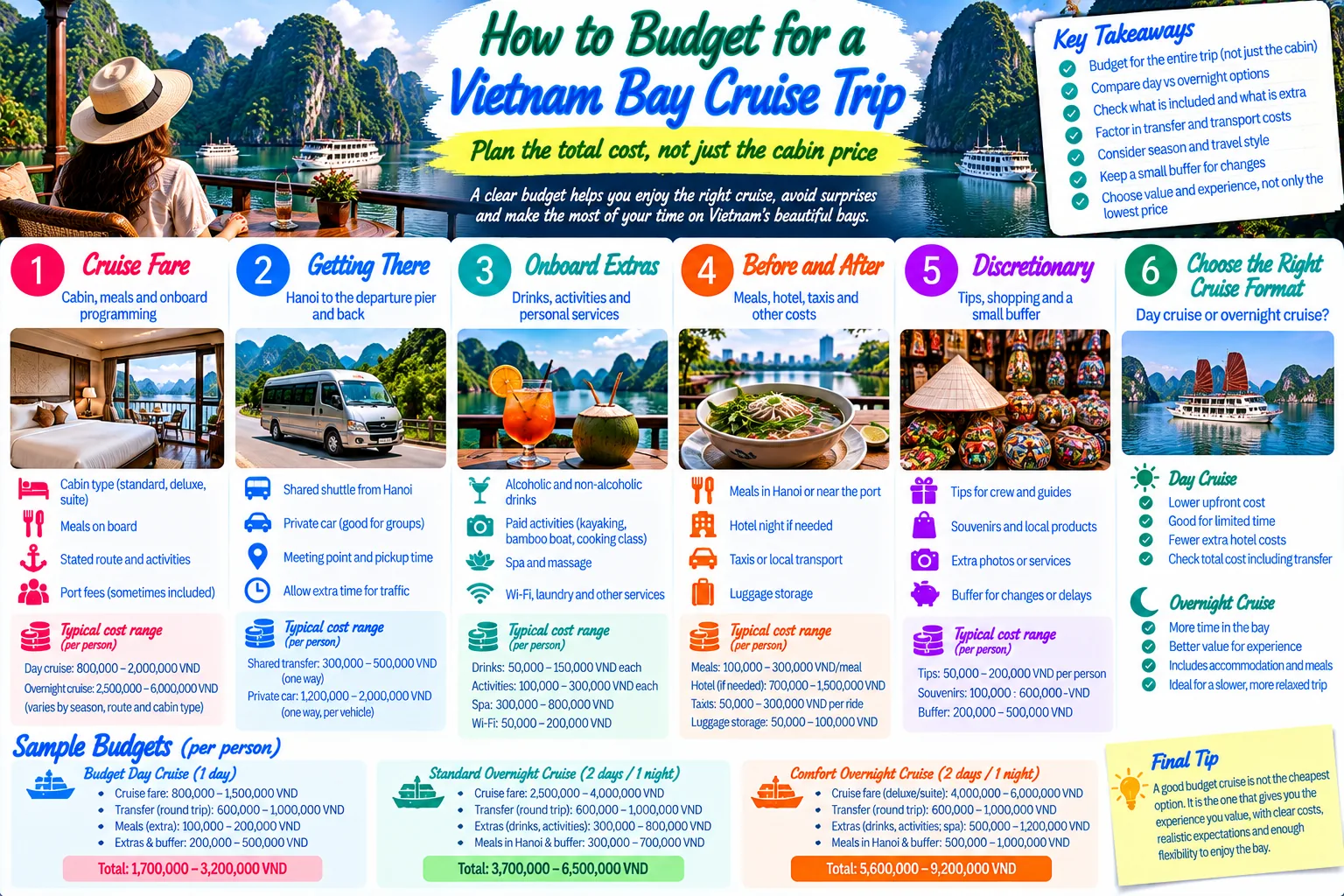
The most important budget-cruise habit is to create a simple “door-to-door” total. Add the advertised cruise fare to the items that are mandatory or highly likely: transport from Hanoi or another starting point, port or route charges if they are listed separately, meals not covered by the package, drinks, optional kayaking or transfers, and a tip budget if you choose to leave one. Do not assume that a low price is misleading; simply ask what it buys.
Look for precise wording in the inclusions and exclusions. “Meals included” may mean set menus or buffet meals, but it does not necessarily include soft drinks, alcohol, specialty coffee, or snacks. “Transfer available” may mean an optional add-on rather than a seat reserved for you. “Activities included” may refer to a scheduled stop, while equipment, entrance charges, or a particular excursion could be treated differently.
Before paying, ask the operator to confirm five details in writing:
- Which meals are included and on which days?
- Is the Hanoi transfer included, optional, or unavailable?
- Are the advertised caves, beaches, kayaking, or village visits guaranteed parts of this itinerary?
- What happens if weather or operating conditions change the route?
- What cancellation or date-change conditions apply to the fare?
This is where the site’s article, Finding a Good-Value Bay Cruise Without Surprises, can help you build a comparison checklist instead of relying on a star rating or a dramatic photograph.
Route choice can matter more than the cabin
Ha Long Bay is known for emerald water, rugged islands, caves, and karst scenery. Vietnam’s official tourism website describes cruises moving among islands and islets, with cave visits and opportunities to find quieter corners. It also notes that autumn and spring often bring clearer, calmer cruising conditions, while summer can be hot and stormier. These broad seasonal patterns are useful for planning, but they are not a promise that any particular sailing will have perfect weather.
A budget itinerary should be judged by how it uses its route. A shorter trip may still be worthwhile when it spends meaningful time among the karsts rather than turning into a long transfer with a brief photo stop. Ask where the boat actually sails, how long the main sightseeing stops last, and whether the schedule allows time on deck. If two cruises cost about the same, the one with a clearer route and less hurried shore programme may deliver more value than the one with a newer-looking lobby.
There is no universally best bay route for every traveller. Some people want a classic Ha Long Bay introduction; others prefer a quieter setting or a different combination of caves, lagoons, and island views. If you are comparing areas, browse the site’s Lan Ha Bay Cruises category and Bai Tu Long Bay Cruises category for route-specific questions. The practical principle is simple: choose the landscape and pace you want, then compare prices among similar itineraries.
Decide whether a day cruise or overnight cruise is better value
When a day cruise makes sense
A day cruise can suit first-time visitors, short Vietnam itineraries, and travellers who prefer to keep accommodation on land. You avoid paying for a cabin and can focus your budget on scenery and a few well-chosen activities. The trade-off is that travel to and from the port can consume a substantial part of the day, especially when a shared transfer makes multiple pickups.
Check the real time on the water. A package described as a full-day experience may include road transfers, check-in, lunch, and return logistics. That does not make it poor value, but it makes the start and finish times important. Vietnam’s official tourism destination page describes Ha Long as reachable by expressway from Hanoi and mentions cruise transfers from Tuan Chau and Bai Chay ports. Use the confirmed pickup point and operator schedule rather than assuming every cruise uses the same port.
When overnight earns its extra cost
An overnight cruise can be better value when you want sunrise and sunset views, a slower rhythm, and more than one excursion period. The official tourism site highlights the appeal of waking among the karsts, and its cruise feature describes a typical overnight pattern that combines deck time, meals, cave or village activities, and optional exercise. Treat that as an example of what an overnight experience can include, not as a guarantee for every boat.
For a first overnight trip, compare the actual cabin and schedule rather than assuming every boat offers the same experience. The site’s first overnight cruise preparation guide is useful for checking what to pack and what questions to ask before booking.
Check the boat features that affect comfort
Budget does not have to mean uncomfortable, but it does mean choosing priorities. A clean private bathroom, reliable air conditioning, safe access to the deck, and a sensible sleeping arrangement usually matter more than a large reception area. Read recent reviews for repeated comments about maintenance, noise, cleanliness, food consistency, and staff communication. One isolated complaint is less useful than a pattern across several dates.
Ask whether the cabin is on the lower deck, whether windows are fixed or opening, and whether the room is near the engine, kitchen, or stairwell. These are not necessarily deal-breakers; they are details that help you decide whether a saving is worth it. If you are travelling with children, older relatives, or anyone with limited mobility, confirm stairs, tender-boat transfers, boarding arrangements, and the amount of walking at excursions before selecting the cheapest cabin.
Shared facilities also deserve attention. A small sundeck may be perfectly adequate if the itinerary spends most of its time in scenic waters, while a larger common area can be valuable during poor weather. Consider whether you want a social boat or a quieter one, and whether the advertised group size matches your expectations.
Make activities work for your budget
Kayaking, cave walks, swimming stops, floating-village visits, cooking demonstrations, and sunrise activities can make a cruise memorable, but more activities do not automatically mean better value. The official Vietnam Tourism guide lists cruising, floating-village visits, kayaking, caves, and even climbing among Ha Long experiences. The best choice depends on your energy, interests, and the time available at each stop.
Choose one or two experiences that you genuinely want rather than selecting every optional extra. A traveller who loves paddling may value a route with a longer kayaking window; someone who prefers photography may benefit more from a scenic deck and a relaxed schedule. Ask whether an activity is included, optional, weather-dependent, or replaced when conditions change. Also ask whether a cave or island stop involves uneven ground, steps, wet surfaces, or a transfer into a smaller tender.
Do not confuse an attractive list of stops with a generous itinerary. A schedule that names six activities may allow only a few minutes at each. A shorter list with realistic time can feel much more satisfying and reduce the risk of paying for excursions you barely experience.
Use reviews as evidence, not as a substitute for questions
Reviews are particularly useful for budget cruises because they reveal whether the advertised value survives contact with the real trip. Sort comments into categories: booking communication, transfer punctuality, cabin condition, food, staff, route, activity timing, and surprise charges. Look for specific observations rather than vague praise or anger. A review that explains what was included and what changed is more useful than a score without context.
Pay attention to dates and patterns. A boat can change its management, vessel, menu, or transfer partner. Recent comments are generally more relevant for current operations, but older detailed reviews may still explain the layout or typical route. If the operator’s reply addresses a repeated problem with a concrete change, that is a better signal than a generic apology.
Use the site’s checklist for comparing cruise operators alongside reviews. Together, they encourage you to compare like with like: the same number of hours, the same route family, similar inclusions, and similar cabin standards.
Build a booking decision you can explain
Before booking, write down your top three priorities and the maximum total budget per person. Then eliminate cruises that fail a non-negotiable requirement, such as a private bathroom, a confirmed pickup, a specific route, or enough time on the water. Among the remaining options, choose the package that gives the clearest answer to ordinary questions. Clear information is itself part of value because it reduces the chance of last-minute spending and disappointment.
A practical comparison table can include:
- boat and route name;
- day or overnight duration;
- door-to-door transfer details;
- cabin type and deck position;
- meals and drinks included;
- activities and possible substitutes;
- weather or cancellation policy;
- estimated total cost.
Once you have this table, the cheapest cruise may not win—and that is fine. A budget cruise succeeds when it gives you the scenery, comfort, and activities you value at a cost you understand. A slightly higher fare with transparent inclusions can be better value than a bargain that requires constant add-ons.
Final thoughts on choosing a budget Ha Long Bay cruise
The best budget Ha Long Bay cruise is not simply the one with the smallest number on a booking page. It is the one whose route, timing, inclusions, boat standard, and policies match your priorities without hidden uncertainty. Compare the full trip, ask specific questions, and treat the bay experience—not the marketing language—as the product you are buying. With that approach, travellers can keep costs controlled while still enjoying caves, karst views, open water, and the distinctive rhythm of a Vietnamese cruise.


JOIN THE CONVERSATION
Comments (0)
No comments yet. Be the first to share a thought.