A budget Ha Long Bay cruise should make the bay easier to experience, not turn every basic service into an extra charge. The cheapest headline fare is rarely the whole decision. You need to compare the route, sailing time, cabin standard, transfers, meals, activities, and cancellation terms together. This guide explains how to find an affordable Vietnam cruise while protecting the parts of the trip that matter most: a reliable operator, a sensible itinerary, and a clear final price.
Start with the kind of budget cruise you actually need
“Budget cruise” can describe several different products. A day boat may be the lowest-cost way to see limestone scenery, while a one-night vessel can offer a slower experience with a cabin and more time on the water. A basic boat with an efficient itinerary may be better value than a heavily discounted sailing that spends much of the day on transfers or optional activities.
Day cruise, overnight cruise, or two nights?
Choose a day cruise if your priority is scenery and you are comfortable with a long travel day from Hanoi or another base. It can work well for travelers with limited time, but the schedule is more sensitive to road delays and weather. An overnight cruise costs more because it includes accommodation, but it spreads the experience across two days and gives you a chance to enjoy sunrise or a quieter evening on the bay.
A two-night itinerary is not automatically better for a careful budget. It may provide a less rushed route, yet the extra night increases the total cost of food, transfers, and time. Compare what the second day adds before paying for it. The separate Day Cruises and Overnight Cruises categories can help you compare the practical differences.
Shared boat or private arrangement?
Most affordable cruises use shared cabins, shared dining, and a fixed group itinerary. That is usually the sensible choice for solo travelers and couples who want to control costs. A private boat can become better value for a larger group, but only after you divide the complete quote by the number of travelers and confirm what is included. Do not compare a private charter quote with a per-person shared-cruise fare without normalizing the numbers.
Compare the final price, not the advertised fare
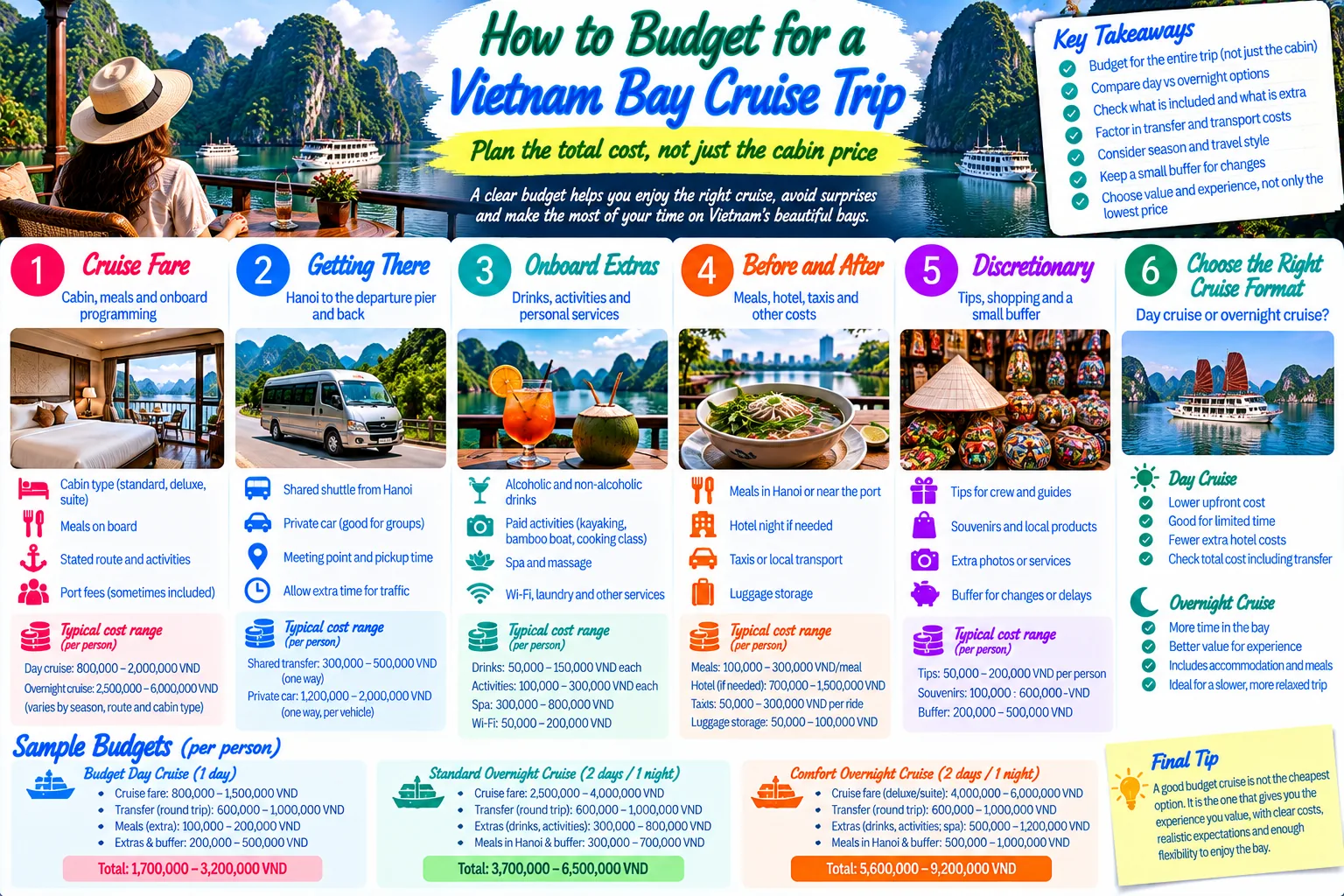
When you compare a cheap Ha Long Bay cruise, make a simple cost sheet. Put the advertised fare in one column and every required addition in another. Ask whether the quote includes transport, meals, drinking water, entrance or sightseeing charges, kayaking or a similar activity, port fees, and taxes. The purpose is not to demand that every cruise include everything. It is to compare like with like.
- Cabin price and the number of guests allowed.
- Round-trip transfer from your accommodation or a meeting point.
- Meals, fixed menus, vegetarian options, and beverages.
- Activities listed in the itinerary and any separate participation charge.
- Port, sightseeing, service, or administration fees.
- Single-supplement, child, extra-bed, and holiday conditions.
- Cancellation, rescheduling, and weather-related refund terms.
Be careful with vague phrases such as “full board,” “all activities,” or “free transfer.” A full-board description may cover meals but not drinks. “Free transfer” may apply only to a particular pickup zone or a shared shuttle at a fixed time. Ask for the inclusions in writing before paying.
For a broader comparison framework, read Finding a Good-Value Bay Cruise Without Surprises. It is especially useful when two operators appear to offer the same price but describe their packages differently.
Choose the route before choosing the boat
Ha Long Bay is not one single sightseeing stop. Cruise routes vary in how much time they spend near busy ports, floating communities, caves, beaches, viewpoints, and quieter stretches of water. A budget cruise is easier to judge when you know what kind of route you want.
Ha Long Bay, Lan Ha Bay, or Bai Tu Long Bay?
A classic Ha Long Bay itinerary may suit first-time visitors who want a recognizable introduction to the karst landscape and a compact schedule. Lan Ha Bay can appeal to travelers who want a route associated with the Cat Ba area and a mix of water-based activities. Bai Tu Long Bay is often considered by travelers looking for a quieter atmosphere, although the exact experience depends on the vessel, season, and daily operating plan.
Do not assume that a route label guarantees a particular number of stops. Operators can alter an itinerary for weather, marine conditions, port instructions, or operational reasons. The useful question is not “Does this cruise visit every famous place?” but “How much time will I spend moving, waiting, and actually seeing the landscape?”
Explore the site’s Ha Long Bay Cruises, Lan Ha Bay Cruises, and Bai Tu Long Bay Cruises categories when the route matters more than a particular brand.
Look for a realistic timetable
A low-cost itinerary can still be good if its timing is honest. Check the stated pickup window, port arrival, boarding time, return time, and transfer duration. A program that lists many activities in a short period may be describing possibilities rather than guaranteed time at each stop. If you want kayaking, swimming, or a cave visit, confirm whether the activity is a central part of the schedule or an optional add-on that may be shortened.
Judge the cabin and vessel with practical questions
Budget does not have to mean uncomfortable, but it usually means fewer extras. Focus on the features that affect sleep and safety rather than decorative language. Ask for the actual cabin category, not just a vessel-wide description. A boat may have different cabin locations, window arrangements, bed configurations, and bathroom sizes.
- Is the cabin private, and can the beds be configured for your group?
- Does the room have a private bathroom and reliable hot water?
- Is the room near an engine, kitchen, staircase, or public deck?
- What is the policy if the requested cabin category is unavailable?
- Are life jackets and basic safety instructions provided onboard?
- Are photos representative of the current boat or of a larger fleet?
Read recent descriptions carefully, but do not treat a star label as a substitute for details. One traveler may value a large sun deck; another may care more about quiet cabins or accessible steps. Match the vessel to your priorities instead of paying for features you will not use.
Protect your budget with the right timing
Demand, weather, public holidays, and school breaks can affect availability and pricing. A flexible traveler may find more choice outside peak periods, but flexibility should not mean booking a non-refundable fare without understanding the conditions. Ask whether the operator can move your departure if poor weather affects sailing and what happens to transport booked through an agent.
Weather can also change the value of an itinerary. A cruise may operate with fewer activities or a modified route when conditions are unsuitable. That is not necessarily a service failure, but the policy should be clear. Avoid claims that a particular month guarantees perfect conditions. Instead, compare the operator’s weather policy with your own tolerance for a changed program.
Book earlier when you need a specific cabin, family configuration, or pickup location. Book with caution when a deal depends on an immediate payment but provides no clear cancellation or contact information. The cheapest option is not a bargain if a change leaves you paying twice for transport or accommodation.
Evaluate transfers and port logistics
For many travelers, the transfer is where a budget cruise quietly becomes expensive. Confirm whether Hanoi pickup is included, whether the service is shared or private, and whether the vehicle collects from your exact hotel area. Ask how much luggage is allowed and where you will meet the driver if the hotel is outside the normal zone.
Also confirm the port or boarding point. A cruise name may be marketed from Hanoi while the actual boarding process happens elsewhere. You need the check-in time, the latest arrival time, and a contact method for delays. If you arrange your own transport, leave a margin rather than planning to arrive just before departure.
A good budget package makes the handoff between road and boat understandable. It tells you who is responsible for the transfer, which costs are included, and what to do if the driver cannot find you. These details are less glamorous than a rooftop pool, but they have a greater effect on the trip.
Check meals, activities, and accessibility
Meals are often included on overnight cruises, yet menus and dining arrangements vary. Tell the operator about vegetarian, vegan, allergy, religious, or medical requirements before departure. Do not assume a special menu will be available because a booking platform uses a general dietary icon.
Activities also deserve a close look. Kayaking, bamboo-boat rides, cave visits, swimming, cooking demonstrations, and sunrise sessions may be included, optional, weather-dependent, or subject to a separate transfer. Read the itinerary line by line and mark each activity as included, optional, or uncertain. If an activity is the main reason you are booking, ask what happens if it is cancelled.
Travelers with limited mobility should ask about tender boats, wet landings, steep steps, narrow corridors, and the distance between the cabin, dining room, and deck. A low fare does not compensate for an itinerary that cannot be used comfortably. Families should check minimum ages, life-jacket sizing, cabin capacity, and whether children can join every planned activity.
For activity-by-activity comparison, see Kayaking, Caves, and Stops: Comparing Cruise Excursions. It helps separate a genuinely useful itinerary from a long list of loosely described stops.
Use reviews without letting them choose for you
Reviews are most useful when they reveal patterns. Look for repeated comments about communication, cabin cleanliness, transfer punctuality, food quality, noise, and how the operator handled itinerary changes. One complaint about weather should not outweigh many consistent reports, but repeated confusion about extra charges deserves attention.
Compare reviews from the same period and vessel where possible. A company may operate several boats under one brand, and standards can differ by boat or cabin category. Look for the date, route, and package before applying a review to your own booking.
You can also use the site’s A Clear Checklist for Comparing Cruise Operators to check communication, documentation, and the quality of the booking explanation before you commit.
A simple decision rule for booking
Shortlist three cruises and score each from one to five for final price clarity, route fit, cabin suitability, transfer reliability, activity value, and cancellation flexibility. Give extra weight to the two factors that matter most to you. A traveler with one free day may prioritize timing; a couple celebrating a special occasion may prioritize cabin position and quiet; a family may prioritize transfer simplicity and food flexibility.
Then ask one final question: if the cheapest option loses one advertised activity because of weather or operations, would the remaining experience still feel worthwhile? If the answer is no, move up to the next package or choose a different route. A good affordable Vietnam cruise is not the one with the lowest number on a search page. It is the one whose total cost, route, and practical conditions match what you will actually use.
Final checklist before you pay
- Confirm the exact cruise name, vessel, route, cabin, and travel dates.
- Request a written list of inclusions and exclusions.
- Check pickup location, port, boarding time, and luggage instructions.
- Ask how weather or operational changes affect the itinerary and refund policy.
- Record dietary, mobility, family, and cabin requirements before confirmation.
- Save the booking contact and payment record in one place.
With those checks complete, a budget Ha Long Bay cruise can offer the essential experience without unnecessary extras. Spend on the route and reliability first, then add comforts only when they genuinely improve your time on the water.


JOIN THE CONVERSATION
Comments (0)
No comments yet. Be the first to share a thought.