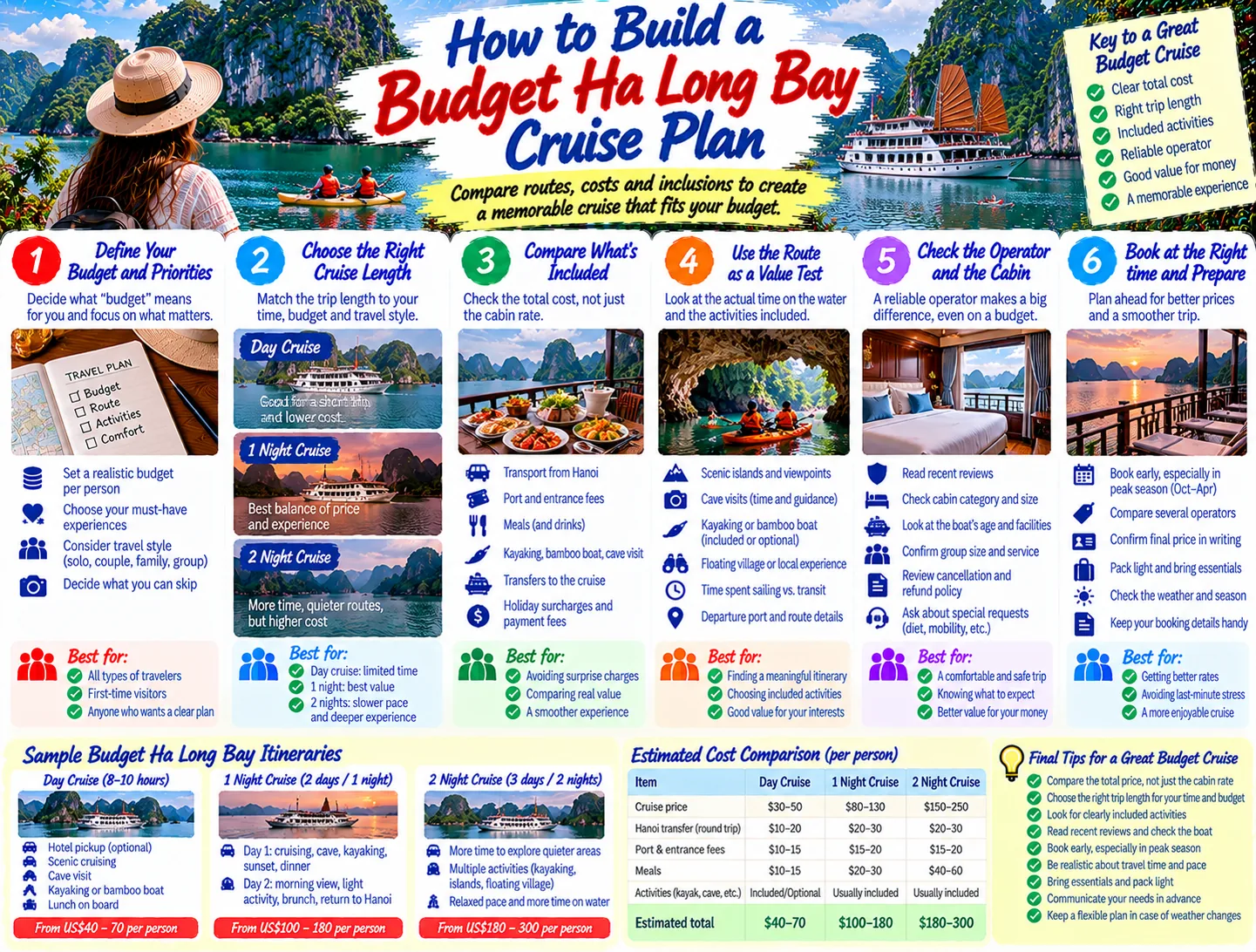
A budget Ha Long Bay cruise can be memorable without becoming a string of surprise charges. The trick is to compare the whole trip rather than the headline cabin rate: route, transport, meals, activities, port fees, and the time you actually spend on the water all shape value. This guide offers a practical way to build a budget Ha Long Bay cruise plan, choose the right length, and ask the questions that reveal the real cost before you pay.
Start with the kind of budget trip you want
“Budget” does not mean the same thing to every traveller. One person wants the lowest possible overnight price; another wants a comfortable cabin, a reliable transfer from Hanoi, and enough included activities to avoid paying extra onboard. Decide which version you want before comparing operators.
For some travellers, a day trip is the sensible low-cost choice because it avoids a cabin night and keeps the itinerary compact. For others, a one-night cruise is better value because it gives more time for the bay experience and reduces the pressure of a long day on the road. A two-night sailing may suit someone who values a slower pace, but it is not automatically the cheapest way to see more.
Write down your priorities in one sentence: for example, “I want one night, shared transport, meals included, and at least one water-based activity.” That sentence becomes a filter for every quote. It also prevents an attractive discount from pulling you toward a cruise that excludes the things you actually care about.
Compare the total price, not just the cabin rate
The most useful budget cruise comparison is a simple total-cost worksheet. Start with the advertised cruise price, then check whether it includes the following:
Transport between Hanoi and the embarkation port
Port, entrance, or sightseeing charges
Meals listed in the itinerary
Drinking water, beverages, and special-diet requests
Kayaking, bamboo-boat trips, cave visits, or other excursions
Transfers between the port and the vessel
Single supplements, holiday surcharges, and payment fees
Not every operator uses the same definition of “included.” A low cabin rate can become less attractive once you add a return transfer, an excursion fee, or drinks that another operator bundles into the package. For a broader method of checking operators, use this checklist for comparing cruise operators, then apply it specifically to the costs that matter on your shortlist.
Ask for the final payable amount in writing. You do not need a complicated spreadsheet: three columns labelled “included,” “optional,” and “unclear” are enough. Any item that remains unclear is a reason to ask another question before booking, not a reason to assume it will be free.
Choose the right cruise length for your money
When a day cruise makes sense
A day cruise can work well if your main goal is to experience the karst scenery, spend time on the water, and return to land the same evening. It may also suit travellers with limited time or those who prefer to keep accommodation on land. The trade-off is that the day includes road travel and a fixed schedule, so the lowest price is not necessarily the best value if most of the day is spent in transit.
Compare the actual cruise hours, not only the departure time. Check where the boat boards, how long the transfer takes, and whether the itinerary allows time for a meal, a cave, a viewpoint, or kayaking without rushing. The site’s day cruises guide is a useful next step if a one-day itinerary fits your trip.
When one night is the budget sweet spot
A one-night cruise often offers a practical balance: you get an evening and morning on the bay without paying for a second cabin night. It can also make the experience feel less like a shore excursion and more like a cruise. Check the schedule carefully, because the first and last days may include embarkation, disembarkation, and transfers rather than a full day of sailing.
One-night cruises are easiest to compare when every operator describes the same elements: cabin category, meals, transfer arrangement, activities, and port. If you are new to overnight sailing, read this first overnight cruise preparation guide for practical questions about what to expect before you focus on price.
When two nights could be worth it
A two-night itinerary may be worthwhile when you want a quieter pace, more time for excursions, or a route that spends longer away from the busiest embarkation pattern. It is not the default budget option, though. Calculate the extra cabin night, meals, transport, and any added activity charges. Choose it because the additional time serves a clear purpose, not because a longer itinerary sounds automatically more complete.
Use the route as a value test
Ha Long Bay is known for emerald water, islands, islets, caves, and floating-community experiences. The official Vietnam Tourism destination page also describes kayaking, cave visits, floating villages, and sunset or morning deck time as ways travellers experience the bay. Those options help you judge an itinerary, but they do not all need to appear in one trip.
Read the daily schedule for time spent doing, not just names of places. “Visit a cave” is more useful when the itinerary explains whether the visit is guided and how long guests have ashore. “Kayaking” is more useful when you know whether it is included, optional, or replaced by another boat. A budget itinerary with two clearly included activities may be better value than a longer list of vague stops.
Also check whether the cruise operates mainly in Ha Long Bay or uses a nearby route. Different routes can offer different scenery, transfer patterns, and activity styles. If you are comparing the destination itself, see the Ha Long Bay cruises category alongside the operator’s day-by-day plan. The point is not to choose the route with the most nouns; it is to choose the route that matches your interests and gives you enough time to enjoy each included stop.
Keep Hanoi transfers from breaking the budget
Transport can be one of the largest differences between two apparently similar cruise quotes. Vietnam Tourism describes Ha Long as reachable from Hanoi by expressway, with cruise transfers operating from Tuan Chau and Bai Chay ports, and gives an approximate road journey of two and a half hours. Treat that as planning context rather than a promise for your pickup: traffic, hotel location, and the operator’s transfer plan can change the day.
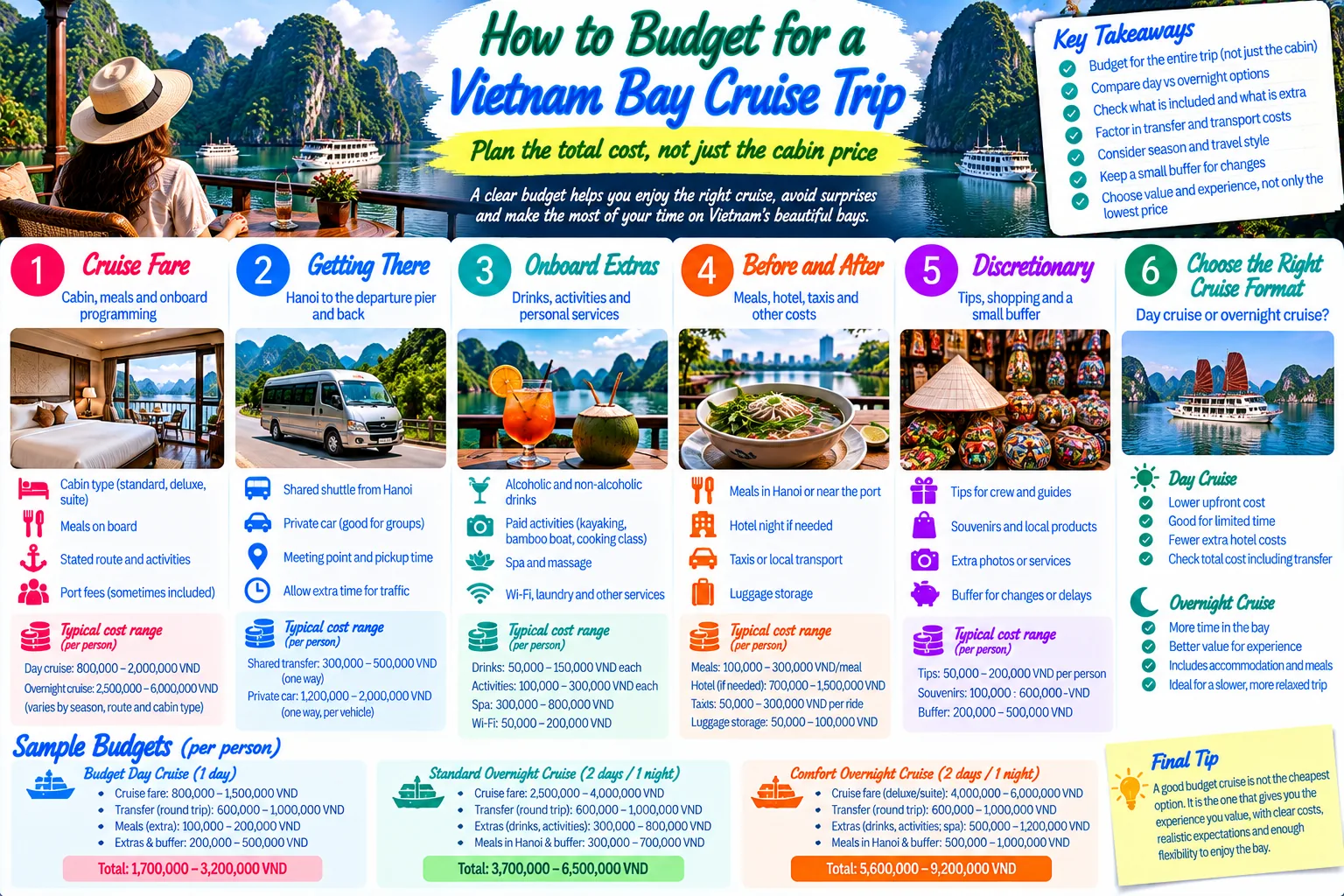
When comparing transport, ask whether the quote covers hotel pickup, the port transfer, and the return journey. Confirm the pickup area, luggage rules, meeting time, and what happens if you are staying outside the standard route. A shared minibus may be the economical choice, while a private car can make sense for a group if the cost is divided among several passengers.
Do not book a tight independent connection after disembarkation unless the operator confirms the timing and transfer procedure. The cheaper-looking plan can become expensive if a delayed arrival forces you to buy new transport or lose a prepaid reservation. Budget planning includes a small time buffer, not only a low number on the invoice.
Protect the budget with payment and booking questions
Vietnam Tourism identifies the Vietnamese dong as the local currency and notes that major hotels, tour operators, restaurants, and other larger establishments generally accept international cards, while cash remains useful for small purchases and street vendors. For a cruise booking, ask which currency the final charge uses, whether your card provider may add a conversion fee, and whether onboard extras are settled by card or cash.
Before paying a deposit, ask these questions:
What is the cancellation and weather-change policy?
Is the quoted price per person, per cabin, or for the whole group?
Are drinks, tips, transfers, and excursions excluded?
Will the operator confirm the vessel name and cabin category?
What identification or passenger details are needed before departure?
Is the price different on weekends, public holidays, or special dates?
Keep the confirmation, inclusions, payment receipt, pickup message, and emergency contact together. If the wording changes between a sales message and the final confirmation, resolve the difference before travelling. A clear written record is one of the simplest ways to prevent a small budget trip from turning into an expensive argument.
Use season and reviews to judge the deal
The official destination guidance lists September to November as a strong period for clear, calm cruising and notes that spring can also bring favourable conditions, while summer is hot with a chance of storms. That does not mean you should treat one season as a guaranteed bargain or perfect-weather promise. Instead, use the seasonal context to decide how much flexibility you need. If your dates are fixed, prioritise a transparent weather-change policy over a small discount.
Reviews are most useful when you read them for patterns rather than one dramatic comment. Look for repeated observations about whether inclusions matched the sales description, whether transfers were organised, whether the cabin category was honoured, and whether activities were delivered as described. Separate comments about a particular date or weather event from recurring service issues. A low price paired with consistent complaints about unclear extras is rarely a genuine saving.
Use recent reviews to create questions, not to outsource your decision. Ask the operator to confirm anything that matters to you in the current written offer, since vessels, schedules, and policies can change. This small step keeps your research grounded in the trip you are actually booking.
Spend selectively once you are onboard
Set an onboard allowance before departure. Decide which extras would genuinely improve the trip and which are easy to skip. You may value a particular excursion, a drink package, or a private transfer; you may not value every optional activity offered during a short itinerary. Choosing in advance keeps convenience from becoming impulse spending.
Pack for the activities you have already selected. Comfortable footwear, a light layer, sun protection, and a small waterproof bag can be more useful than buying replacements onboard or at the port. Keep valuables compact and carry only what you need for shore visits. Ask the operator what equipment is supplied before packing bulky items.
Finally, judge the experience by the whole balance: time on the bay, comfort, clarity of inclusions, and reliability of the plan. A budget cruise is successful when the price is understandable and the itinerary delivers what you were promised.
Conclusion: make “cheap” mean clear value
The best budget Ha Long Bay cruise is not always the lowest advertised rate. It is the option whose final cost, route, transfer plan, cabin, meals, and activities are clear before payment. Compare like with like, choose a cruise length that fits your available time, and ask about every item that could become an extra. With that approach, you can spend less on surprises and more on the parts of the bay experience you actually came to enjoy.


JOIN THE CONVERSATION
Comments (0)
No comments yet. Be the first to share a thought.