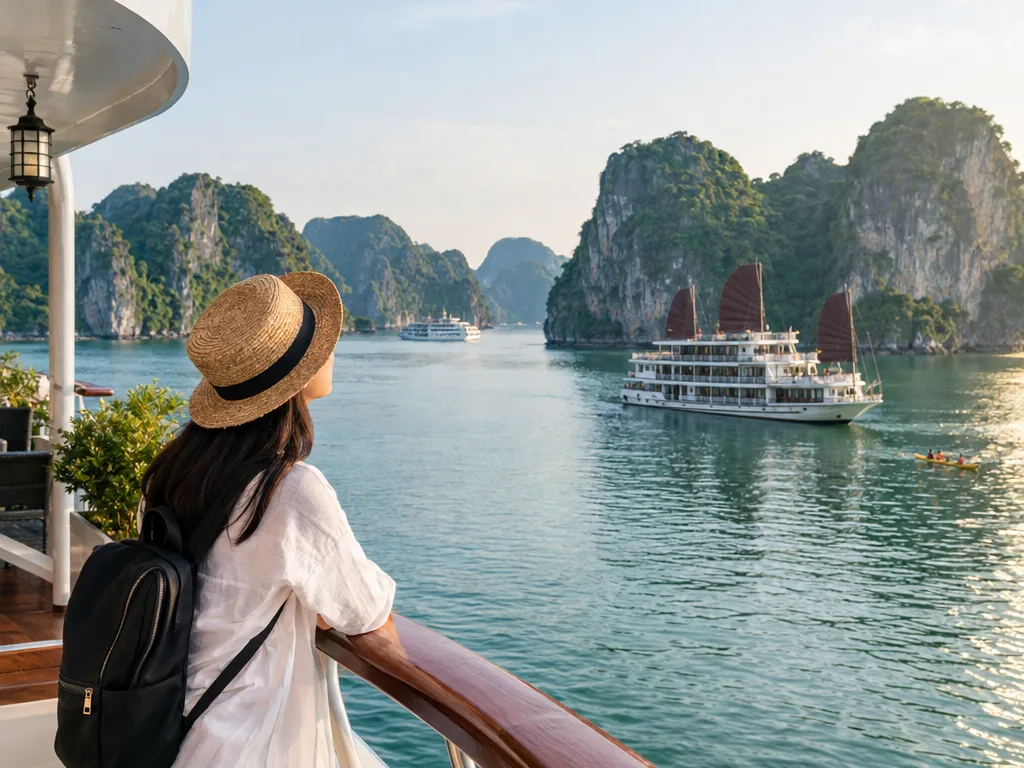
A cheap Ha Long Bay cruise can still feel generous if you spend on the parts that shape the experience and avoid paying for extras you will not use. The challenge is that “budget” may describe a short day boat, a shared transfer, a compact cabin, or simply a lower headline rate with important items left out. This guide shows how to compare the real trip, choose sensible compromises, and book with fewer surprises.
Start with the trip you actually need
Before comparing operators, decide whether you want a day cruise or an overnight cruise. A day on the bay can be the better budget choice when your priority is scenery, caves, a boat meal, or a short taste of the landscape. An overnight trip may be worth the extra cost when you want a slower rhythm, sunrise or sunset on the water, and a cabin rather than a long return journey.
The official Ha Long Bay management website separates vessels into day sightseeing boats, overnight accommodation boats, and restaurant boats. That distinction is useful because a low price is not meaningful until you know which product you are comparing. A day boat is not a cheaper version of an overnight cabin; it is a different travel format with different time, space, and service expectations.
- Choose a day cruise if you want the lowest total spend and a compact introduction.
- Choose one night if sleep on the bay and a gentler pace matter more than the minimum fare.
- Choose a restaurant or private service only when the added meal, space, or privacy is genuinely useful to your group.
Compare the total cost, not the headline fare
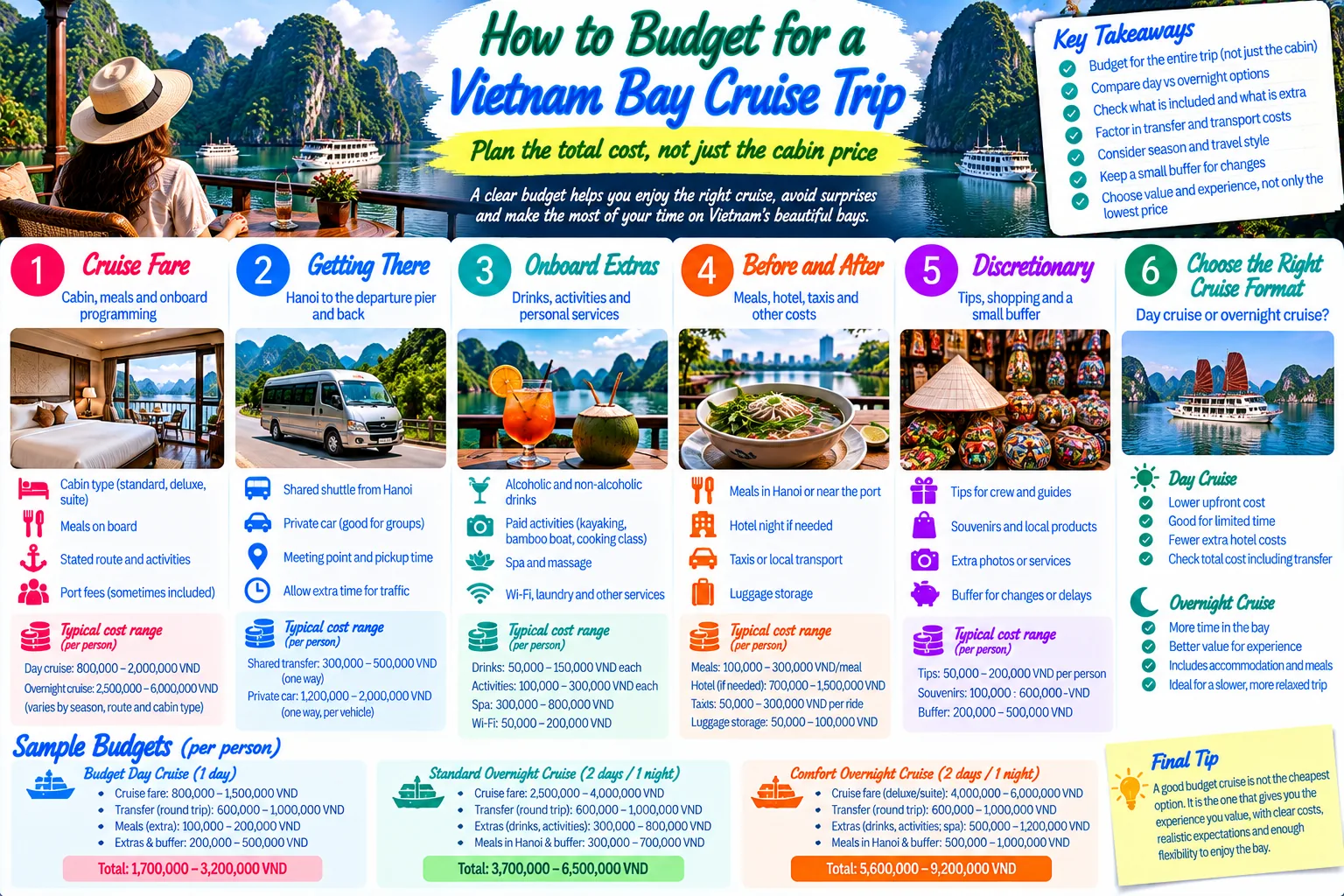
A budget cruise should be assessed as a complete day or night away from your hotel. Write down every cost that can affect the decision: transport to the port, port or sightseeing charges, meals, drinks, transfers between activities, optional equipment, and the cost of getting back if the advertised itinerary ends somewhere different from where it began. Ask whether taxes, service charges, and shared transfers are already included.
This is not about assuming that a lower price hides a problem. It is about making equivalent comparisons. Two cruises may advertise similar routes while one includes a transfer and the other expects you to reach the harbour independently. Another may include lunch but charge extra for a drink, a kayak, or a different cabin category. Ask for an itemised inclusion list before paying rather than relying on a single “from” figure.
Use a simple comparison table
- Advertised price and booking currency
- Port and transfer arrangements
- Meals, drinking water, and other included refreshments
- Cabin type or seating arrangement
- Excursions and equipment
- Cancellation, weather, and date-change terms
The official visitor-information site maintains separate pages for sightseeing tickets and general visitor rules. Check the current official information close to departure, especially when your operator’s quote treats access charges as a separate line. Avoid copying an old price from a blog or forum into your budget; fees and operating conditions can change.
Choose the route by value and pace
Ha Long Bay is known for karst islands, caves, and boat-based sightseeing, but not every itinerary delivers the same balance of sailing and stops. A cheap cruise is poor value if most of the day is spent rushing between a crowded transfer, a meal, and a short activity that does not interest you. Read the route in sequence: departure point, sailing time, stops, activity duration, meal timing, and return.
The management authority publishes named routes and lists different vessel types, while Vietnam’s official tourism website describes common experiences such as cruising among islands, visiting caves, exploring floating communities, and kayaking. Use those descriptions as a checklist, not a promise that every boat includes every activity. Ask which stops are actually part of your departure date and which are optional or weather-dependent.
Match the route to your priorities
- For scenery, prioritise time on deck and an itinerary with unhurried sailing.
- For caves, confirm whether walking time and entrance arrangements are included.
- For kayaking, ask whether equipment, supervision, and the alternative activity are covered.
- For a quieter day, ask about group size and the timing of major stops rather than trusting “peaceful” in the marketing copy.
A route with fewer named attractions can be the better budget choice if it gives you more time to enjoy the water. Paying for a long list of stops is not automatically better when each visit is brief.
Save money without sacrificing the important basics
The safest savings usually come from choosing less space, fewer extras, or a simpler transfer—not from ignoring safety, communication, or clear booking terms. A compact cabin can be perfectly comfortable if you know its size and location. A shared transfer can work well when pickup and drop-off details are written down. A fixed menu may be fine when dietary needs are confirmed in advance.
Be cautious when a deal depends on vague wording. “Free upgrade,” “all-inclusive,” and “luxury experience” can mean different things to different sellers. Ask what happens if the requested cabin category is unavailable, whether a replacement boat can be used, and how you will be notified about a route change. The cheapest option is not a bargain if you must purchase missing essentials at the last minute.
- Keep: a licensed or clearly identified operator, safety briefing, life-saving equipment, reachable contact details, and transparent cancellation terms.
- Question: large discounts tied to an unexplained boat change, unclear port information, or pressure to pay outside the stated booking process.
- Trim: private transfers, premium drinks, oversized cabins, and activities your group does not plan to use.
Pick the season and departure timing carefully
Timing affects value because weather, demand, and the amount of usable time on the water all shape the experience. Vietnam’s official tourism site describes autumn and spring as generally clearer and calmer for cruising, while summer is hot and may bring storms. Treat that as planning context rather than a guarantee: the bay can change quickly, and a cruise may be adjusted for safety.
If your schedule is flexible, compare more than one departure date and ask whether a lower-demand date has the same itinerary and inclusions. If you have only one night in the region, do not choose a cheap cruise whose transfer consumes most of your available time. The official tourism guidance places Ha Long about two and a half hours from Hanoi by road and identifies Tuan Chau and Bai Chay as cruise-transfer areas, so transfer planning belongs in the budget from the beginning.
Questions to ask about weather
- Who makes the final decision if sailing is delayed, shortened, or cancelled?
- Will you receive a refund, a date change, or an alternative service?
- Is the transfer still charged if the cruise cannot operate?
- Which contact number will be monitored on the morning of departure?
Do not book a non-refundable add-on until you understand the operator’s weather policy. A flexible plan can be worth more than a small discount.
Check the boat and booking details
Photos are useful, but they do not answer the practical questions that matter on a budget trip. Confirm the boat name or registration where available, the departure port, the number of passengers or cabin layout, and whether the vessel is designed for day sightseeing or overnight accommodation. Ask where luggage is stored and whether stairs, narrow gangways, or tender boats are involved if anyone in your group has mobility concerns.
Read recent reviews for patterns rather than isolated complaints. Look for repeated comments about communication, cleanliness, timing, food, and whether the published itinerary matched the day. Give more weight to reviews that identify the date, boat, route, and booking channel. A vague review cannot tell you whether the issue is still relevant or whether it concerns a different vessel.
Before payment, make sure the confirmation shows the passenger names, date, pickup point, port, cabin or seating category, inclusions, and emergency contact. Save the confirmation offline. If the seller cannot answer basic questions in writing, the problem is not necessarily the price; it is the lack of a dependable record.
Build a budget-cruise packing plan
Thoughtful packing prevents small purchases from eroding the savings. Bring sun protection, a light layer for wind or indoor air-conditioning, shoes suitable for wet decks or cave paths, medication, and a reusable water bottle if the operator allows it. Keep valuables and documents in a small waterproof pouch. For an overnight trip, pack lightly because cabin storage may be limited and moving luggage through a port is easier with one compact bag.
Check the operator’s instructions before bringing food, alcohol, drones, or specialist equipment. Rules can vary by vessel and destination. Pack for the activities actually listed in your confirmation rather than for every possible excursion. If kayaking is included, ask whether footwear and dry storage are supplied; if not, bring what you need instead of buying an unnecessary kit at the port.
A final booking checklist
Use this checklist before you commit:
- Identify the format: day cruise, overnight cruise, restaurant boat, or private service.
- Calculate the full cost, including transport, access charges, meals, drinks, and optional activities.
- Confirm the exact port, departure time, return point, and transfer arrangement.
- Read the route in order and mark the stops your group actually values.
- Ask for the boat name, passenger or cabin details, and current weather policy.
- Check cancellation, date-change, and replacement-boat terms in writing.
- Save the confirmation and the operator’s contact details offline.
Compare booking channels before you pay
The same cruise may appear through a hotel desk, a local agency, an online marketplace, or the operator’s own sales channel. The cheapest-looking page is not automatically the best place to book. Compare the final written inclusions, the cancellation contact, and the payment record rather than comparing only the first displayed number.
A direct operator conversation can be useful when you have dietary, mobility, family, or transfer questions. An established booking platform may be useful when you need clearer review history or a documented cancellation process. Whichever route you choose, make sure the name on the confirmation matches the boat or operating company you were promised. Keep screenshots or a downloaded confirmation if the offer is time-limited, but do not treat a countdown clock as proof that the deal is exceptional.
- Ask who is responsible for changes: the seller, the operator, or both.
- Confirm the exact currency and whether card or transfer fees are added later.
- Check that the booking contact can be reached after office hours on departure day.
- Do not send a second payment because a message claims the first one failed until you verify it through the original channel.
This small comparison step protects the budget by reducing the chance of paying twice or discovering that a promised inclusion belonged to a different package.
A good budget cruise is not the one with the smallest number on a search page. It is the trip whose inclusions, route, timing, and conditions match what you genuinely need. Compare like with like, protect the basics, and spend selectively on the moments that make the bay worth visiting.


JOIN THE CONVERSATION
Comments (0)
No comments yet. Be the first to share a thought.