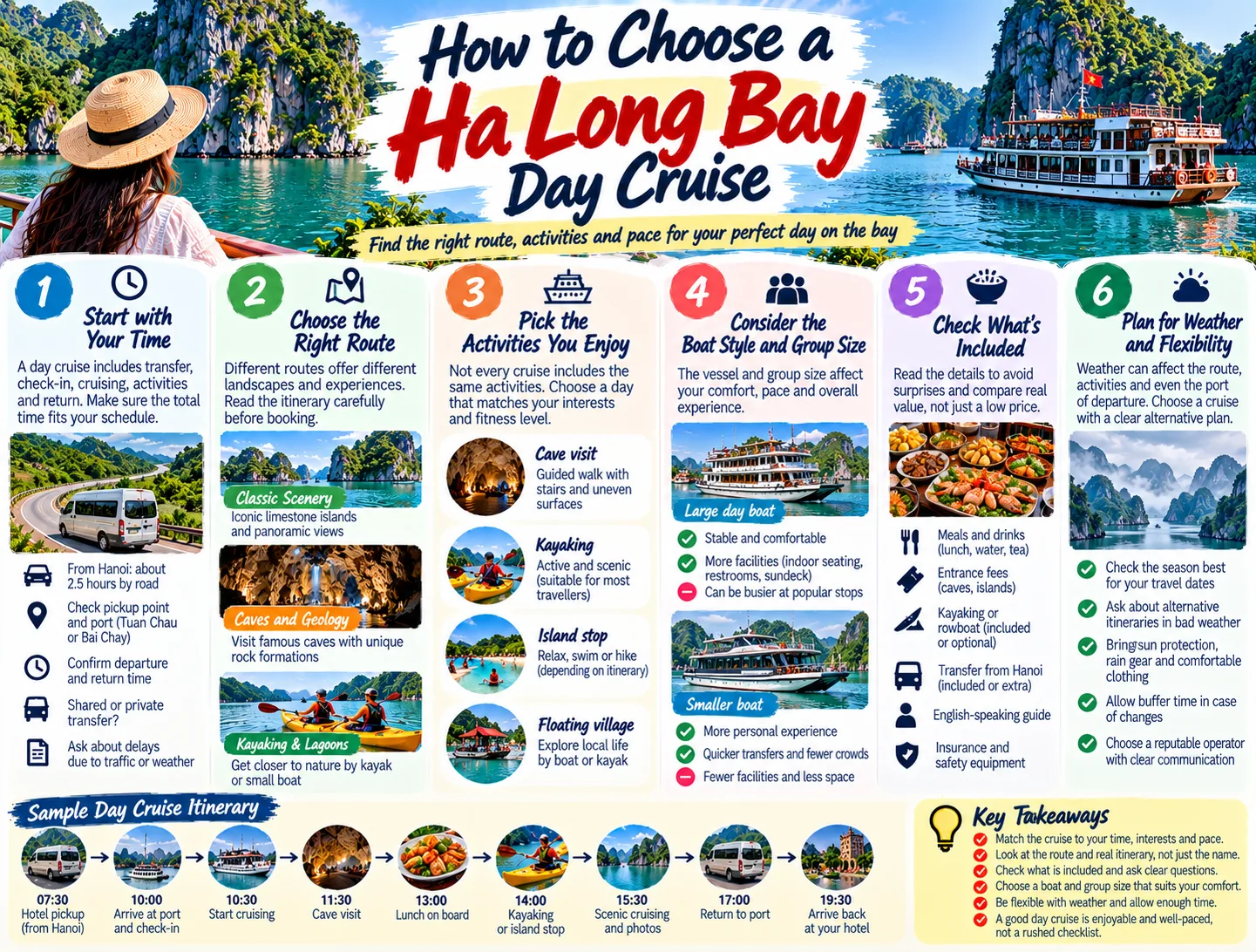
A Ha Long Bay day cruise is designed for travellers who want the bay’s limestone scenery, caves, and water-based activities without booking a night on board. The challenge is choosing an itinerary that fits the hours you actually have, rather than treating every “one-day cruise” as interchangeable. This guide explains how to compare routes, transfer plans, activities, meals, and weather flexibility so you can book a day cruise with realistic expectations.
Start with the right day-cruise expectation
A day cruise is a concentrated introduction to Ha Long Bay. You normally spend the day on a larger vessel or a fast sightseeing boat, moving between karst islands and planned activity stops before returning to port. It is not the same rhythm as an overnight cruise: there is less time for slow sailing, fewer chances to change plans, and more importance attached to the departure and return schedule.
The official Vietnam Tourism destination guide describes Ha Long as a seascape of emerald water, rugged islands, caves, and floating communities. It also identifies cruising, kayaking, cave visits, and floating-village experiences as key ways to see the area. Those are useful benchmarks when reading an itinerary: a strong day cruise should make clear which of these experiences is included, optional, or replaced by another stop.
For a broad overview of how a single day can work, see Making the Most of a One-Day Bay Cruise. Use this article as the decision guide for choosing between different versions of that format.
Choose the departure area before comparing boats
Many travellers begin in Hanoi, but the cruise itself departs from the bay rather than from the city centre. Vietnam Tourism notes that Ha Long is about two and a half hours by road from Hanoi, with cruise transfers from Tuan Chau and Bai Chay ports. That makes the transfer plan one of the most important parts of a day-cruise booking.
Questions to ask about transfers
Is Hanoi hotel pickup included, optional, or unavailable?
What time must you leave Hanoi, and is the return time compatible with your evening plans?
Does the operator use a shared shuttle, a private car, or a meeting point?
Which port and boarding area does the boat use?
What happens if road traffic delays the arrival?
Do not compare the advertised sailing time alone. A cruise described as a full day may involve a long road transfer on each side, while a shorter city-based itinerary may leave more usable time for other plans. If you are arranging transport independently, confirm the exact port and check the operator’s latest meeting instructions rather than relying on a map pin copied from a third-party listing.
For wider route-planning context, the site’s Cruise Planning & Reviews category is useful when you want to compare operators and booking details before committing.
Match the itinerary to the experience you want
“Ha Long Bay day cruise” can describe several different products. Some itineraries emphasise panoramic sailing and a comfortable deck; others are built around active stops. Read the schedule in sequence and decide whether the balance suits you.
For scenery and a slower pace
Choose a route with meaningful sailing time, open-deck space, and fewer rushed activities. This suits photographers, first-time visitors who mainly want the karst landscape, and travellers who prefer conversation or a relaxed meal to a packed activity list. Check whether the boat has indoor seating as well as an upper deck, since heat, wind, or rain can change how comfortable the open-air areas feel.
For caves and geology
A cave stop adds a guided walk and usually some stairs or uneven surfaces. Ask which cave is included, how long the visit lasts, and whether the boat waits for the whole group. The official destination guide presents cave exploration as one of the defining Ha Long experiences, but the practical quality depends on how much time the itinerary gives you rather than the cave name alone.
For kayaking or water activities
Look for a clear description of the launch point, equipment, supervision, and alternative activity. Kayaking can be the highlight of a day, particularly around quieter water and lagoons, but it is not ideal for every traveller. If you would rather stay dry, find out whether the alternative is a rowboat, a short island visit, or simply remaining on the vessel.
The comparison of kayaking, caves, and cruise stops can help you weigh activity time against sightseeing time instead of choosing from attractive labels alone.
Compare boat style, crowding, and the onboard rhythm
The vessel itself shapes the experience as much as the route. A large day boat may offer several decks, stable dining space, and more room to move around, but it can also feel busy at popular stops. A smaller boat may feel more personal and make transfers quicker, while providing fewer sheltered areas or less space when everyone returns from an excursion.
Look for photographs that show the actual public areas rather than only a polished exterior. Check whether seating is assigned, whether the dining room is shared, and whether the upper deck has enough shade. If you are sensitive to motion, ask where guests usually sit and whether the boat has a quieter indoor area. If you want photographs, confirm that you will have safe, unobstructed access to an outside deck rather than assuming the best viewpoint is available throughout the day.
Group size also affects the pace of kayaking, cave walks, and boarding. Ask how many guests share a guide or small transfer boat, and whether the cruise combines several booking channels. A clear answer is more useful than a vague promise of a “premium experience.”
Read the schedule for hidden time pressure
A useful itinerary tells you more than “lunch, cave, kayaking.” It shows approximate arrival windows, activity duration, and the point at which the boat turns back. This matters because a day cruise has a fixed return requirement. If an activity runs late, the operator may shorten another stop.
Watch for wording such as “subject to weather,” “depending on operating conditions,” or “route may change.” That language is not automatically a warning sign; it reflects the fact that a boat’s route can be adjusted for conditions and port operations. The important question is whether the operator explains the substitute plan.
A simple schedule test
Count the number of major activities, not just the number of named destinations.
Check whether lunch occurs while sailing or during a fixed stop.
Allow time for boarding, transfers between the boat and smaller craft, and regrouping.
Look for a stated return-to-port time, not just a vague “back in the afternoon.”
Ask whether the listed sequence is guaranteed or an example route.
More stops are not always better. A route that includes one cave, one paddle, and generous sailing time may feel more satisfying than one that lists five attractions but gives each only a rushed visit.
Use weather and season to choose your day
Weather is central to a day cruise because scenery, deck time, and water activities all depend on conditions. Vietnam Tourism identifies September to November as a particularly good period for Ha Long, describing autumn and spring as bringing clearer, calmer days for cruising, while summer can be hot with a chance of storms. Treat that as seasonal planning guidance, not a promise of conditions on a specific date.
When your schedule is flexible, leave a buffer day around the cruise or choose a booking policy that explains changes and cancellations. When your schedule is fixed, prioritise an operator with a clear weather procedure and realistic communication. Pack for more than one scenario: sun protection, light layers, and a waterproof cover for small electronics are more useful than planning around a perfect forecast.
Do not assume that a cloudy day makes the trip worthless. Mist can soften the landscape and reduce glare, while calm but overcast conditions may still be comfortable for cruising. The bigger concern is whether activities are altered or suspended, so ask how the itinerary changes when kayaking or a particular stop is not available.
Compare what is included, not just the headline fare
Day-cruise prices are difficult to compare when inclusions are presented differently. Build a small checklist before you book:
Port fees or local charges, if applicable
Meals and whether drinks are included
Kayak, rowboat, or other activity equipment
Entrance or sightseeing fees
Hanoi transfers, if you need them
Use of indoor and outdoor seating areas
English-speaking guide or another language service
Then compare the booking terms. A low headline rate may make sense if you are staying near the port and do not need extras, but it may not be the best value once transfers and activity charges are added. Conversely, a higher-priced package may be worthwhile if it saves you from coordinating several separate pieces of the day.
For a more detailed value check, read Finding a Good-Value Bay Cruise Without Surprises. It is especially relevant when two itineraries look similar but differ in transport, meals, or optional activities.
Plan for comfort, mobility, and group needs
A day cruise can involve a road transfer, a gangway, stairs, a tender or small boat, a cave walk, and time in bright sun. Ask practical questions before paying, particularly if anyone in your group has limited mobility, motion sensitivity, or a medical condition that affects heat or exertion.
What to clarify in advance
How many steps are involved at boarding and at the activity stops?
Can a guest skip kayaking or the cave without losing the main cruise?
Is there a quiet indoor place to sit during rougher or hotter periods?
How is vegetarian, child-friendly, or allergy-related food handled?
Can the operator accommodate a private group or family schedule?
Families may prefer a boat with a simple schedule and an easy way to return indoors between activities. Couples may value a less crowded deck and longer scenic sailing. Older travellers or anyone who dislikes repeated transfers should favour fewer, better-explained stops. The site’s Private & Family Cruises category offers a useful next step if a standard group itinerary does not fit your needs.
Book with a verification checklist
Before confirming, save the operator’s exact itinerary and reread the latest confirmation email. Verify the pickup address, port, boarding time, return estimate, inclusions, cancellation terms, and contact method for the day of travel. If a listing uses impressive language but avoids specifics, treat that as a reason to ask questions rather than assume the missing details will be obvious.
Use the site’s Day Cruises category to compare related planning guidance, then narrow your choice using three priorities: the amount of sailing you want, the activities you will genuinely enjoy, and the transfer time you can tolerate. This method is more reliable than choosing solely by boat photographs or the number of attractions in a headline.
Conclusion: choose the day that fits your pace
The best Ha Long Bay day cruise is not necessarily the longest or busiest. It is the one whose departure logistics, activity mix, weather policy, comfort level, and inclusions match your actual travel day. Start with the port and transfer, inspect the schedule for pressure points, then decide whether scenery, caves, kayaking, or convenience matters most. With those choices clear, you can compare boats more fairly and arrive at the bay knowing what the day can realistically deliver.
JOIN THE CONVERSATION
Comments (0)
No comments yet. Be the first to share a thought.