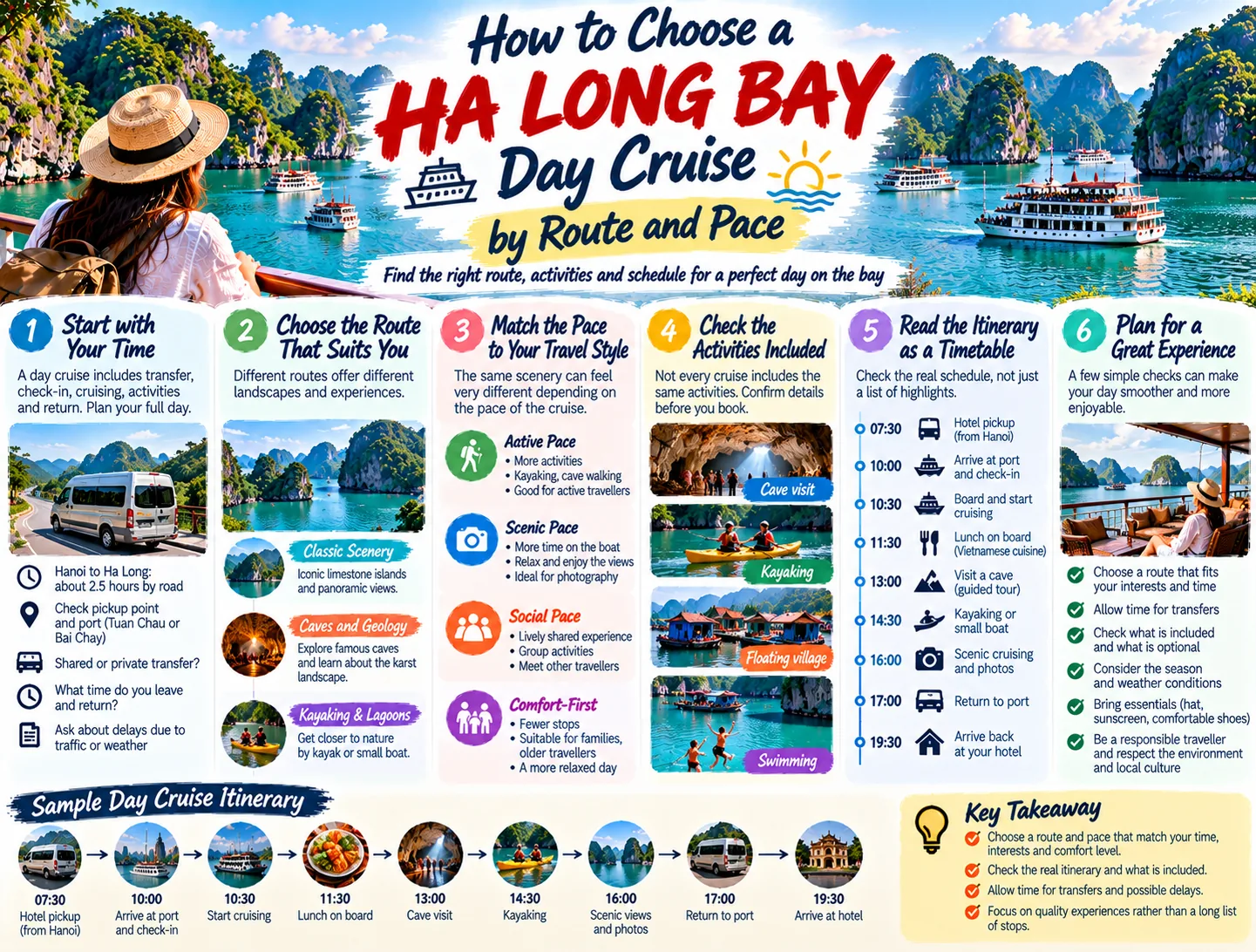
A Ha Long Bay day cruise can be the simplest way to see Vietnam’s limestone seascape when you do not want to spend a night on the water. It can also become a tiring day of transfers and rushed stops if the itinerary is chosen from a glossy photo alone. The best day cruise is not automatically the newest vessel or the longest list of activities. It is the trip whose route, timing, transfer plan, and pace fit the time you genuinely have.
This guide explains how to compare Ha Long Bay day cruises and similar Lan Ha Bay options. You will learn what to check before booking, how to read an itinerary, which questions reveal hidden compromises, and how to plan a comfortable day from hotel departure to return.
Start with the route, not the boat
“Ha Long Bay day cruise” can describe several different experiences. Some boats follow a conventional route through the central bay; others depart from a different port and focus on Lan Ha Bay or a quieter area. A route may combine scenic sailing with a cave, beach, viewpoint, floating village, or kayaking stop. Those choices affect the character of the day more than the dining room or sun deck.
Ha Long Bay, Lan Ha Bay, or a combined itinerary?
Ha Long Bay is the most familiar name and suits travellers who want a classic introduction to the iconic seascape. Lan Ha Bay can appeal to people comparing a different departure point, a more activity-led itinerary, or a route connected with Cat Ba. Neither label tells you enough by itself. Ask for the actual sequence of stops and the pier used, rather than assuming every “bay cruise” visits the same places.
For a broader comparison, read How to Choose a Ha Long Bay Cruise alongside the practical planning advice in the Ha Long Bay Cruises category. If you are weighing a Lan Ha route, the Lan Ha Bay Cruises category provides a useful alternative frame.
Match the route to your priority
- Choose a sightseeing-led itinerary if the landscape and photography matter most.
- Choose an activity-led itinerary if kayaking, swimming, or a cave visit is the main reason you are going.
- Choose a shorter transfer or simpler schedule if you are travelling with children, older relatives, or limited energy.
- Choose a quieter route only when the operator clearly explains what you will see instead of the famous central attractions.
A day cruise cannot include every bay, cave, beach, and viewpoint. A credible itinerary makes that trade-off visible.
Read the timetable as a travel plan
The advertised cruise duration is only one part of the day. You must also account for the journey to the pier, check-in, boarding, disembarkation, and the trip back to your accommodation. A schedule that looks relaxed on the water may feel compressed once road travel is included.
Check the four time blocks
- Collection: Confirm whether transport is included, where it collects, and whether the stated time is a firm pickup or a broad window.
- Pier and boarding: Ask how early you need to arrive and whether check-in happens at a central terminal or directly beside the vessel.
- On-water programme: Note the sailing time, meal period, activity stops, and any transfer by smaller boat.
- Return: Confirm the expected arrival at the pier and the likely return to your hotel, airport, train, or onward connection.
Do not book a day cruise immediately before a flight, overnight train, or important appointment unless the operator gives a generous buffer and you have a backup plan. Water conditions, road traffic, boarding procedures, and weather can all affect the practical end time.
The article Making the Most of a One-Day Bay Cruise is a useful companion for turning a fixed schedule into a more realistic day plan. The key lesson is to protect time for the parts of the trip that are not printed in the headline duration.
Compare what is actually included
Two cruises can show similar prices while delivering different total value. Build a simple comparison using the full inclusions, not the first number you see in a listing.
Transport and port costs
Ask whether hotel transfers, port fees, entrance fees, sightseeing tickets, and small-boat transfers are included. If transport is optional, find out whether the pickup area is limited and whether a private transfer is the only practical choice from your accommodation. “From the city” is not precise enough; request the named pickup zone and the named pier.
Meals and drinks
Find out whether lunch is a set menu, buffet, or shared meal, and whether dietary requests must be submitted in advance. Check whether water, tea, coffee, soft drinks, or alcoholic drinks are included. A meal described as “international” does not tell you how substantial it is or whether there are suitable choices for children and vegetarians.
Activities and equipment
Confirm whether kayaking, swimming, caves, beaches, and viewpoints are included in the base itinerary or offered as optional extras. Ask whether life jackets, paddles, towels, lockers, and changing facilities are available. If an activity is weather-dependent, the operator should explain what normally replaces it.
For a detailed way to compare stops and active excursions, see Kayaking, Caves, and Stops: Comparing Cruise Excursions. This helps separate a genuinely varied itinerary from one that simply names many activities without allowing enough time for them.
Choose a pace you can enjoy
Day cruises often try to create a complete holiday experience in a single daylight window. That can mean early collection, a fast boarding process, a meal between activities, and limited time at each stop. A packed itinerary is not necessarily better. The right pace depends on whether you want to photograph the scenery, take part in activities, or simply sit on deck and watch the karsts pass.
Questions for families and mixed groups
Ask how far guests walk from the pier to the vessel, how many stairs are involved, and whether the boat has shaded seating. Families should check minimum ages for kayaking or swimming, supervision arrangements, toilet access, and the meal format. Travellers with mobility concerns should describe their needs directly rather than relying on a general “family-friendly” label.
Private groups may value control over stops and meal timing more than a large shared boat. The guide Private & Family Cruises can help you compare that option with a standard group day cruise. If you are travelling on a tighter budget, also review the Budget Cruises category, but compare inclusions carefully before treating a lower headline fare as a saving.
Questions for photographers and slower travellers
Ask whether the vessel spends meaningful time in scenic areas or mainly moves between activity stops. Check whether the upper deck is open, whether seating is assigned, and whether the programme leaves any unhurried sailing time. A slower itinerary with fewer attractions may produce a better day for someone who values views and atmosphere over a checklist.
Judge the operator before you pay
A clear booking process is part of the product. Before paying, look for a named operator, a specific vessel or vessel class, a written cancellation policy, and a reachable contact channel. The operator should be able to answer basic questions about the pier, transport, meals, activities, and weather changes without giving contradictory replies.
Use the checklist in A Clear Checklist for Comparing Cruise Operators to compare communication, safety information, customer support, and what is promised in writing. Be cautious when the listing relies on dramatic images but avoids naming the departure point or explains the itinerary only after payment.
Warning signs worth taking seriously
- The route is described only with broad phrases such as “many attractions” or “hidden gems.”
- Pickup, port, entrance, or activity charges are not explained.
- The operator cannot state what happens if kayaking, swimming, or a cave visit is cancelled.
- The cancellation terms are difficult to find or differ between the booking page and confirmation.
- Reviews discuss a different vessel, route, or departure point from the product you are considering.
Save the confirmation, inclusions, pickup instructions, and emergency contact details offline. If the itinerary changes, you then have a clear record of what was sold.
Plan clothing, weather, and practical comfort
The bay can feel different from the city even on the same day. Pack light clothing that dries reasonably quickly, sun protection, a waterproof layer, secure footwear, and a small bag that you can keep with you. Bring medication, motion-sickness supplies if you use them, and a phone pouch or dry bag for boat transfers.
Wear shoes suitable for wet decks and uneven paths. If swimming is offered, do not assume towels or changing rooms are guaranteed; confirm in advance. A light layer is useful on a windy upper deck, while sun protection remains important during long periods outside. Keep valuables minimal because a day cruise is easier when you are not moving a large bag between transport, pier, and boat.
Weather decisions are operational, not just personal. A cruise may adjust its route, replace an activity, delay boarding, or cancel when conditions are unsuitable. Ask how and when the operator communicates those changes, what refund or rebooking rules apply, and whether the decision comes from the cruise company or port authorities. Do not rely on an old review for current rules or conditions.
Build a better booking comparison
Before choosing, put two or three options in the same note and answer the same questions for each:
- Which bay and which pier does it use?
- What is the real collection and return plan?
- How much time is spent sailing compared with stopping?
- Which activities and fees are included?
- What meal and drink arrangement is provided?
- What happens when weather changes the programme?
- Is the pace suitable for everyone in the group?
- Can the operator explain the cancellation policy clearly?
Then choose the option with the fewest important unknowns. A slightly higher fare can be sensible when it includes reliable transfers, clear activity arrangements, and a schedule that does not force you to rush. Conversely, a premium boat is not good value if its route, pier, and inclusions remain vague.
Conclusion: choose a day cruise that fits your day
The best Ha Long Bay day cruise is the one you can enjoy without spending the whole day managing surprises. Start with the route, calculate the complete travel time, compare inclusions, test the itinerary against your group’s energy, and ask direct questions about weather and cancellation terms. Use published guidance to understand the options, but rely on the operator’s written confirmation for the specific departure, inclusions, and arrangements of your booking.
With those checks completed, a day on the bay can deliver dramatic scenery, well-chosen activities, and a comfortable introduction to Vietnam’s northern coast without requiring an overnight stay.
JOIN THE CONVERSATION
Comments (0)
No comments yet. Be the first to share a thought.