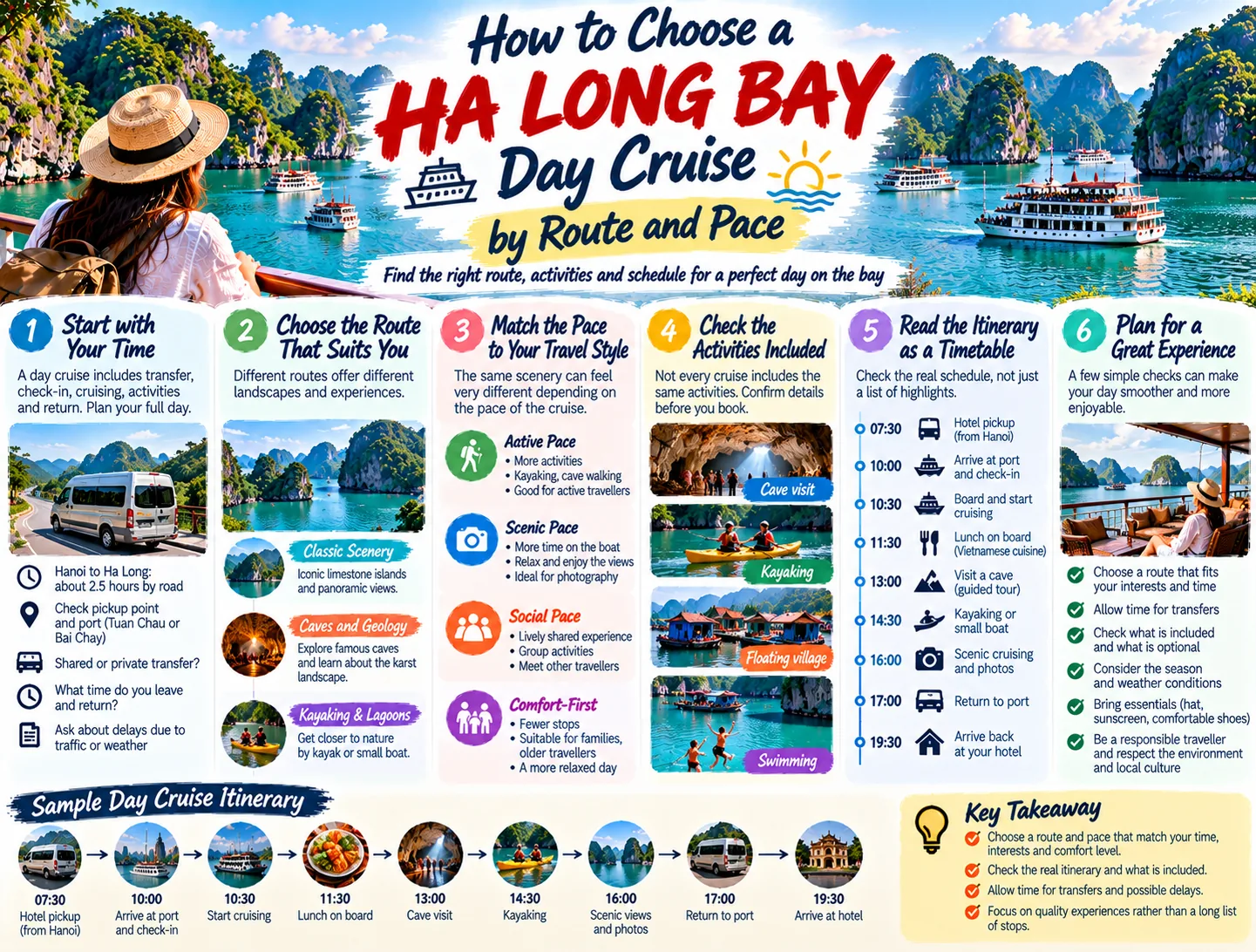
A Ha Long Bay day cruise can be the most efficient way to see Vietnam’s famous limestone seascape when you do not have a night to spare. It can also become a long, rushed day if the itinerary looks impressive on paper but leaves too little time for transfers, boarding, meals, and the activities you actually want to enjoy. The best choice is not simply the cruise with the longest list of stops. It is the cruise whose route, schedule, and pace fit your available time.
This guide focuses on the decisions that matter before you book: how to match the cruise to your starting point, how to compare routes, what to ask about activities, and how to build a practical plan around weather and comfort. For broader context, you can also read our guide to making the most of a one-day bay cruise and browse the Day Cruises category.
Start with the time you really have
Before comparing boats, write down the hours available from your accommodation to your accommodation. A day cruise is not only time on the water. It may include a road transfer, check-in, boarding, lunch, guided stops, and the return journey. If you are staying in Hanoi, the official Vietnam Tourism destination page describes Ha Long as about two and a half hours by road, with cruise transfers from Tuan Chau and Bai Chay ports. That makes the transfer plan a central part of the experience, not a minor detail.
Ask the operator these questions in writing:
Where is the pickup point, and is the transfer shared or private?
Which port does the boat use?
What time do you leave the hotel, and what time do you realistically return?
How much time is spent cruising versus stopping at attractions?
What happens if traffic, weather, or port procedures delay the schedule?
If your main priority is seeing the bay without an exhausting evening, a closer starting point may be more important than adding another activity. If your priority is fitting a cruise into a Hanoi itinerary, accept that the road day will be substantial and avoid scheduling a fixed, high-stakes appointment immediately afterward.
Choose the route before you choose the boat
“Ha Long Bay day cruise” can describe very different experiences. Some routes emphasize the classic karst panorama and cave visits. Others place more weight on kayaking, quieter water, or a longer list of shore stops. The official Vietnam Tourism guide describes cruises among islands and islets, with caves, floating-village experiences, kayaking, and views from the water. Use that description as a menu of possibilities, then check which of those elements is actually included in the itinerary you are considering.
For classic scenery
Choose a route that protects time for open-water viewing rather than filling every hour with transfers between attractions. A scenic day works best when you can spend unhurried time on an outdoor deck, take photographs, and watch the landscape change. Look for a clear statement of the sailing area and the main viewpoint or cave, not just a list of destination names.
For caves and geology
Check how much walking is involved, whether the stop is guided, and whether the route includes stairs or uneven surfaces. A cave visit can be memorable, but it changes the shape of the day: you will leave the boat, walk at a group pace, and return through the same boarding process. If a guide’s explanation matters to you, ask whether the stop is escorted or simply self-directed.
For kayaking or water-level exploration
Confirm whether kayaking is included, optional, or replaced by a small tender when conditions change. Ask how long the activity lasts and whether there is a non-kayaking alternative. The official destination guide presents kayaking as a way to approach lagoons and fishing boats more closely, but an activity described in general destination advice is not a guarantee that every day cruise offers it. Treat the operator’s current itinerary as the controlling detail.
For more help comparing activity choices, see our comparison of kayaking, caves, and cruise excursions and the Cruise Activities & Excursions category.
Match the pace to your travel style
Two cruises can visit similar scenery but feel completely different. One may be designed around a full program of activities, while another leaves more space for sitting, eating, and looking out at the bay. Decide which version you want before reading reviews.
Active pace: Choose this if kayaking, cave walking, and several structured stops are the reason you are going. Pack light, wear secure footwear, and expect fewer long pauses.
Scenic pace: Choose this if the landscape is the main attraction. Prioritize deck space, a sensible sailing window, and a schedule that does not turn every view into a rushed photo stop.
Social pace: Choose this if you enjoy a lively shared boat and group activities. Read the schedule carefully so you know how much time is guided and how much is independent.
Comfort-first pace: Choose this if you are travelling with older relatives, young children, or anyone who dislikes repeated boarding and walking. Fewer stops may produce a better day.
Do not treat “more included activities” as automatically better value. Each stop uses time and energy. A day cruise is successful when the included experiences feel enjoyable rather than like a checklist you are trying to complete before the boat turns back.
Read the itinerary as a timetable, not a sales slogan
Look for a sequence with approximate time blocks. You want to know when the road transfer ends, when boarding begins, when lunch is served, and how much time is reserved for the principal activity. Vague phrases such as “explore hidden caves” or “visit a peaceful village” are useful inspiration, but they do not tell you whether the stop lasts twenty minutes or two hours.
Compare itineraries using the same questions:
How many times do passengers leave and reboard the main vessel?
Is lunch served while the boat is moving or during a stop?
Are drinks, entrance fees, transfers, and activities clearly separated in the inclusions?
Is there a stated return time, or only a broad promise of an evening arrival?
Does the itinerary offer any quiet time on the boat?
Also check the cancellation and weather language before paying. The official Vietnam Tourism climate guide notes that tropical storms can sometimes cause cruise cancellations in Ha Long Bay. That is a reason to choose flexible plans and read the operator’s procedure, not a reason to assume every rainy day means the same outcome. Ask what happens if sailing is shortened, changed, or cancelled, and keep the answer with your booking documents.
Use the season to set expectations
Weather affects a day cruise in ways that go beyond whether you need an umbrella. Sunlight changes the appearance of the karsts, mist can soften distant views, and wind or storms may alter what is possible on the water. Vietnam Tourism groups Ha Long Bay weather into cool, misty winter months; warmer, clearer conditions in April to June; stormier, humid conditions in June to August; and a mixed pattern from September to November. It recommends April to June or September to November for a better chance of pleasant cruising weather.
Use those patterns as planning guidance rather than a promise. In any season, pack a light layer, sun protection, and a rain-ready outer layer. If kayaking or an open deck matters most, leave room in your itinerary for weather flexibility. If you are travelling during a period when storms are more likely, do not make the day cruise the only plan supporting an important onward connection.
Pick the right transfer arrangement
The transfer can shape your mood before the boat even leaves the port. A shared vehicle may be practical and sociable, but it can involve multiple hotel pickups. A private transfer usually gives you more control over departure and rest stops, though the price and availability vary by operator. Never assume a transfer is included because the cruise is advertised as a Hanoi day trip; check the exact pickup area and supplement.
If you are already staying near the bay, ask whether a local pickup or self-arrival option is available. The official destination page identifies Tuan Chau and Bai Chay as cruise-transfer points, so the port named in your confirmation should match the route and meeting instructions you receive. Save the operator’s emergency contact and allow extra time before boarding rather than aiming to arrive at the last possible minute.
Check comfort details that marketing copy skips
Day cruises are easier when small practical details are clear. Ask whether there is indoor seating as well as an outdoor deck, how meals accommodate dietary needs, and where bags can be stored. If you are sensitive to motion, ask which parts of the route are most exposed and choose a seat where you feel comfortable rather than chasing the busiest photo position.
Mobility also deserves an honest assessment. A cave or viewpoint may involve stairs, narrow paths, wet surfaces, or a group walking pace. If anyone in your party has limited mobility, ask the operator to describe each stop and the boarding process. It is better to choose a simpler route than to discover halfway through the day that the itinerary depends on physical activity you cannot comfortably manage.
Build a simple booking checklist
Before you confirm, copy the answers into one note. Your checklist should include:
the exact cruise name and sailing date;
hotel pickup location and transfer type;
port, boarding time, and expected return time;
route, main stops, and activity duration;
what the price includes and excludes;
weather, cancellation, and refund terms;
dietary, mobility, and luggage arrangements;
an emergency contact for the operator or transfer provider.
Then compare only two or three serious options. A large spreadsheet of nearly identical boats can make the decision harder. Give more weight to a clear schedule and honest inclusions than to dramatic adjectives or a long list of attractions.
A realistic one-day plan
A practical Ha Long Bay day cruise plan has four phases: transfer, boarding and orientation, cruising with one or two meaningful experiences, and the return journey. Protect a little unstructured time for the scenery. If every minute is assigned to a meal, cave, kayak, village, and photograph, the day may feel busy rather than beautiful.
On the morning of travel, check the final pickup message and weather notice, carry only what you need, and keep valuables close. During the cruise, listen to the safety briefing, confirm the meeting time before leaving the boat, and return early from independent stops. At the end of the day, keep your onward plans flexible enough to absorb ordinary road delays.
Conclusion: choose the day you want to remember
The right Ha Long Bay day cruise is a match between route, timing, weather tolerance, activity level, and comfort—not simply the boat with the fullest itinerary. Start with the hours you truly have, verify the port and transfer, choose one main experience, and read the weather and cancellation terms. With those decisions made in advance, a day on the bay can feel spacious, scenic, and satisfying even when your trip schedule does not allow an overnight cruise.
JOIN THE CONVERSATION
Comments (0)
No comments yet. Be the first to share a thought.