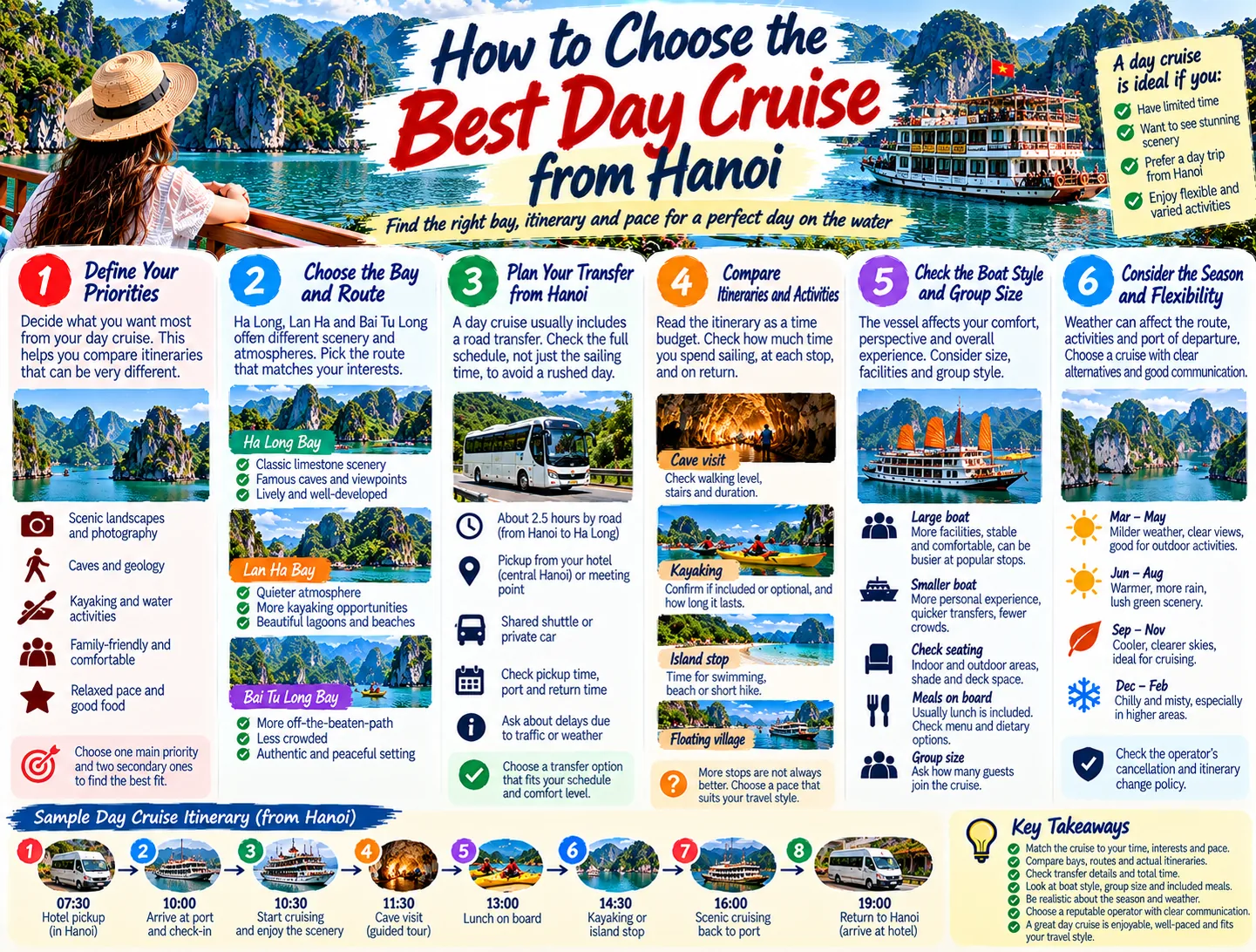
A day cruise in Ha Long Bay can be the easiest way to see northern Vietnam’s limestone seascape when an overnight boat does not fit your itinerary. The challenge is choosing a route that matches your transfer time, weather tolerance, activity level, and expectations for time on the water. This guide explains how to choose a day cruise from Hanoi without treating every itinerary as interchangeable.
Start with the real question: what should your day cruise achieve?
The phrase “best day cruise from Hanoi” hides several different searches. One traveller wants a scenic first look at Ha Long Bay. Another wants kayaking and a cave visit. A family may prefer a comfortable boat, predictable timing, and fewer demanding activities. A photographer may care more about open views and a relaxed deck than about ticking off every stop.
Write down your priority before comparing operators. Choose one main outcome and two secondary ones. For example, your priority might be seeing the bay in a single day; your secondary goals might be a cave visit and a quiet lunch. This prevents an itinerary with many advertised stops from automatically looking better than a shorter, better-paced route.
It also gives you a useful comparison with the site’s existing guide to making the most of a one-day bay cruise. That article is helpful for planning the day itself; this guide focuses on choosing the right day-cruise format before booking.
Choose the bay and departure pattern before the boat
“Ha Long Bay day cruise” is often used as a broad label, but routes can differ in scenery, port arrangements, and the balance between sailing and shore activities. The official Vietnam Tourism destination guide describes Ha Long as a seascape of emerald water, rugged islands, caves, floating communities, and kayaking opportunities. Those features are not experienced in exactly the same way on every route.
For a first visit, a classic Ha Long Bay route may suit you if the landscape itself is the main reason for going. Look for an itinerary that clearly explains its sailing area and the order of its major stops. If you want a quieter atmosphere or a different visual character, compare it with the options in the site’s Lan Ha Bay Cruises category and Bai Tu Long Bay Cruises category.
Do not choose by bay name alone. Ask whether the boat departs from a port that fits your transfer plan, how long the boat remains on the principal sailing area, and whether the itinerary includes a long road transfer between Hanoi and the port. A route that looks attractive on a map may leave less time for the experience you actually want.
Match the transfer to your tolerance for a long day
Vietnam Tourism currently describes Ha Long as about two and a half hours by road from Hanoi, with cruise transfers from Tuan Chau and Bai Chay ports. That description is useful for setting expectations, but a real door-to-door day is longer once you add hotel pickup, traffic, check-in, port procedures, and the return journey.
Before booking, request the complete schedule rather than only the sailing hours. Check:
the planned hotel pickup window and whether pickup is limited to central Hanoi;
the expected arrival time at the port;
the time allowed for check-in and boarding;
the latest expected return to Hanoi;
whether a late road arrival can shorten a scheduled activity.
A shared transfer may be practical and sociable, while a private transfer can offer more control over pickup and comfort. Neither is automatically better. The right choice depends on whether you value a lower-cost, structured day or a smoother journey with fewer passengers and less waiting.
If your travel plans already include several long road days, compare a day cruise with the site’s Overnight Cruises category. One night on the bay can reduce the feeling that every part of the experience is compressed, although it brings different packing and cabin considerations.
Read the itinerary as a time budget
A day-cruise itinerary is not just a list of attractions. It is a time budget. A schedule that names a cave, kayak stop, swimming area, cooking demonstration, lunch, and sunset deck may sound comprehensive, but each activity uses sailing or shore time. The important question is not how many stops appear in the brochure; it is how much time you will have at the places that matter most.
Look for the activity details
For each included stop, check whether it is guided, optional, or dependent on conditions. “Kayaking” might mean an organised paddle, a small boat transfer to a kayaking area, or an optional activity with a separate queue. “Cave visit” may involve steps, uneven ground, crowds, or a walk from the landing point. If you prefer to stay aboard, ask what the non-participating option is while the group goes ashore.
Check the pace between stops
Some travellers want a full programme; others want time to watch the karsts from the deck. A useful day-cruise schedule shows when lunch happens, when the main scenic sailing occurs, and whether the final hours are reserved for a calm return or filled with another activity. If the schedule is vague, treat that as a reason to ask questions rather than assume the most generous interpretation.
Use the site’s guide to comparing kayaking, caves, and cruise excursions when you want to evaluate activities more closely. It can help you distinguish a genuinely useful excursion plan from a list of attractive nouns.
Use the season to choose your priorities
Weather is part of the booking decision, not a footnote. Vietnam Tourism’s Ha Long climate guide describes December to March as cool to cold, misty, and cloudy; April to June as warm to hot with clearer skies; June to August as hot, humid, and stormy; and September to November as a mix of sun and clouds with warm to cool conditions. It also notes that tropical storms can sometimes cause cruise cancellations.
In clearer months, a day cruise may reward travellers who want broad views, photography, and time on the sun deck. In mistier weather, the bay can feel atmospheric, but you should be comfortable with lower visibility and a more flexible experience. During hotter or more humid periods, shade, airflow, drinking water, and a sensible activity load matter more than a crowded schedule.
Do not buy a non-refundable plan on the assumption that the weather will behave exactly like a seasonal summary. Ask the operator how weather-related changes are handled, what happens if a route is shortened, and whether the transfer provider follows the same policy. Treat any policy as operator-specific and save the written terms with your booking details.
Compare boats by the parts you will actually use
A day boat is not a floating hotel, so cabin features may be irrelevant while deck layout, seating, toilets, shade, and boarding access matter greatly. Compare the boat’s usable spaces rather than relying on polished photographs.
Outdoor space: Is there a shaded area as well as an exposed upper deck?
Seating: Can you sit comfortably during scenic sailing, or is seating mainly arranged for meals?
Dining: Is lunch served at a set time, and can dietary requirements be discussed before departure?
Movement: Are there stairs or long walks between the port, deck, restaurant, and activity pontoons?
Group size: Does the boat’s capacity suit you, especially if you dislike crowded excursions?
Equipment: If kayaking or swimming is included, what equipment and supervision are described?
For a broader checklist on evaluating companies, see the guide to comparing cruise operators. Apply the same questions to day boats, but give extra weight to boarding, deck comfort, and schedule clarity because you will use them continuously on a short trip.
Build a practical shortlist in three passes
Pass one: remove poor logistical matches
Discard any option whose pickup area, port, return time, or cancellation terms do not fit your trip. Do this before comparing menus or promotional extras. A beautiful itinerary that creates a missed flight, train, or hotel transfer is not good value.
Pass two: compare the core experience
For the remaining choices, write down the sailing area, principal activity, approximate time on the bay, boat capacity, transfer arrangement, and what is clearly included. Keep the notes in the same order for every operator. This makes vague promises easier to spot.
Pass three: test the unanswered questions
Send the same short list of questions to each operator: What is the normal pickup and return window? Which activities are included and which are optional? What happens if weather changes the route? Are there stairs or long walks? How are dietary requests handled? A clear, specific reply is useful evidence of operational organisation, even though it cannot guarantee the weather or exact sailing conditions.
Choose the right day cruise for your travel style
First-time visitors: Choose a well-explained classic route with a clear transfer plan and one or two major activities. You do not need every possible stop to understand why the bay is famous.
Photographers and scenery seekers: Prioritise open sailing time, a comfortable deck, and a route whose schedule does not rush from one landing to another. Ask how much time is spent travelling between stops.
Active travellers: Compare the actual kayaking, hiking, or swimming arrangements, including physical access and weather contingencies. A long activity list is less useful than detailed descriptions.
Families and mixed-age groups: Look for flexible participation, shade, toilets, simple boarding, and a schedule that allows someone to rest without missing the whole experience. The site’s Private & Family Cruises category offers a useful comparison if a shared day boat does not suit everyone.
Travellers with a tight itinerary: Treat the road transfer as part of the cruise price in time, not just money. Confirm the return window and leave a buffer before any fixed evening commitment.
Questions to settle before you pay
A short pre-booking checklist can prevent most avoidable mismatches. Confirm the exact departure port, pickup area, total day schedule, activities included, physical demands, meal arrangements, transfer type, group size, weather policy, and refund or rescheduling terms. Ask whether the published itinerary is an example or the standard plan for your travel date.
Also check what you need to bring for comfort: sun protection, a light layer, secure footwear, and any personal medication or motion-sickness supplies appropriate for you. Avoid packing as though every activity is guaranteed; routes can change, and a day on the water is more enjoyable when you can adapt without frustration.
Conclusion: choose the day that fits, not the brochure that lists most
The best day cruise from Hanoi is the one whose route, transfer, activities, boat layout, and weather policy fit your actual priorities. Start with the experience you want, turn the itinerary into a time budget, and compare operators using the same practical questions. Ha Long Bay offers the dramatic scenery; careful selection determines whether you experience it as a rushed checklist or as a rewarding day on the water.
JOIN THE CONVERSATION
Comments (0)
No comments yet. Be the first to share a thought.