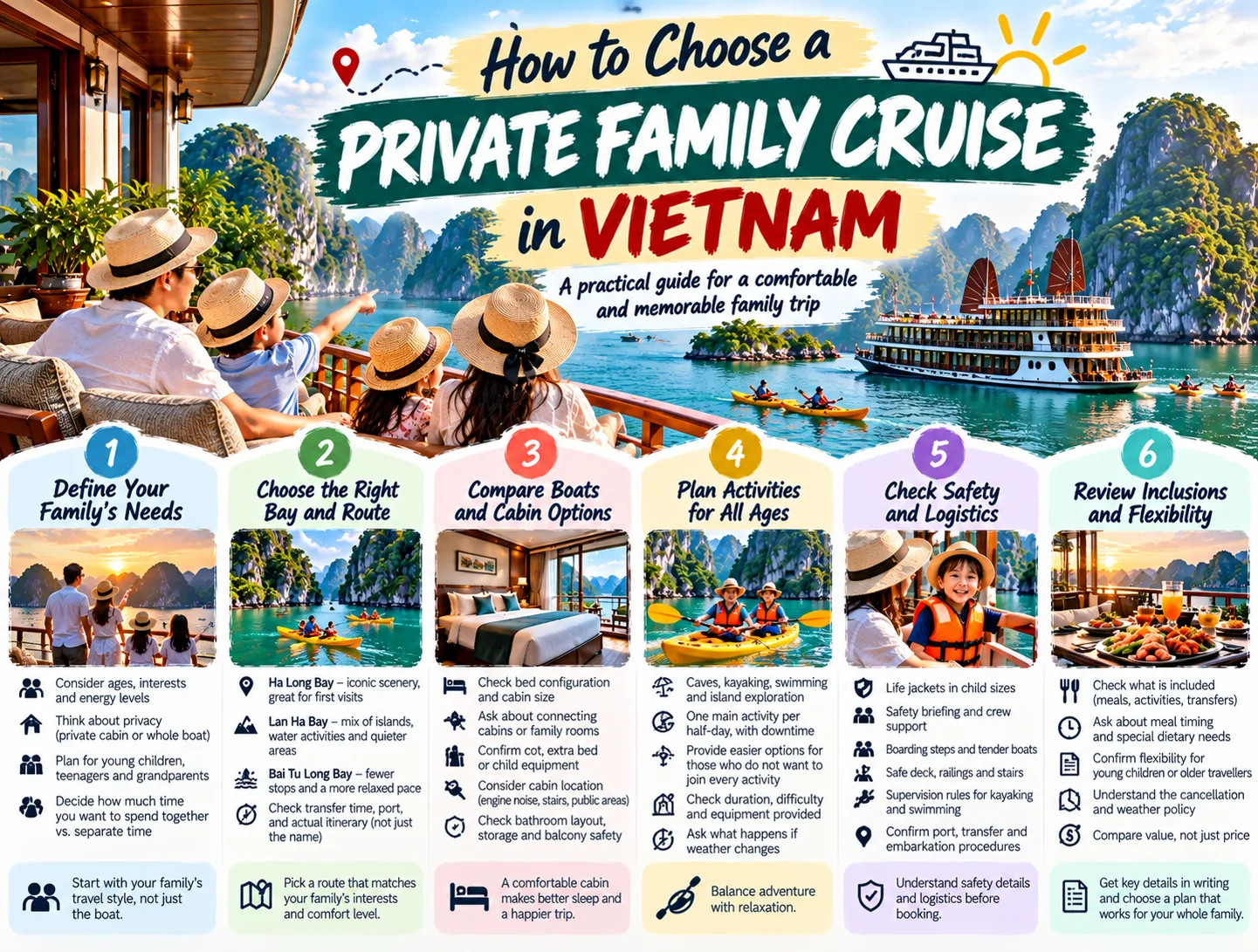
A private family cruise in Ha Long Bay can be one of Vietnam’s easiest group holidays to enjoy, but only when the boat, route, cabin plan, and daily rhythm fit the people travelling. Families often focus first on a private boat or a larger cabin. Those matter, yet the better decision is broader: choose an itinerary that leaves enough time for children, older relatives, and adults to enjoy the bay without turning every transfer or excursion into a negotiation. This guide explains how to compare private family cruises, what to ask before booking, and how to build a comfortable plan around weather, mobility, sleep, and shared space.
Start with the family’s real travel style
“Private” can mean several different things. It may mean a whole boat chartered for one group, a private cabin on a shared cruise, a private day boat, or simply a small group transfer. Ask which meaning applies before comparing prices or photos. A family that wants quiet breakfasts and flexible activity times needs a different product from a multigenerational group that mainly wants a comfortable base between sightseeing stops.
Match the cruise to the group
For young children, prioritise short activity blocks, easy access to the cabin, shade, and a sleeping arrangement that does not require constant room changes.
For grandparents or travellers with limited mobility, ask about boarding steps, tender boats, cave pathways, wet surfaces, and the distance between dining, cabins, and the deck.
For teenagers, check whether kayaking, swimming, viewpoints, or cooking activities are genuinely included or only possible as optional additions.
For a private celebration, confirm whether the operator can manage meal timing, a quiet area, or a simple group request without changing the whole itinerary.
It is also worth deciding how much togetherness the group wants. A private family cruise does not need every person to join every excursion. A good plan allows one adult to stay aboard with a tired child while others kayak or visit a cave. That flexibility is often more valuable than adding another stop.
Choose the route before choosing the boat
Ha Long Bay is the familiar choice, but families may also compare Lan Ha Bay and Bai Tu Long Bay. The right question is not which name sounds most famous. Ask what the route means for the group’s priorities: scenery, time on the water, quieter moments, swimming, caves, or the ease of reaching the port.
Vietnam’s official tourism guide describes Ha Long as a karst seascape where cruises visit caves, floating communities, and areas suited to kayaking. It also notes that cruises commonly depart from Tuan Chau and Bai Chay ports, with road access from Ha Noi. Use those broad facts as a starting point, then ask the operator for the exact port, embarkation procedure, and route used on your dates. For a useful comparison of destination choices, see the site’s Ha Long Bay Cruises category and its guide to how to choose a Ha Long Bay cruise.
What to compare between bay areas
Ha Long Bay may suit first-time visitors who want the classic landscape and a choice of cave and kayaking experiences.
Lan Ha Bay can be worth comparing when the itinerary’s balance of islands, water activities, and access from the Cat Ba side fits the family better.
Bai Tu Long Bay deserves attention when the group prefers a quieter-feeling route and is comfortable checking the extra transfer details carefully.
Do not treat a route label as a guarantee of solitude. Ask where the boat actually spends the main daylight hours, how long the transfers take, and whether weather or local operating conditions can change the sequence. A shorter, calmer plan may be the better private family cruise even if it visits fewer named attractions.
Compare cabins and sleeping arrangements carefully
Cabin capacity is only the first question. Families should check bed configuration, connecting rooms, balcony access, bathroom layout, storage, and whether a cot or extra bed is available. A room advertised for three people may technically fit three while still leaving little space for luggage, changing, or an early bedtime.
Questions that prevent uncomfortable surprises
Are children placed in a separate bed, sofa bed, bunk, or existing bed?
Can the operator place adjacent cabins together, and is that confirmed rather than requested?
Is the cabin close to the engine, galley, stairs, or a busy outdoor area?
Can the group reserve a quiet dining table or choose an earlier meal time?
What happens if one traveller needs to return to the cabin during an excursion?
For a multigenerational party, connecting cabins can be more practical than putting everyone into one large room. They provide proximity without making the entire group share one sleep schedule. Families with infants should ask about noise, movement around the cabin, and the safest way to use the balcony or deck. Avoid assuming that a premium cabin solves every practical issue; location and layout can matter more than decoration.
Build a realistic activity schedule
A family itinerary works best when it alternates active moments with open time. The official Vietnam Tourism page highlights kayaking, cave visits, floating-village experiences, and time on the sun deck as common ways to see Ha Long. Those are useful possibilities, not a requirement to complete everything. Select one main activity per half-day and treat the rest as optional.
Before booking, ask how long guests are away from the boat, how they reach shore, whether life jackets and basic equipment are provided, and what happens when weather changes. If kayaking is important, confirm the age, height, swimming, or supervision requirements directly with the operator. If a cave visit involves steps or uneven ground, ask for a plain description rather than relying on promotional photographs.
Families can also divide activities. One group might kayak while another enjoys the deck, reads, or takes photographs. This is easier when the cruise has a clear schedule and staff can explain return times. A private boat may offer more flexibility, but it does not remove the need to respect local operating conditions or the captain’s safety decisions.
For more ideas about evaluating excursions without overloading the day, use the guide to comparing kayaking, caves, and cruise stops. Families planning several nights can also browse the Overnight Cruises category before deciding how much time on board feels comfortable.
Plan around weather and cancellation risk
Weather is not a footnote on a bay cruise. Vietnam Tourism’s current destination guidance describes September to November as a generally favourable period for clear, calm cruising, while summer can be hot with a chance of storms. Its wider weather guide identifies June to August in Ha Long Bay as stormy, hot, and humid, and notes that tropical storms can sometimes cause cruise cancellations. It also describes December to March as cooler, mistier, and cloudier.
For a family, the practical lesson is to protect the itinerary. Avoid placing a non-refundable flight, wedding, or long onward connection immediately after the cruise if your plans cannot absorb a change. Ask the operator’s written policy for cancellation, shortened routes, port changes, refunds, and hotel arrangements. Policies vary, so do not rely on a verbal promise or a generic booking page.
Pack for more than one version of the day: light layers, a waterproof bag for electronics, comfortable shoes with grip, sun protection, and a warmer layer for misty or breezy conditions. Children can become uncomfortable faster than adults, so a familiar snack, small activity, or dry change of clothes may be more useful than extra sightseeing equipment.
Make transfers part of the booking decision
The cruise begins before the boat leaves the pier. Vietnam Tourism describes Ha Long as reachable from Ha Noi by expressway in about two and a half hours, with cruise transfers associated with Tuan Chau and Bai Chay. Treat that as destination-level orientation, not as a promise about your operator’s pickup time. Confirm the collection address, vehicle type, luggage limits, rest stops, and what happens if a family member becomes unwell during the drive.
For families arriving from another Vietnamese destination, compare the full door-to-door journey rather than only the cruise duration. The official national transport guide explains that Vietnam offers flights, trains, buses, taxis, and other local options, and that route planning can take time because distances between destinations are easy to underestimate. A private transfer may cost more than a shared one, but it can reduce waiting and make child or mobility needs easier to manage. For broader planning, review the site’s Cruise Planning & Reviews category.
Check food, privacy, and group communication
Food is a daily comfort issue, especially for families with allergies, young children, or different meal preferences. Tell the operator about allergies and dietary requirements before payment, then repeat them at embarkation. Ask what can be prepared, how meals are served, and whether children can receive simpler food. Do not assume a private boat automatically means a fully custom menu.
Privacy also needs a specific definition. Does the group have exclusive use of the vessel, or only a private cabin? Are shared excursions, dining areas, or transfers still part of the package? If the family wants a private guide or private tender, ask whether that is included. Write down the agreed inclusions, because “private” is often used in several different ways across booking listings.
Designate one booking contact for the family and keep the final itinerary, emergency contact, pickup details, and dietary notes together. This avoids six people sending conflicting changes to the operator. If the group includes children, agree in advance on who supervises them near stairs, water, balconies, and shore transfers. Keep that conversation practical rather than assuming the crew can provide one-to-one childcare.
Use a simple decision checklist
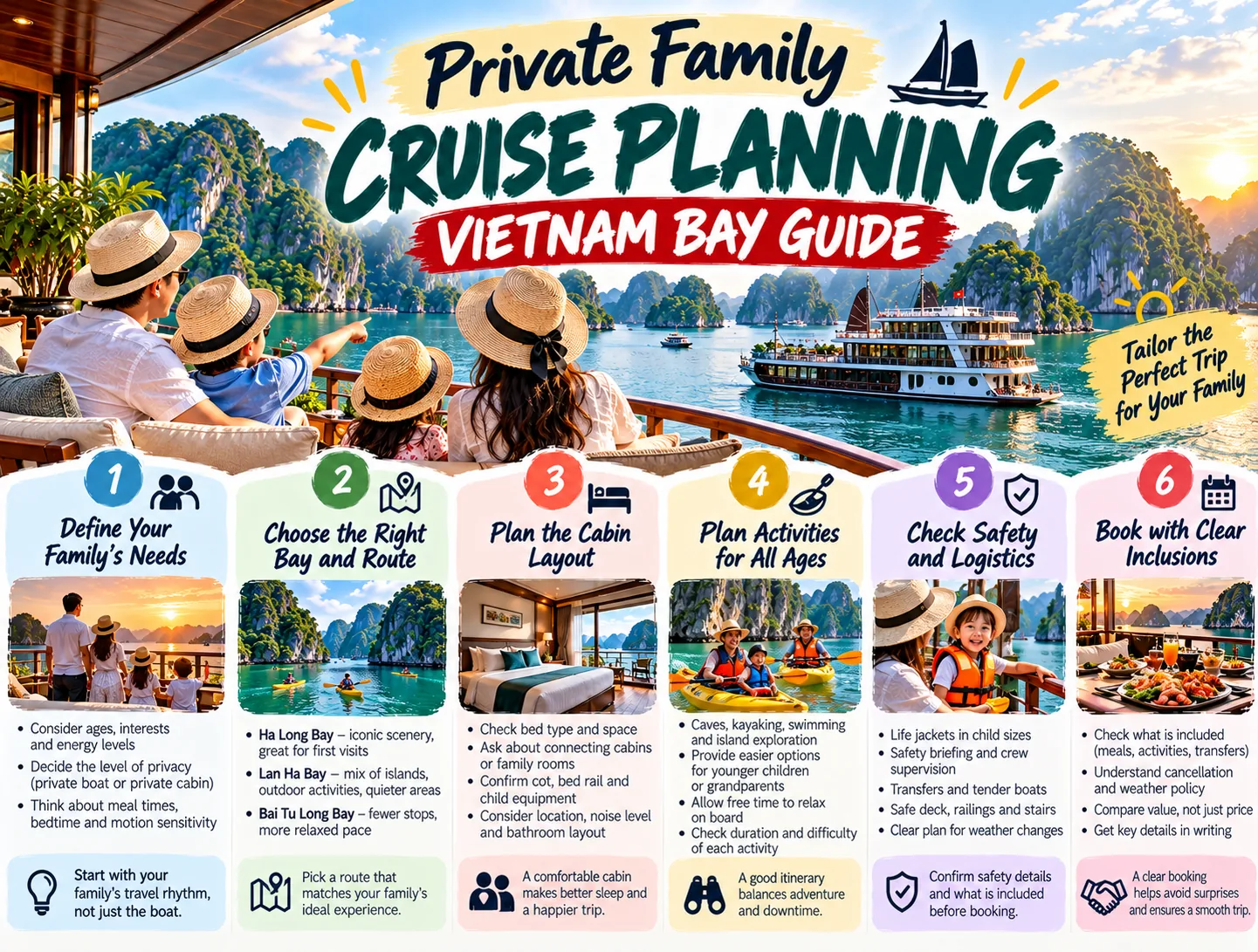
Once you have two or three options, score them against the same criteria instead of choosing from photographs. A useful family cruise checklist includes:
Route and actual time on the water
Cabin layout and sleeping privacy
Boarding, stairs, tenders, and excursion accessibility
Weather policy and flexibility if the route changes
Transfer time, pickup details, and luggage handling
Meal planning and allergy communication
Adult-to-child supervision expectations
What “private” includes and what remains shared
Give each item a simple priority: essential, helpful, or optional. If a cruise fails an essential requirement, remove it even if the vessel looks attractive. If two choices remain, prefer the itinerary that gives the family more recovery time and clearer communication. The best private family cruise is rarely the one with the longest list of activities; it is the one that makes the group feel looked after without taking away everyone’s independence.
Conclusion: choose ease over excess
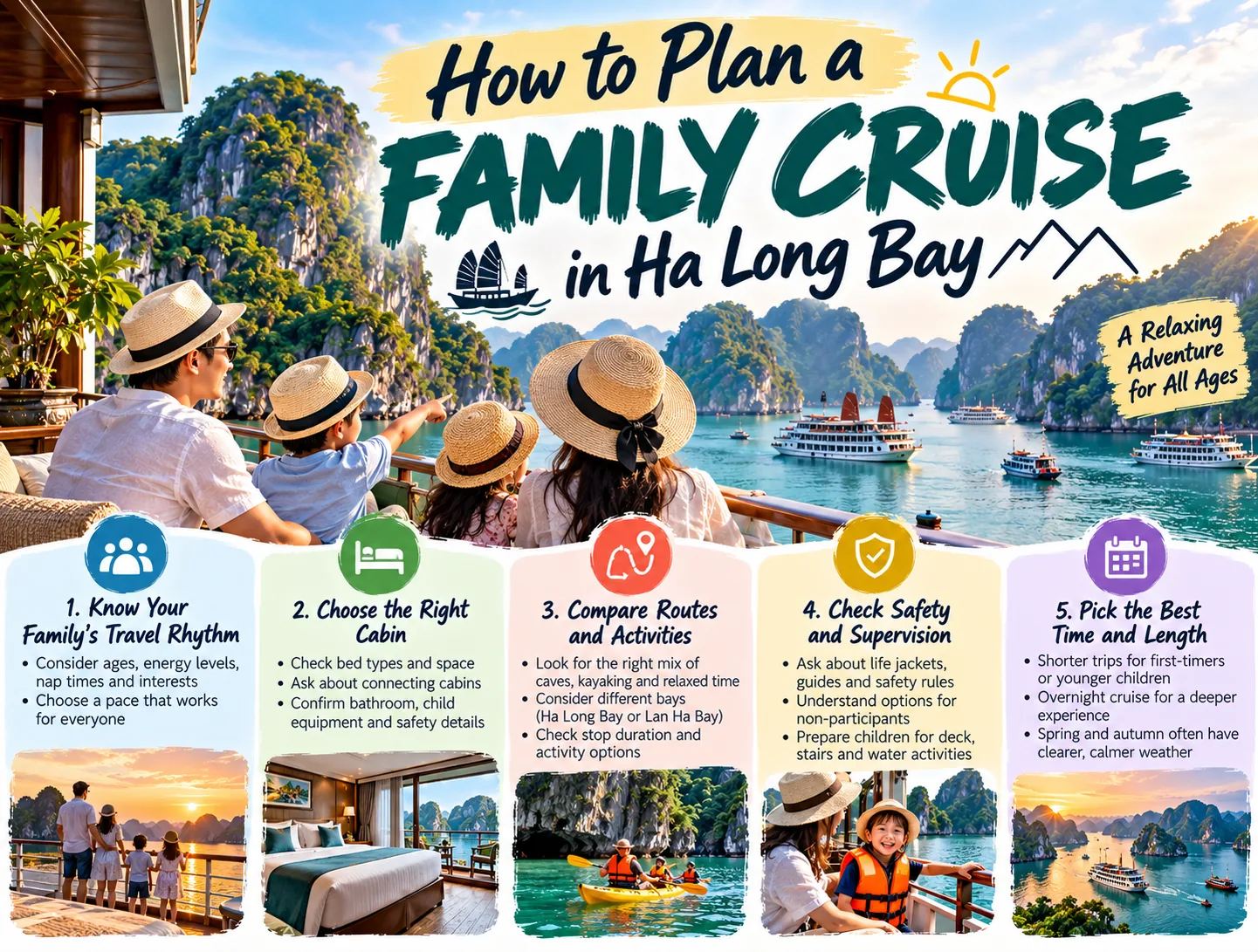
Choosing a private family cruise in Vietnam is mainly an exercise in matching expectations. Start with the family’s sleep, mobility, activity, food, and transfer needs. Compare Ha Long Bay, Lan Ha Bay, and Bai Tu Long Bay by the experience they create rather than by name alone. Confirm cabin details, weather policies, and the exact meaning of private use in writing. Then leave enough unplanned time for the bay to be enjoyed at a human pace. A thoughtful itinerary with fewer moving parts will usually give children, parents, and grandparents a better memory than an ambitious schedule that leaves everyone tired.
JOIN THE CONVERSATION
Comments (0)
No comments yet. Be the first to share a thought.