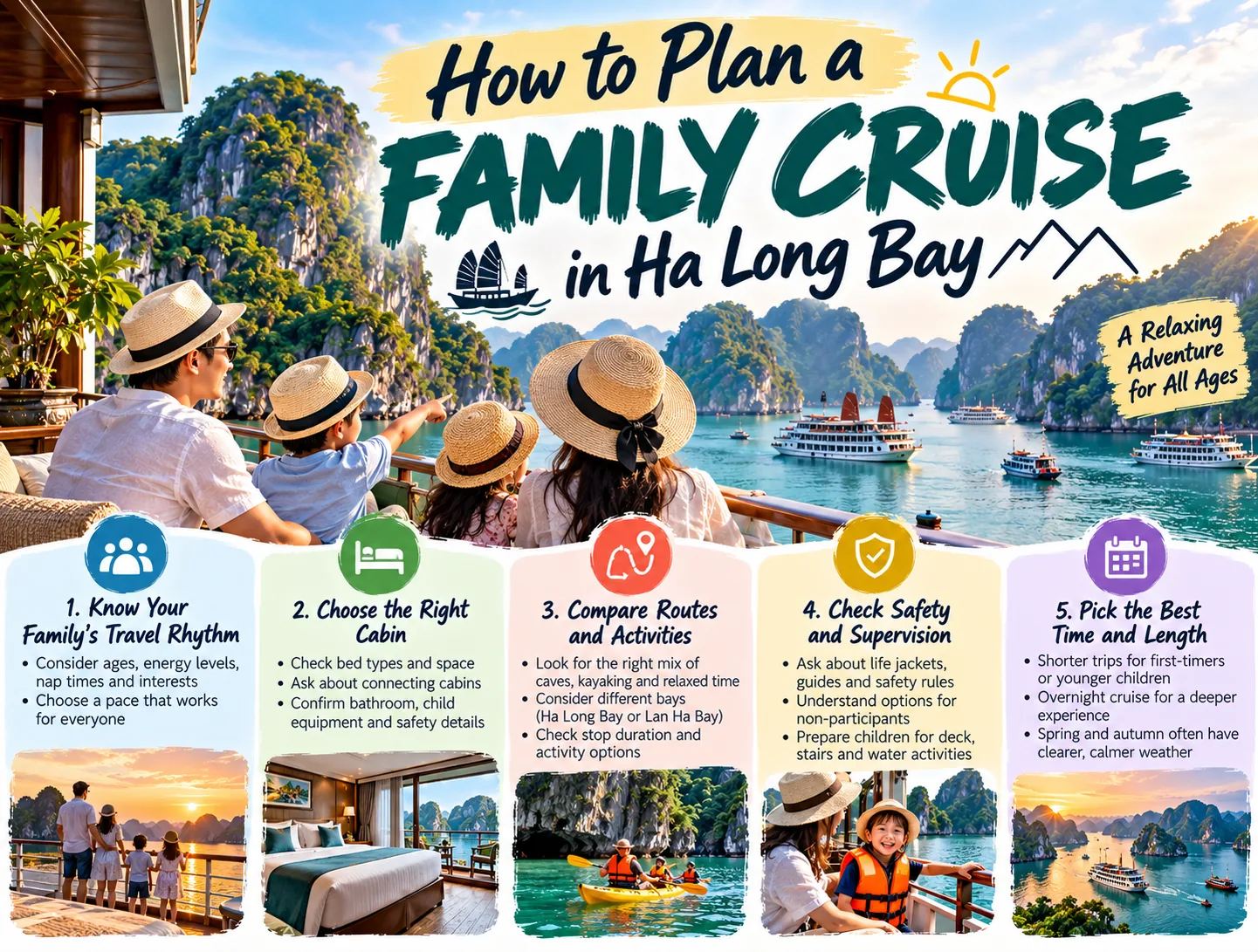
A family cruise in Ha Long Bay can be wonderfully easy to enjoy, but only if the boat, cabin and daily rhythm fit the people travelling. Children may want caves and kayaking, teenagers may want space and freedom, while grandparents may value quiet mornings, safe access and a comfortable bathroom more than a packed activity list. The best choice is not simply the most luxurious vessel or the longest itinerary. It is the cruise that makes movement, meals, sleep and shore time work for everyone.
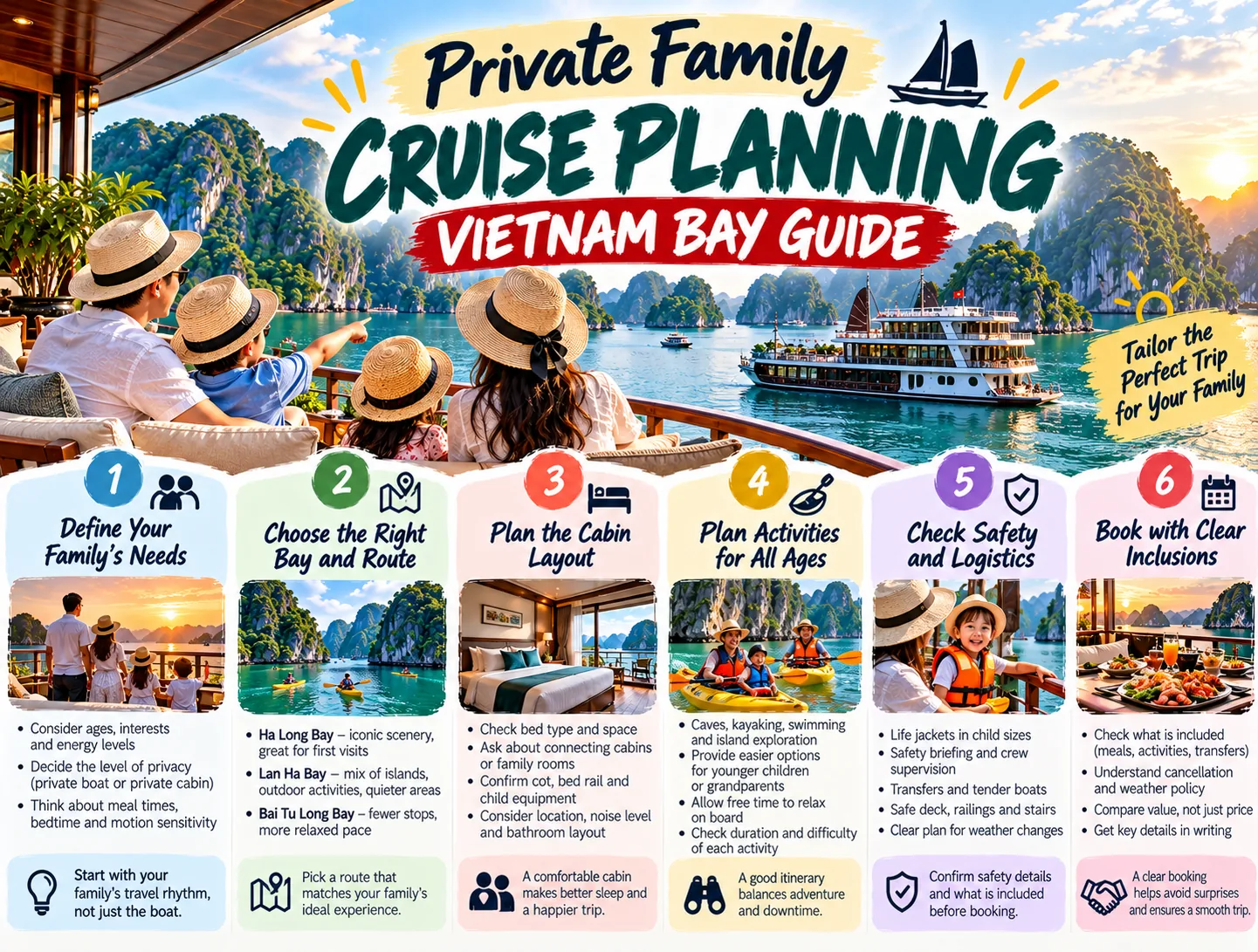
This guide focuses on the decisions families often overlook: how to choose a cabin, how to compare routes, what to ask about activities and transfers, and how to build a plan that leaves room for changing energy levels. For a broader starting point, see Planning a Bay Cruise for Families or a Private Group, then use the framework below to make your shortlist more specific.
Start with the family’s real travel rhythm
Before comparing ships, write down how your group actually travels. A family with a toddler has different needs from a group of adults travelling with an active teenager. Consider wake-up times, nap requirements, motion sensitivity, walking pace, dietary needs and how long people are happy to be together in one space. These details shape the right family cruise far more than a brochure’s list of facilities.
Match the trip length to attention spans
A shorter itinerary can be sensible for a first cruise, for families unsure about seasickness, or for children who become restless when routines change. An overnight cruise gives the bay more room to breathe and usually makes the journey feel less like a checklist, but it also means one more night in a compact cabin. If your group needs an easier test run, compare the practical differences with the advice in Overnight Cruises and ask exactly how much time is spent sailing versus visiting shore sites.
Do not assume that adding more days automatically creates a better family holiday. A well-paced itinerary with one major outing and generous downtime may be more memorable than several transfers and activities squeezed into every available hour.
Choose a cabin for sleep, not just the view
Families often begin with the balcony, but cabin layout is usually more important. Check the number and type of beds, whether a third or fourth berth is a proper bed or a converted sofa, and whether the sleeping areas can be separated. Ask for the exact cabin dimensions and a current plan rather than relying on a category name such as “family suite.” Names vary between operators.
Questions that prevent cabin surprises
Can the cabin hold the stated number of guests without blocking walkways or storage?
Are connecting cabins available, and are connecting doors guaranteed or only requested?
Is the bathroom a full-size bathroom, and does it have a shower enclosure or a wet-room layout?
Are life jackets available in child sizes, and where are they stored?
How close is the cabin to engines, stairs, public areas and crew work spaces?
Can the operator provide a cot, bed rail or other child equipment, and is it confirmed in writing?
A balcony can be useful for quiet family time, but it should not replace safe supervision. Ask about railing design, door locks and whether children can reach the handle. For grandparents or anyone with limited mobility, confirm the route from the cabin to the dining room, tender or transfer boat, and any steps involved in shore excursions.
Compare routes by activity fit
Ha Long Bay is known for karst islands, caves, kayaking opportunities and floating-village experiences. Vietnam’s official tourism guide also notes that conditions can change by season: autumn and spring are presented as clearer, calmer periods, while summer can be hot and affected by storms. Use those broad patterns for planning, but ask the operator for the current sailing and weather policy before paying.
For families, the useful question is not “Which bay is best?” but “Which route gives our group the right mix of effort and reward?” A route with a cave visit, a short paddle and relaxed sailing may suit mixed ages. Families considering a quieter alternative can also compare the Lan Ha Bay Cruises category before deciding. A more active itinerary may work for older children and teenagers who enjoy swimming, climbing or longer excursions. Use Kayaking, Caves, and Stops: Comparing Cruise Excursions to compare the activity menu, then ask how long each stop lasts and what happens if someone does not participate.
Build in an easy option for every outing
Every family member should have a dignified alternative to the hardest activity. If one person does not want to kayak, can they remain on the main boat or join a shorter walk? If a cave involves steps, is there a scenic place to wait? If the excursion leaves early, can a tired child skip it without creating a supervision problem? Operators may have different rules, so treat these as questions to confirm rather than promises.
Check safety and supervision details directly
A family cruise is not a substitute for active adult supervision. Children should understand boundaries around decks, stairs, swimming areas and tender boats before the vessel leaves. Ask the operator to explain the muster procedure, life-jacket arrangements, swimming supervision and the rules for children on kayaks or small transfer boats.
Do not infer safety standards from polished photography. Ask who leads shore activities, whether guides stay with the group, how the crew handles a separated child and what the plan is if weather changes. Families should also clarify whether a child can join each activity at their age and size, whether footwear is required and whether parents must remain with minors throughout.
For a wider operator-comparison checklist, read A Clear Checklist for Comparing Cruise Operators. It is especially useful when two cruises appear similar but differ in transfer arrangements, cancellation wording, meal flexibility or the level of included guidance.
Plan meals, motion and downtime together
Meals can determine whether a family cruise feels relaxed. Request the current meal schedule and ask what can be adapted for allergies, vegetarian diets, young children or strong dislikes. Confirm whether snacks are available between set meals and whether drinking water is included or charged separately. Avoid assuming that a child’s preferred food will be available simply because the vessel advertises a broad menu.
Reduce avoidable discomfort
If anyone is prone to motion sickness, ask where the cabin and dining areas are located relative to the vessel’s movement, and speak with a qualified medical professional about suitable precautions before travel. Keep the first day light if possible. A calm meal, a view from the deck and an early night may be a better start than immediately joining every excursion.
Downtime is not wasted time. Bring compact, quiet entertainment, but also plan screen-free periods for looking at the landscape, playing cards or sharing a simple family routine. A cruise gives families a rare chance to be together without commuting between attractions; protect some of that time instead of treating the ship only as transport.
Make transfers and embarkation part of the plan
The holiday begins before the boat leaves port. Vietnam Tourism describes Ha Long as reachable by road from Hanoi, with cruise transfers associated with Tuan Chau and Bai Chay ports. The exact arrangement depends on the operator and departure date, so confirm the pickup window, vehicle type, luggage limits, rest stops and what happens if your family arrives late.
Ask whether the transfer is shared or private, whether child seats can be arranged, and where luggage stays during embarkation. Keep medication, swimwear, a change of clothes, sun protection and essential snacks in a day bag rather than in a large suitcase that may be collected. If an older traveller or small child struggles with stairs, request a clear description of the boarding route and any tender transfer.
Also check the cancellation and delay terms before booking transport that connects tightly to the cruise. Weather-related changes, road delays and missed embarkation procedures can affect families more severely than solo travellers because there are more people, bags and needs to coordinate.
Use a simple family cruise decision checklist
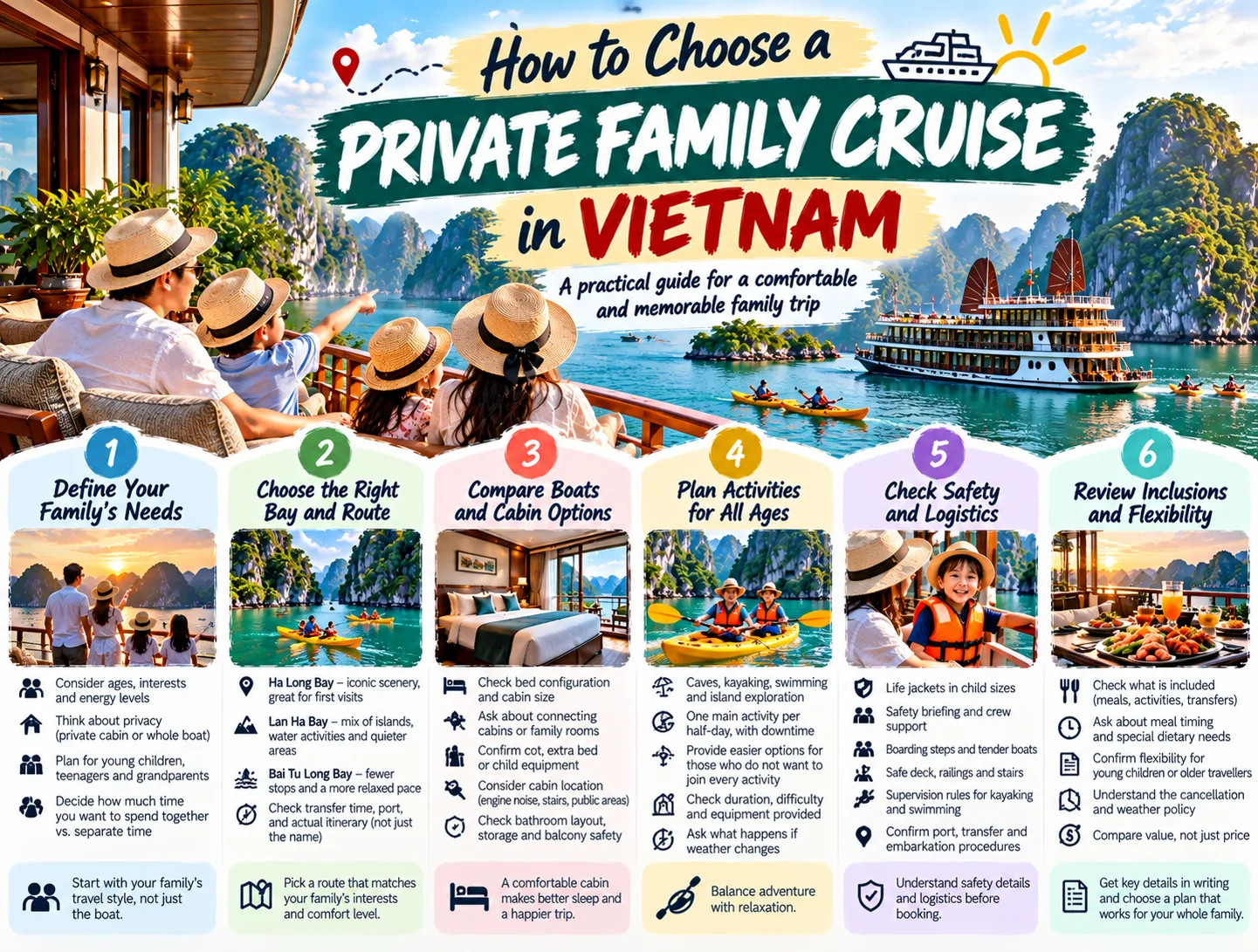
Once you have three or four options, score them against the same criteria rather than choosing the most attractive website. A useful family cruise checklist includes:
Cabin fit: real beds, usable storage, bathroom layout, connecting-room options and safe access.
Activity fit: at least one appealing activity for each age group and a realistic non-participation option.
Rhythm: enough sleep, unhurried meals and breaks between excursions.
Food: confirmed handling of allergies, dietary requests and child-friendly alternatives.
Transfers: clear pickup, port, luggage and late-arrival instructions.
Communication: written answers from the operator rather than assumptions based on generic listings.
Weather flexibility: a clear explanation of substitutions, cancellations and refunds if conditions change.
Then imagine the least enthusiastic traveller in your group. Would they still have a comfortable day if they skipped kayaking? Could they sleep if an outing starts early? Can they reach the dining room without a difficult climb? This test often reveals more than comparing room photographs.
When a private family cruise is worth considering
A private boat or private sailing arrangement can make sense when relatives have different schedules, when grandparents need a slower pace, or when your group wants more control over meals and shore time. It can also simplify communication because one booking contact handles the group’s questions. The trade-off is that the organiser may carry more responsibility for choosing the vessel, checking inclusions and confirming what is genuinely private.
Do not pay for privacy without asking what it covers. Clarify whether the whole boat is exclusive, whether activities remain shared, how many crew members are included, and whether the itinerary can change without additional charges. A private arrangement is valuable when it solves a real coordination problem, not merely because the word “private” sounds premium.
Conclusion: choose the cruise your family can enjoy together
The best family cruise in Ha Long Bay is the one that fits your group’s sleep, mobility, appetite for activity and tolerance for change. Start with cabin geometry and daily rhythm, compare routes by effort rather than marketing labels, and ask direct questions about supervision, meals, transfers and weather plans. Leave space for quiet time. When every traveller has a comfortable way to participate—or to opt out—the bay becomes the shared experience it should be, rather than a demanding itinerary that some family members merely endure.
JOIN THE CONVERSATION
Comments (0)
No comments yet. Be the first to share a thought.