A private family cruise in Vietnam can be one of the easiest ways to see the limestone islands and sheltered waters of the north without forcing every traveller into the same pace. The best choice is not simply the most expensive boat. It is the itinerary, vessel and service combination that fits your children, grandparents, privacy needs and tolerance for travel time.
This guide explains how to compare private and family-friendly cruises in Ha Long Bay and nearby waters. It focuses on decisions that matter before booking: whether to charter a whole boat, how to choose between routes, which cabin details to confirm, and how to make excursions work for a mixed-age group. For a broader starting point, compare this advice with planning a bay cruise for families or a private group.
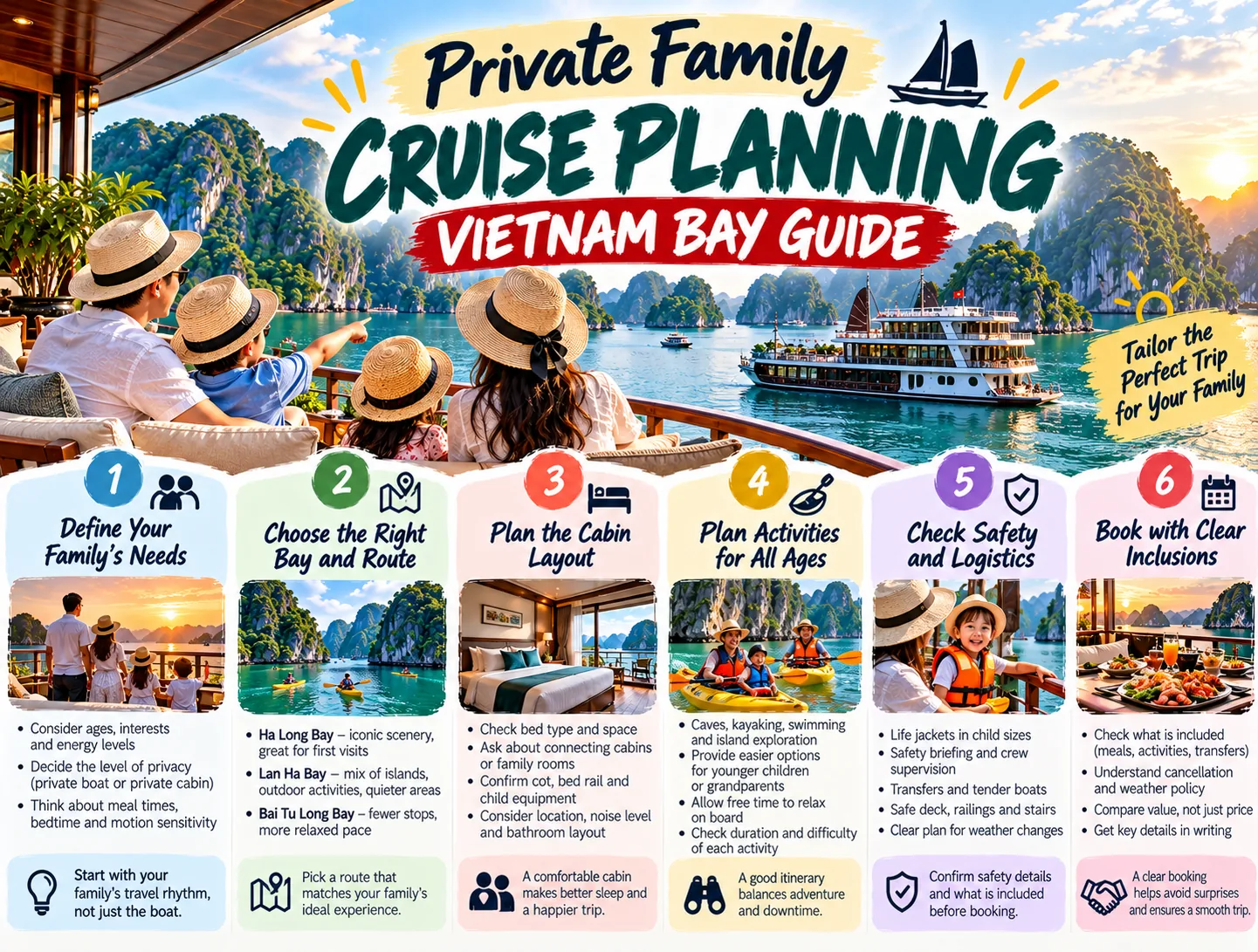
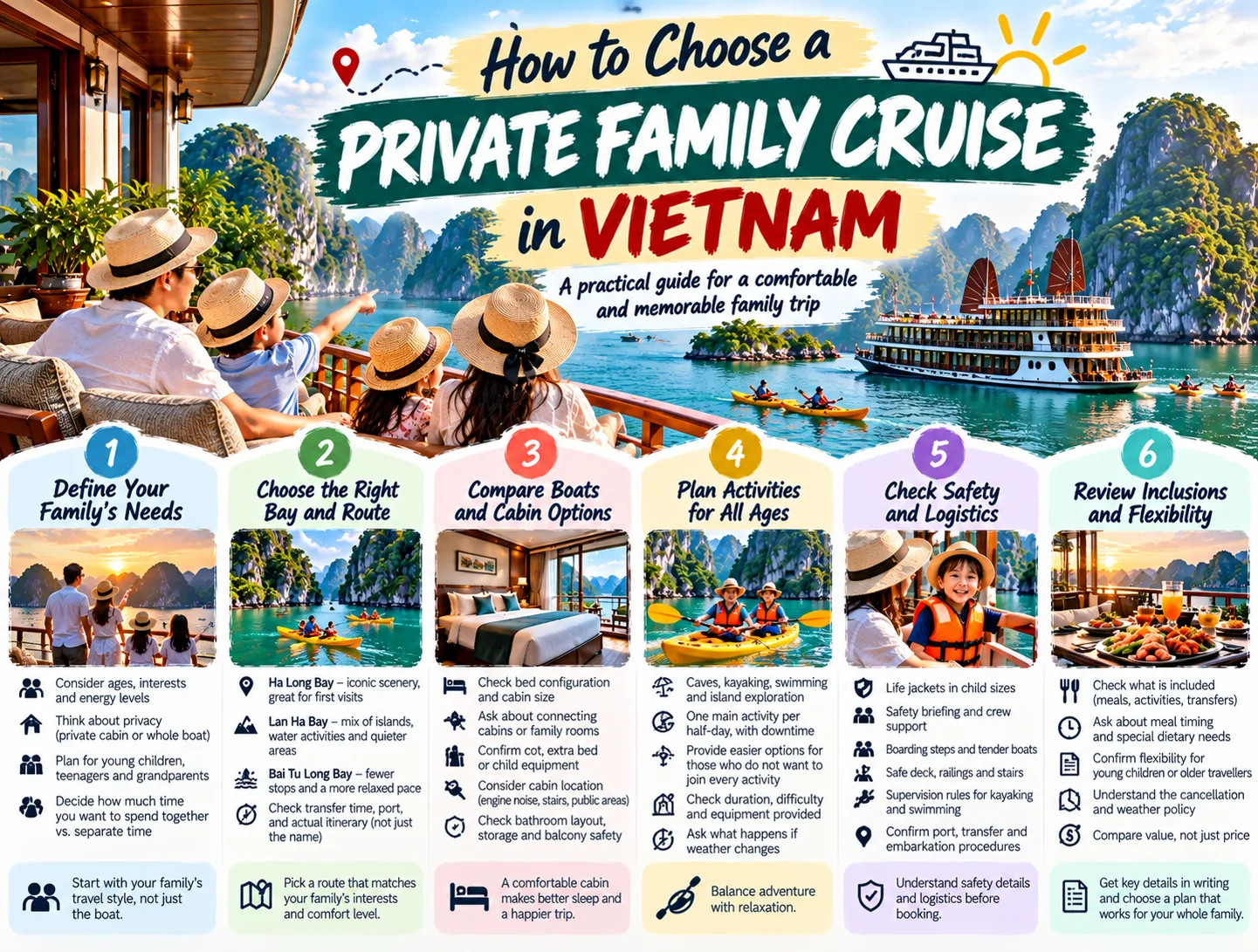
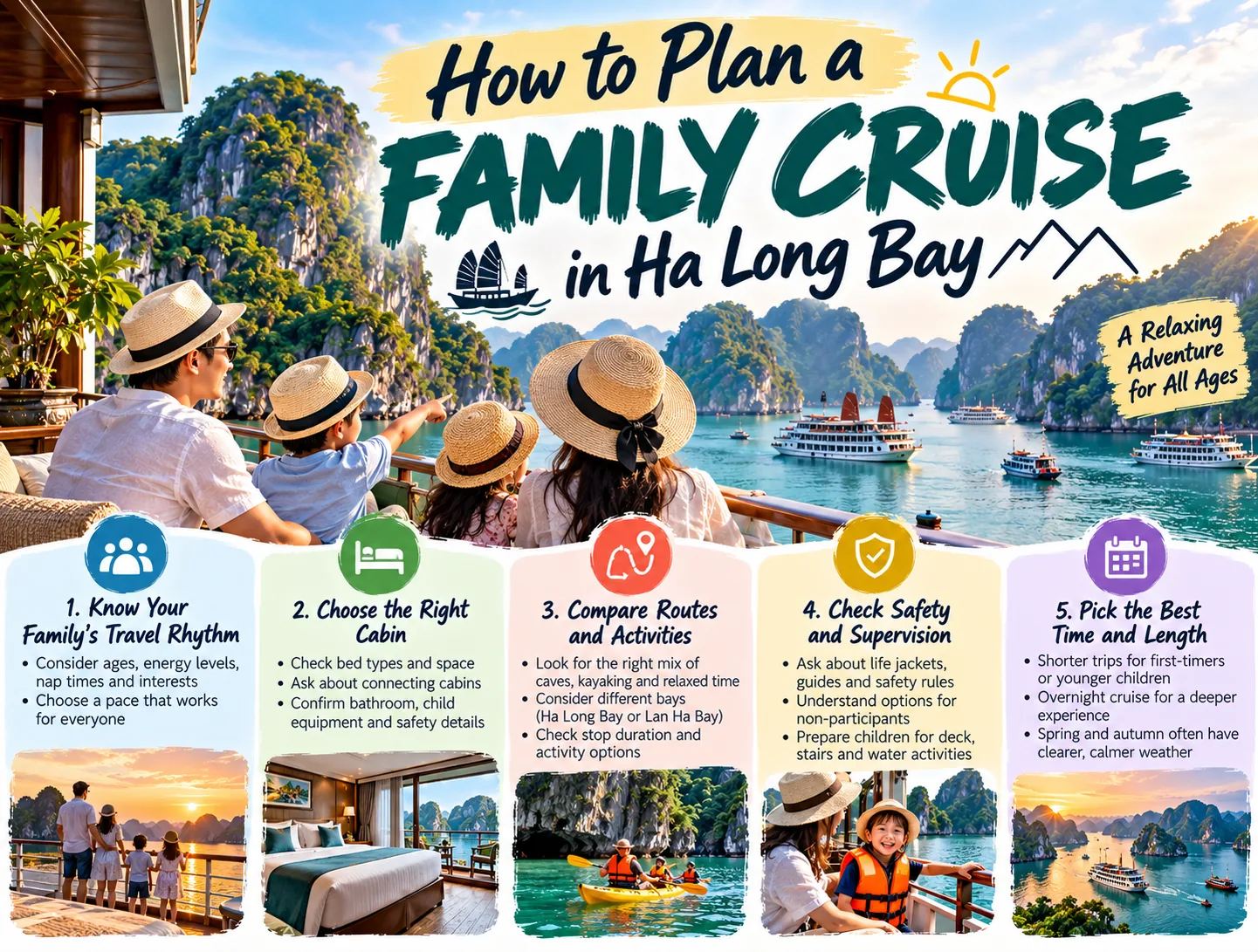
Start with the group, not the boat
Families often begin by searching for a “private family cruise” and then compare vessels by appearance. Reverse that order. Write down who is travelling, what each person needs, and what would make the trip uncomfortable. A family with two active teenagers has different priorities from a multigenerational group with a toddler and a traveller who cannot manage steep steps.
Make a simple needs list
- Number of adults, children and infants, including their ages.
- Whether anyone needs a connecting cabin, a single-level route, a quiet sleeping area or help boarding.
- Preferred trip length: a day, one night or two nights.
- Activities the group genuinely wants, such as kayaking, swimming, cooking or relaxing on deck.
- Food restrictions, allergies, medication requirements and preferred meal times.
- How much privacy matters compared with shared facilities and a larger activity programme.
A private charter can make meal times and daily pacing more flexible, but it does not remove the physical realities of a boat. Cabins may be reached by stairs, decks can be wet, and tender transfers may be required for shore activities. Ask about those details before paying a deposit rather than assuming “private” means fully accessible.
Decide what private actually means
“Private cruise” can describe several arrangements. A whole-boat charter gives your group exclusive use of the vessel. A private cabin on a shared cruise gives you personal sleeping space but keeps meals, excursions and many facilities communal. A private day boat may offer a tailored route without the cabins or overnight rhythm of a larger vessel.
Whole-boat charter
This is usually the best fit when the group wants control over its schedule, dining atmosphere and social space. It can be useful for grandparents and children travelling together because the group can agree on shorter activity windows and quiet periods. Confirm the boat’s maximum capacity, not only the number of cabins. A vessel that technically sleeps your party may still feel cramped when everyone is inside during poor weather.
Private cabins on a shared cruise
This option can suit smaller families who want predictable facilities and a ready-made itinerary. It may cost less than chartering a vessel, but the group will usually follow shared meal times, activity departures and route decisions. Check whether children can opt out of an excursion without leaving an adult behind, and whether the boat has a calm indoor lounge.
Private day boat
A private day cruise can work well for families with very young children, travellers who dislike sleeping on boats, or groups combining a bay visit with a wider itinerary. The trade-off is less time on the water and less opportunity to spread activities across two days. Compare the transfer time to the pier with the actual sailing time.
Choose the route around energy levels
Ha Long Bay, Lan Ha Bay and Bai Tu Long Bay can all appear in cruise searches, but a family should compare the experience rather than choose only by name. Routes differ in scenery, transfer arrangements, activity stops and the amount of time spent moving between places.
Ha Long Bay is the familiar choice for dramatic limestone scenery and a wide range of cruise products. Lan Ha Bay is often considered when families want a route associated with Cat Ba and a mix of water-based activities and island landscapes. Bai Tu Long Bay may appeal to travellers who value a quieter-feeling itinerary, although the right choice depends on the exact vessel and departure plan. Use the site’s guides to Ha Long Bay cruises, Lan Ha Bay cruises and Bai Tu Long Bay cruises to compare route-specific questions.
Match the route to the youngest traveller
Young children may enjoy the view but struggle with long road transfers, late meals, repeated boat changes or a full schedule of excursions. Ask how long it takes to reach the embarkation point, whether a family can board early, and what happens if a child needs a nap while the rest of the group is kayaking. A route with fewer ambitious stops may produce a happier trip.
Match the route to the oldest traveller
For older adults, ask about boarding surfaces, stairs, bathroom access and the distance between the cabin, dining room and sun deck. Also check whether the itinerary requires climbing into a small transfer boat. The most scenic route is not automatically the most comfortable if every excursion involves unstable footing.
Compare cabins and onboard space carefully
Cabin photographs rarely answer the questions families need answered. Request a deck plan or a clear description of cabin positions. A family cabin may contain one large bed, extra berths, a sofa bed or a rollaway arrangement, and each setup changes how comfortably people can move around.
- Ask whether beds can be configured as twins, doubles or a family arrangement.
- Confirm the number of bathrooms and whether a cabin has a full shower enclosure.
- Check if connecting cabins are genuinely adjoining or merely nearby.
- Ask about balcony rails, window locks and child-safety features.
- Find out whether air conditioning, hot water and power outlets are available overnight.
- Identify an indoor common area in case wind, rain or tired children make the open deck unsuitable.
Cabin location matters too. Rooms near the engine, kitchen, anchor point or stairwell can be less peaceful. A balcony cabin may help a family get fresh air without sending a child to an exposed deck, while a central cabin can be more convenient for anyone with limited mobility.
Build a realistic family itinerary
A good private cruise itinerary has space between highlights. Trying to fit every cave, beach, viewpoint and water activity into one day can turn a relaxing charter into a sequence of queues and transfers. Ask the operator to identify the two or three experiences that matter most, then protect time for meals, naps and unplanned observation.
Activities for mixed ages
Kayaking can be memorable for older children and adults, but it is not the only way to experience the water. Depending on the route and conditions, a family may prefer a short tender ride, a calm swim, a viewpoint, a cave visit or time on deck. Read the detailed comparison in kayaking, caves and stops on cruise excursions before promising a particular activity.
Ask whether children must meet a minimum age or swimming ability for kayaking and whether life jackets are available in suitable sizes. Find out whether a non-participating adult can remain onboard with a child.
Keep the schedule flexible
For a private boat, request a sample timetable rather than a rigid promise. Weather, tide, port procedures and local operating decisions can alter the order of stops. A useful schedule shows approximate windows for boarding, meals, activities and rest, while leaving room for safe adjustments.
Ask direct questions about safety and service
Safety information should be specific. A trustworthy operator should explain emergency procedures, life-jacket availability, crew responsibilities and how children are supervised during transfers. Do not rely on “family-friendly” as proof that a boat suits your group.
Before booking, ask:
- How many trained crew members will be onboard and who is responsible for guest safety?
- Where are life jackets stored, and are child sizes available?
- What is the procedure if weather changes or an excursion is cancelled?
- Can the crew accommodate allergies, and how are meals prepared separately?
- What medical support and communication equipment are available?
- Are children allowed on every deck, and are there restricted areas?
- What happens if a passenger becomes seasick or needs to leave early?
These are part of comparing cruise operators, just as you would compare cancellation terms and inclusions. The guide to comparing cruise operators can help organise the answers.
Plan food, sleep and daily comfort
Family comfort is often decided by small routines. Tell the operator about allergies and dietary restrictions in writing, including whether cross-contact is a concern. Ask how much notice the kitchen needs and whether children can receive simpler meals if a formal menu is unsuitable.
Sleep deserves equal attention. Ask whether the boat can serve an earlier meal, whether the cabin is quiet after a stated time, and whether blackout curtains or other window coverings are provided. Bring familiar sleep items where practical, but do not overload the cabin.
Pack lightweight layers, non-slip footwear, sun protection, insect protection where appropriate, swimwear, medication and a small waterproof bag for phones. Keep essential items in hand luggage for boarding. For a longer sailing, review the advice in the overnight cruises category.
Understand the price before comparing quotes
Private cruise prices are difficult to compare when one quote includes transfers, meals and activities while another lists the boat alone. Request an itemised proposal identifying the vessel, dates, cabin arrangement, route, meals, transfers, excursions, taxes or port charges, and child policy.
Ask which services are included and which are optional. A low headline price may exclude a Hanoi transfer, private guide, drinks, special meals or an activity. A higher quote may represent a smaller boat, more flexible staffing or a genuinely private arrangement. Compare like with like and read cancellation and weather clauses before paying.
Use Cat Ba and the bay responsibly
The Cat Ba area combines marine landscapes, limestone islands, forest and valuable biodiversity. The official Cat Ba National Park site describes forest, marine, mangrove, seagrass and coral ecosystems, and presents kayaking, small-bay exploration, trekking and community experiences as activities that should sit alongside conservation. Exclusivity should mean a more thoughtful experience, not permission to ignore local rules.
Follow crew instructions about where to land, swim or anchor. Do not remove shells, plants or rocks, and keep food packaging secured. Families can make the trip educational by asking children to observe wildlife quietly, use refillable bottles where possible and understand why some areas are protected. If your group wants a quieter itinerary, compare the guide to a quieter Bai Tu Long Bay route.
A booking checklist for private family cruises
Before confirming, save the operator’s written answers and check that the final proposal matches what was discussed. Your checklist should include:
- The exact vessel, cabin layout and maximum passenger capacity.
- Whether the booking is a whole-boat charter, private cabin or private day boat.
- The embarkation point, transfer time and boarding arrangements.
- The route, approximate activity schedule and alternatives for non-participants.
- Child policies, life-jacket sizes, stair access and transfer-boat requirements.
- Meals, allergies, drinks, special requests and included services.
- Cancellation, weather, itinerary-change and medical-emergency procedures.
- The total price, payment schedule and every excluded charge.
If the answers are vague, keep comparing. A private family cruise should reduce uncertainty before departure, not create new questions after the boat leaves the pier.
Conclusion
The best private family cruise in Vietnam is the one that fits the people travelling, not the one with the longest itinerary or most polished photograph. Start with ages, mobility, sleep and food needs. Then compare the meaning of “private,” choose a route around energy levels, inspect the cabin arrangement, and ask direct questions about safety and weather changes. With those details settled, your group can spend less time managing logistics and more time enjoying the limestone seascape together.
JOIN THE CONVERSATION
Comments (0)
No comments yet. Be the first to share a thought.