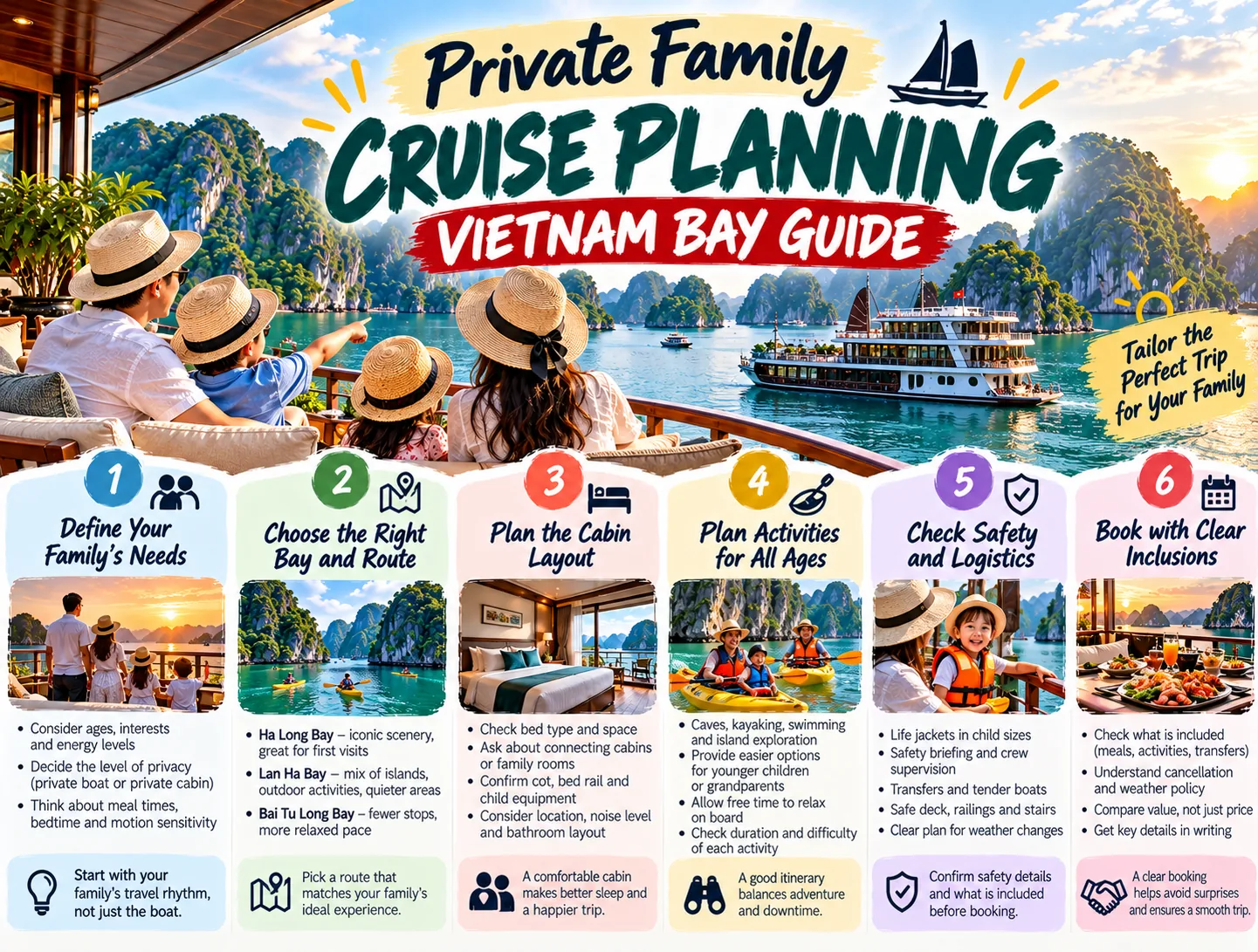
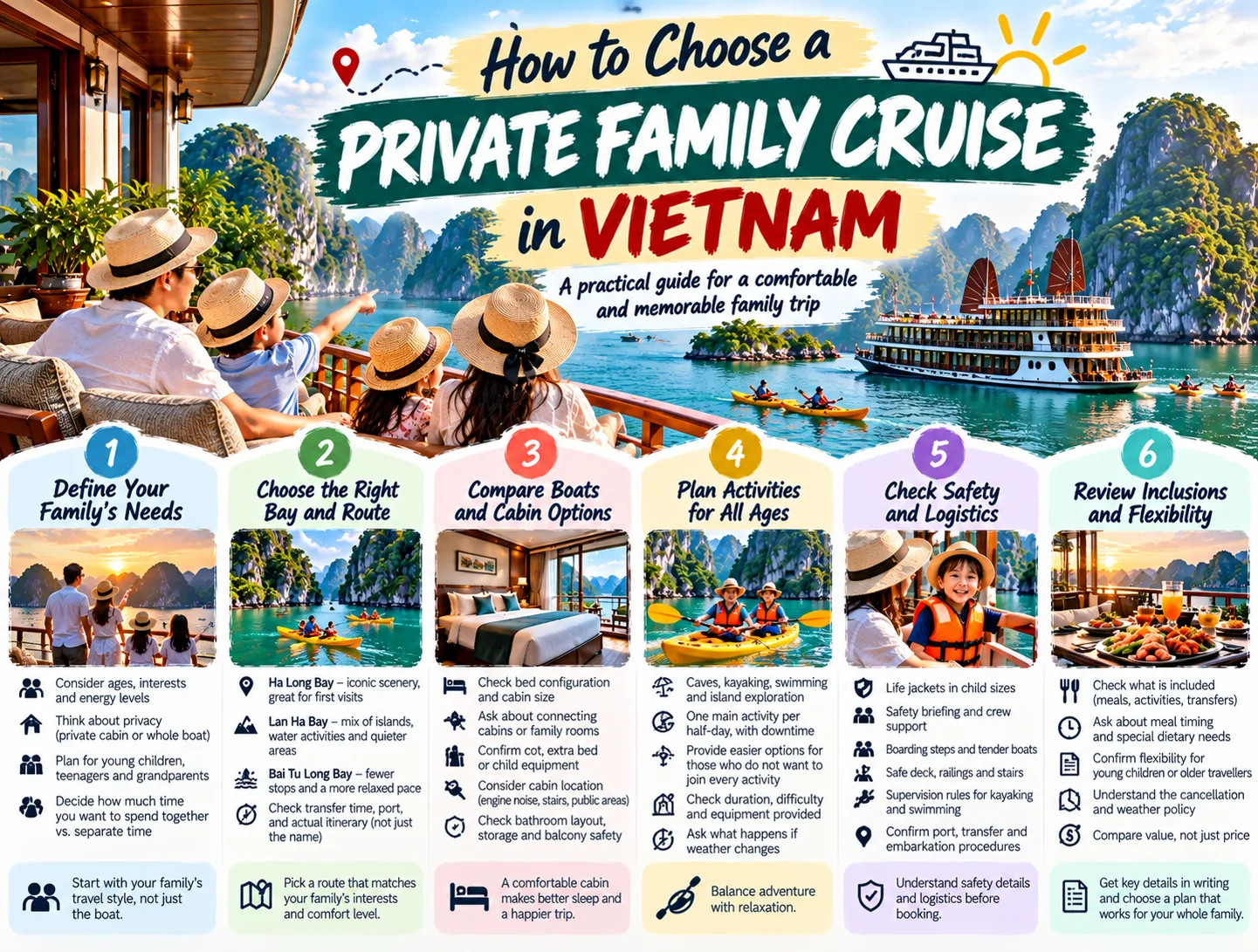
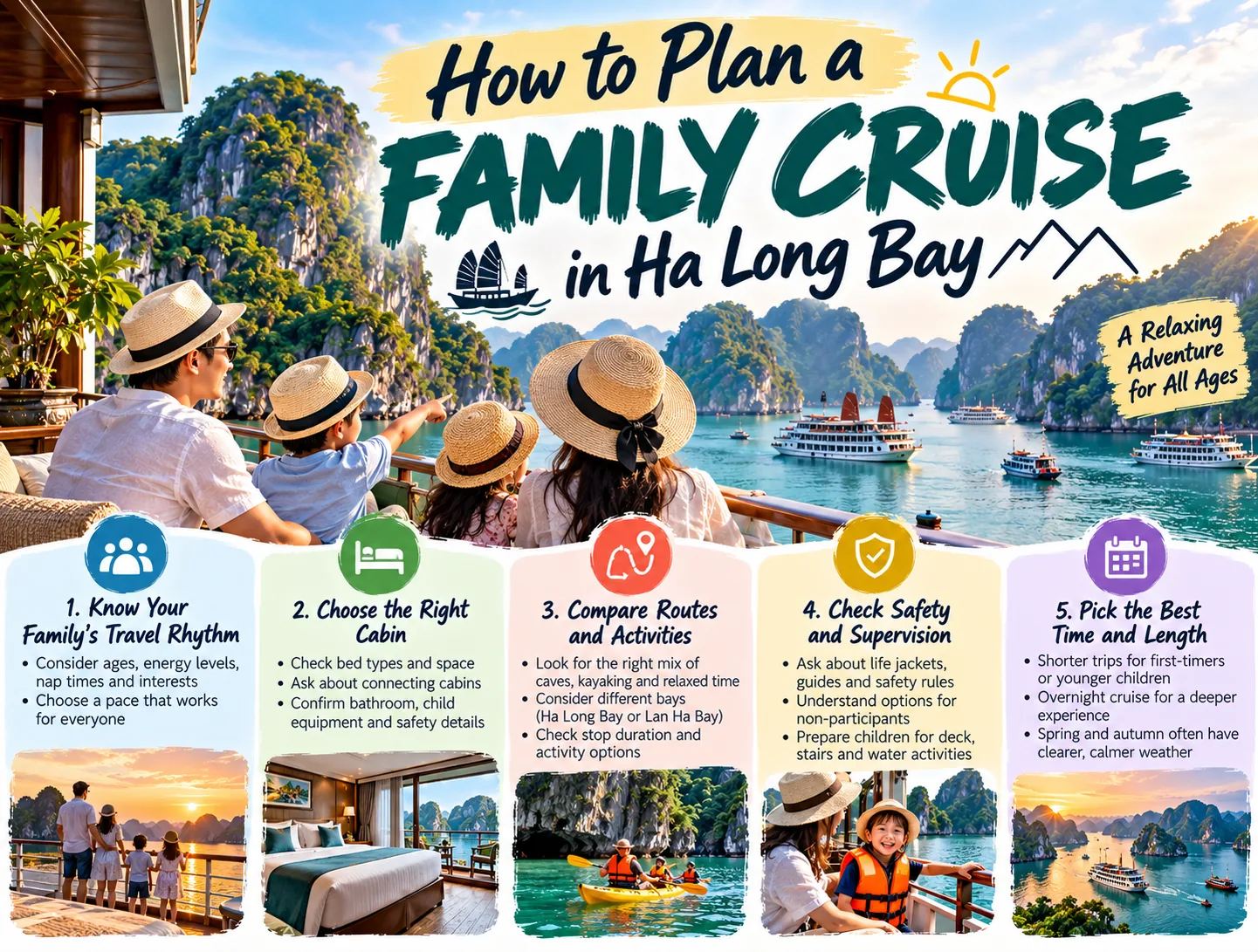
Planning a private family cruise in Vietnam is less about finding the biggest boat and more about matching the trip to the people on board. Parents may want quiet time and predictable logistics, while children need room to move, flexible meals, and excursions that feel manageable rather than rushed. A private arrangement can solve many of those tensions, but only when the route, cabin plan, transfer schedule, and safety expectations are agreed before booking.
Start with the kind of privacy your family actually needs
“Private cruise” can describe several different products. A family might reserve a private cabin on a shared vessel, book a private day boat, charter a small overnight boat, or reserve every cabin on a larger vessel. These options create very different experiences, so define privacy before comparing operators.
Private cabin or private boat?
A private cabin gives your family a personal sleeping space while retaining the social atmosphere and standard itinerary of a shared cruise. It can be a sensible choice for one family that enjoys meeting other travellers and does not need to alter every stop. A private boat, by contrast, gives you more control over departure timing, activities, meals, and quiet time. It is especially useful for grandparents, several related households, or a group with mixed ages.
Ask whether “private” means exclusive use of the vessel, exclusive use of a cabin, or simply a private transfer. Get the answer in writing. Also check which parts remain fixed: port check-in, safety briefing, meal times, permitted swimming areas, and the return schedule may still follow local operating rules.
Choose the trip around the youngest traveller
Build the plan around the child who has the shortest attention span, the earliest bedtime, or the strongest motion sensitivity. A beautiful itinerary is not family-friendly if it requires repeated long transfers, late dinners, or several activity changes in one day. Families with toddlers may value a short sailing period and easy access to the cabin. Families with older children may prefer more time for kayaking, swimming, cycling, or exploring an island setting.
For a useful starting point, compare the planning principles in Planning a Bay Cruise for Families or a Private Group, then use this guide to make the private-versus-shared decision more specific.
Pick the bay and route by experience, not by label
Ha Long Bay, Lan Ha Bay, and Bai Tu Long Bay are often presented as interchangeable choices, but families may notice differences in pace, landscape, and the balance between sightseeing and free time. The right route is the one that makes the day comfortable for your group.
Ha Long Bay for classic scenery and first visits
A Ha Long Bay cruise can suit families who want the iconic limestone-island setting and a straightforward introduction to a famous destination. Before booking, ask how much time is spent travelling between stops and how many organised activities are included. A full schedule can sound impressive in a brochure but may leave little space for naps, unplanned play, or simply watching the scenery from the deck.
Lan Ha Bay for a broader island-and-water itinerary
A Lan Ha Bay family cruise may appeal to groups that want a combination of seascape, quieter corners, and outdoor activities. Ask whether the programme involves transfers to a separate day boat, how long any paddling session lasts, and whether an alternative is available if a child does not want to kayak or swim. The site’s Lan Ha Bay Cruises category can help you compare route ideas without treating every itinerary as identical.
Bai Tu Long Bay for a deliberately slower rhythm
Families who prefer fewer scheduled stops may want to investigate Bai Tu Long Bay. The key question is not whether the route is “quietest,” a claim that can change with season and operator, but whether the proposed programme leaves enough time between activities. Review Considering a Quieter Route to Bai Tu Long Bay alongside the operator’s current itinerary and ask what happens when weather changes the order of stops.
Build the cabin plan before you compare facilities
Cabin design often matters more to a family than a long list of onboard facilities. Look for the actual sleeping arrangement, not just the maximum passenger number. Confirm whether extra beds are permanent or converted from seating, whether children share a bed with an adult, and whether adjoining or connecting cabins are available.
Questions for families with young children
Can the crew provide a cot, bed rail, or another child-suitable arrangement, and must it be requested in advance?
Is there enough floor space for luggage, changing, and a tired child to settle down?
Can the cabin be reached without frequent stairs, and is the bathroom practical for the youngest traveller?
Are doors, balconies, windows, and railings suitable for your family’s supervision needs?
Do not assume that a family room is automatically the best choice. One larger room may keep everyone together but offer less privacy and fewer quiet moments. Two nearby cabins may work better for older children and grandparents, provided the operator confirms the layout and access. Request a current deck plan or a video walkthrough when the published room description is vague.
Think about noise and sleep
Ask where the cabin sits relative to the engine room, kitchen, lounge, stairs, and outdoor deck. A family may prefer being close to public areas during the day but may sleep better away from evening activity. On a private boat, ask whether the group can choose a quieter dining or lounging pattern, rather than assuming the entire vessel will become silent after dinner.
Test the itinerary against real family energy
The best family cruise itinerary has a dependable rhythm: travel, look around, eat, rest, and choose an activity. It should not require every traveller to perform at peak energy from morning until night. Ask the operator to separate included activities from optional ones and identify which parts require transfers into smaller boats.
Make active excursions flexible
Kayaking, swimming, cave visits, cycling, and short walks can be memorable, but they should not be treated as compulsory tests. Confirm minimum ages, life-jacket availability, supervision arrangements, footwear guidance, and the fallback plan for anyone who sits out. If your group includes children who cannot swim, ask whether they can remain safely on the main boat while others take part.
For a broader way to assess the activity mix, see Kayaking, Caves, and Stops: Comparing Cruise Excursions. The practical issue is not collecting the most activities; it is choosing the ones your family will still enjoy after a transfer, a meal, and changing weather.
Protect unplanned time
Leave a buffer each day for reading, games, a nap, or a slow meal. Children often remember the deck, the view, or a shared snack as vividly as a formal excursion. If you are comparing a one-day option with an overnight stay, the Day Cruises and Overnight Cruises categories provide useful starting points for weighing pace against depth.
Clarify transfers, meals, and communication
A private family cruise is only as easy as the journey around it. Ask what is included from the moment you leave your hotel until you return: hotel pickup, road transfer, port fees, tender or speedboat transfers, luggage handling, and return transport. Confirm the meeting point, expected arrival time, and what happens if traffic or a delayed flight affects the schedule.
Food deserves equal attention. Share allergies, intolerances, religious requirements, texture preferences, and children’s reliable foods before departure. Ask whether meals are fixed menus, set courses, or flexible orders, and whether a simple early meal is possible for younger children. Do not assume that a “western option” covers every need. A private boat may offer more flexibility, but only if the kitchen and crew have been briefed before sailing.
Also check how the operator communicates during the trip. Is there a crew member who speaks a language your family can use comfortably? Can parents reach the guide from the cabin? Is there a clear procedure for weather updates, a child becoming unwell, or an activity being cancelled? These questions are more valuable than vague promises of personalised service.
Use safety questions as a booking filter
Safety should be discussed plainly and without alarm. Ask which vessel will operate the trip, how many guests it carries, what child-sized life jackets are available, and where the muster point is. Find out how the crew handles a medical concern, whether the route has access to shore-based care, and what happens if the weather makes the planned route unsuitable.
Parents should also inspect the physical environment during boarding. Keep children away from working areas, mooring equipment, galley spaces, and railings. Establish a simple rule for deck time, especially when the surface is wet or visibility is poor. If anyone in the group has limited mobility, disclose that before payment and ask about gangways, steps, tenders, and shore excursions rather than relying on general accessibility language.
For a second layer of due diligence, use A Clear Checklist for Comparing Cruise Operators. A professional operator should answer specific questions consistently and explain what is fixed, what is flexible, and what is subject to weather or local operating decisions.
Compare value by total family effort
The cheapest quote is not necessarily the lowest-cost family trip. Compare the full package: transport, meals, drinks, activities, extra beds, private transfers, port charges, and any required supplement for a child or an exclusive boat. Then add the less visible cost of inconvenience. A longer road transfer, a complicated boarding process, or a schedule that forces extra hotel nights may change the real value.
Ask for a written list of inclusions and exclusions. Clarify cancellation terms, weather-related changes, and whether an unused excursion receives any credit. If the group is large enough to consider a full charter, request the maximum and minimum passenger numbers, not only the headline rate. A private boat can become good value when it replaces several cabins and gives the group control over the day, but it can be poor value if most of the vessel remains unused.
Keep the comparison practical: one family may pay more for an easier transfer and a calmer cabin location, while another may prefer a shared vessel with a shorter programme. The right choice protects energy, sleep, and flexibility rather than simply maximising facilities.
A simple booking checklist for your family
Write down each traveller’s age, sleep needs, dietary needs, mobility considerations, and comfort with water-based activities.
Choose the privacy level: private cabin, private day boat, or exclusive overnight charter.
Shortlist the route by pace and activity pattern, not only by destination name.
Request the current cabin layout, deck plan, and sleeping configuration.
Ask for transfer details, meal arrangements, safety equipment, and weather procedures in writing.
Identify which excursions are optional and what children can do instead.
Compare the complete price and cancellation terms before paying a deposit.
Save the operator’s emergency contact and the confirmed meeting details offline.
Before finalising, compare the route with the wider Private & Family Cruises category so you can spot whether the proposed trip genuinely fits this type of travel or simply uses family language in a standard itinerary.
Conclusion: design the calmest version of the trip
A private family cruise in Vietnam works best when privacy serves a clear purpose: easier sleep, flexible meals, manageable excursions, or time together without a rigid group schedule. Start with the youngest or least confident traveller, verify the cabin and transfer details, and ask direct questions about safety and weather changes. Then choose the bay and boat that support your family’s rhythm. A carefully matched itinerary will feel more luxurious than a crowded schedule full of features no one has the energy to enjoy.
JOIN THE CONVERSATION
Comments (0)
No comments yet. Be the first to share a thought.