Choosing a Vietnam bay cruise is easier when you compare the booking decision, not just the photographs. A polished website can still leave important questions unanswered about the route, cabin, transfers, meals, excursions, weather procedures, and cancellation terms. This guide gives you a practical way to compare cruise options before paying a deposit.
Start with the experience you actually want
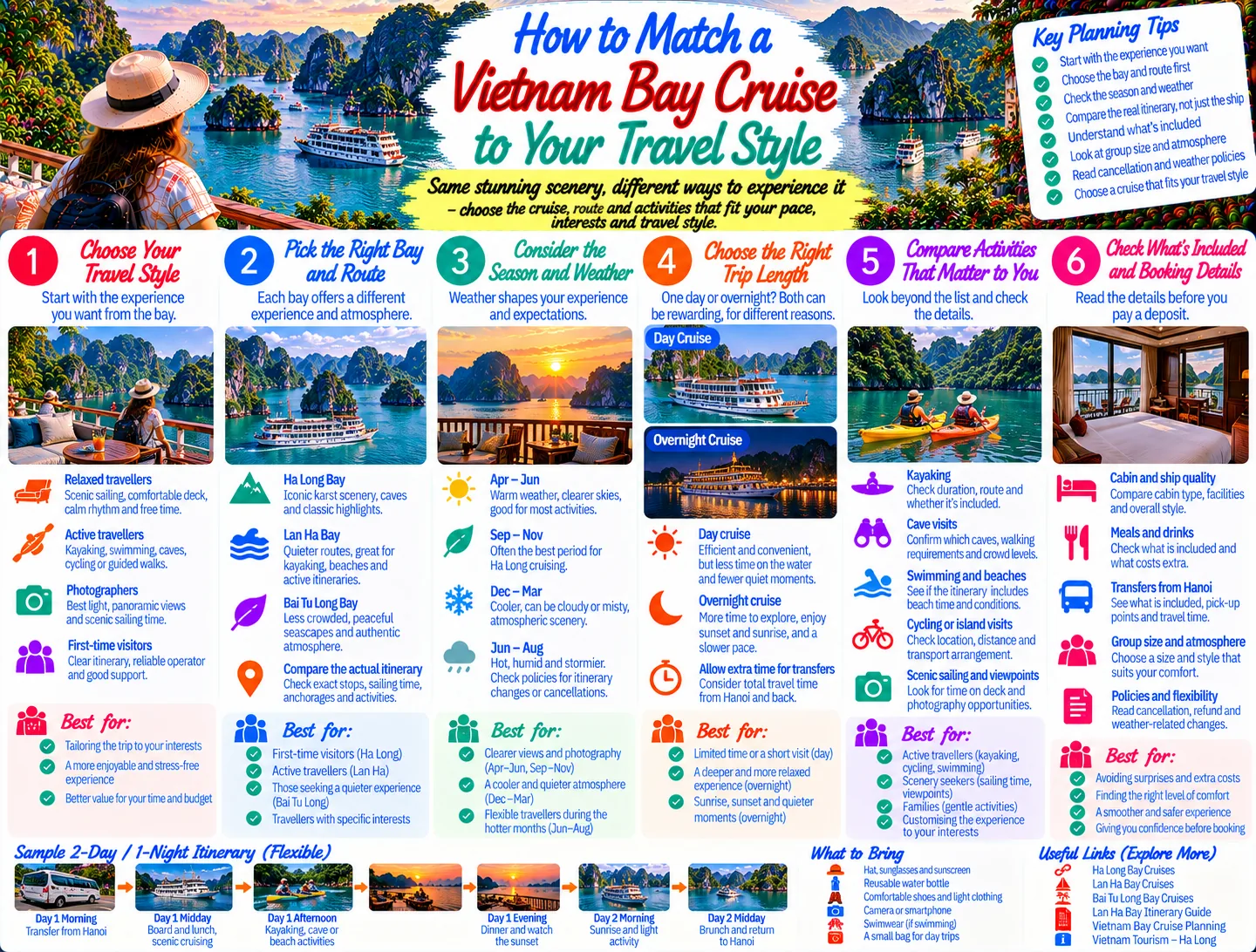
Write down your priorities before opening booking pages. You may want dramatic limestone scenery, a quiet sailing, active excursions, a comfortable cabin, a short transfer from Hanoi, or a relaxed schedule with more time on board. These priorities matter because no itinerary maximises every benefit.
For a short trip, prioritise a realistic embarkation schedule and a route with activities you genuinely want to do. For a longer holiday, you may prefer a slower itinerary, a larger cabin, or a second night that reduces the feeling of travelling from one scheduled stop to another. Treat route names as starting points and read the actual programme for each sailing.
Compare the route line by line
Look for the embarkation port, the areas visited, the time spent cruising, and the number of shore stops. Ask whether the advertised highlights are viewed from the boat or visited on foot, and whether an excursion requires a tender, transfer, stairs, or a particular level of fitness.
A useful comparison table should include departure and return times, transfer arrangements, kayaking or rowing opportunities, cave or village visits, swimming conditions, and what happens if weather changes the programme. Avoid treating a longer list of stops as automatically better. A crowded schedule can leave less time to enjoy the scenery.
Check what the fare really includes
Separate the advertised cruise fare from the complete trip cost. Confirm whether the price includes Hanoi transfers, port or entrance fees, meals, drinks, activities, equipment, single supplements, and taxes. If a transfer is optional, record its price and pickup area separately. If meals are included, check whether special diets must be requested in advance.
Also ask about onboard extras. Drinks, spa treatments, premium excursions, private transfers, and tips may be handled differently by each operator. A cheaper headline price is only better when the inclusions match the trip you want.
Evaluate the cabin beyond the photographs
Compare the cabin’s usable space, bed arrangement, window or balcony, bathroom layout, storage, ventilation, and location on the boat. Ask whether the pictured cabin is the exact category being sold. Families should confirm connecting rooms, extra beds, child policies, and cabin occupancy limits rather than relying on a generic family label.
Cabin position can affect convenience and motion. If anyone in your party is sensitive to movement, ask the operator which cabin locations are generally steadier and whether the boat has accessibility limitations. These are questions for the cruise company because vessel layouts and policies differ.
Read reviews as evidence, not as a score
Recent reviews are most useful when they describe specific parts of the trip: cleanliness, communication, transfer coordination, food handling, cabin accuracy, activity timing, and how staff responded when plans changed. Look for patterns across multiple review sources and dates. One dramatic complaint or one perfect rating is not enough to assess an operator.
Compare review claims with the current itinerary and booking terms. A review may describe a different vessel, season, cabin category, or route. Note what is directly observed, what is an opinion, and what the operator has promised in writing.
Understand weather and disruption procedures
Ask what happens if authorities, the port, or the operator changes the sailing plan because of weather or operating conditions. Confirm whether you receive a refund, a rebooking option, a shortened trip, or a land-based alternative, and whether transfer costs are treated separately. Do not assume that a general “weather policy” covers every scenario.
Save the policy that applies to your booking, including deadlines for changes and the contact method used outside office hours. Conditions and operational decisions can change, so confirm the latest details shortly before departure.
Check cancellation and payment terms before booking
Read the cancellation schedule from the date your payment is made, not only the date of departure. Check deposits, balance deadlines, amendment fees, no-show rules, name changes, and the treatment of optional transfers or excursions. Ask who is responsible for a refund if a booking platform, agency, or cruise operator is involved.
Use a written message for any promise that affects your decision. Keep the confirmation, invoice, itinerary version, inclusions, and cancellation terms together. If the answer is vague, consider that uncertainty part of the comparison.
A simple Vietnam bay cruise comparison checklist
- Does the route match your preferred scenery, pace, and activities?
- Are the port, transfer, pickup, and return arrangements clear?
- Does the fare list every major inclusion and likely extra?
- Does the cabin description match the category you will receive?
- Do recent reviews show consistent evidence about service and communication?
- Are weather, cancellation, payment, and rebooking rules written clearly?
- Can the operator answer your practical questions before payment?
Final decision rule
Choose the cruise whose route, inclusions, cabin, policies, and communication fit your priorities with the fewest unanswered questions. A good Vietnam bay cruise review is not simply a high rating; it is evidence that the operator is offering the experience described, at a total cost and level of flexibility you understand.
JOIN THE CONVERSATION
Comments (0)
No comments yet. Be the first to share a thought.