Comparing Vietnam bay cruises is not only about the route, cabin, or price. The booking terms can matter just as much when weather changes, a port authority suspends departures, or you need to cancel. A clear policy tells you what happens to your payment, while vague wording can leave you unsure about refunds, rebooking, transfers, and unused services.
This guide explains how to compare cancellation and weather policies for a Ha Long Bay, Lan Ha Bay, or Bai Tu Long Bay cruise before you pay. It is not a promise that any operator will sail in particular conditions. Instead, use it as a set of questions for the cruise line, agent, or booking platform whose terms apply to your reservation.
Why policy details deserve the same attention as the itinerary
A cruise itinerary describes the experience the operator intends to provide. A policy explains what happens when that plan cannot be delivered exactly as advertised. These are different questions. A beautiful itinerary may still be a poor fit if its cancellation deadline is earlier than your trip planning allows, if weather changes are handled only by verbal assurances, or if a non-refundable transfer is bundled into the booking.
Start by separating four parts of the purchase:
- the cruise fare and cabin;
- transport between your hotel and the port;
- activities, meals, and services listed as included;
- optional extras, such as drinks, private transfers, or upgraded cabins.
Each part may have different terms. Ask whether one cancellation rule covers the complete booking or whether the cruise, transfer, and extras follow separate rules.
How to compare cancellation deadlines
Do not stop at a phrase such as “free cancellation.” Find the exact deadline, time zone, and method required to cancel. Record the last date and time for a full refund, any partial-refund period, the point after which the booking becomes non-refundable, the party that must receive the request, and any administrative, payment-processing, or transfer charges.
Ask whether the deadline is measured from scheduled embarkation, the calendar date, or the time the operator receives your request. Keep the answer with your booking confirmation. If you book through an agent, confirm whether the agent’s terms or the cruise operator’s terms control the reservation.
Also check whether changing the date counts as a cancellation. Some bookings allow a date change only if space is available; others treat it as a new reservation. A change may affect the fare, cabin category, transfer, and any promotion attached to the original booking.
What to look for in a weather or port-closure policy
Weather language should explain who makes the operational decision and what options follow. On a Vietnam bay cruise, an operator may need to shorten, alter, delay, or cancel a sailing because of conditions or an official instruction. The policy should tell you whether you receive a refund, a rebooking option, a credit, or an amended itinerary.
Look for answers to these questions:
- Does the policy apply only when an official authority prevents departure, or also when the operator decides conditions are unsuitable?
- Can the cruise depart but change its route or activities without triggering a refund?
- If the first day is shortened, is compensation calculated for the unused service?
- What happens if the cruise is cancelled before you reach the port?
- What happens if you arrive at the port but embarkation is delayed?
- Are hotel nights, meals, or transport costs outside the cruise booking covered?
Do not assume that “weather permitting” means a full refund. It may only mean that the itinerary can change for safety or operational reasons. Ask the operator to explain the difference between a cancelled departure and a modified sailing.
Separate safety decisions from personal reluctance
A policy often distinguishes between an official cancellation and a traveller choosing not to go because the forecast looks uncomfortable. Those situations may have different outcomes. If the cruise is operating and you cancel voluntarily, the normal cancellation terms may apply even if rain, wind, or reduced visibility affects your plans.
Ask what evidence the operator uses when making a disruption decision and when customers are notified. You do not need a weather guarantee; you need a clear process. A reliable answer should identify the communication channel, the responsible party, and the practical next step for your booking.
Check what happens to transfers and missed connections
Transfer terms are easy to overlook because they may appear on a separate confirmation. Confirm whether a shared shuttle, private car, or port transfer is refundable when the cruise is cancelled. Ask what happens if a delayed transfer causes you to miss embarkation, and whether the operator requires a specific pickup location and time.
If you are connecting from Hanoi, another Vietnamese destination, or an airport, leave enough margin to avoid treating a normal travel delay as the cruise operator’s responsibility. The exact risk depends on your booking arrangement, so get the answer in writing rather than relying on an informal promise.
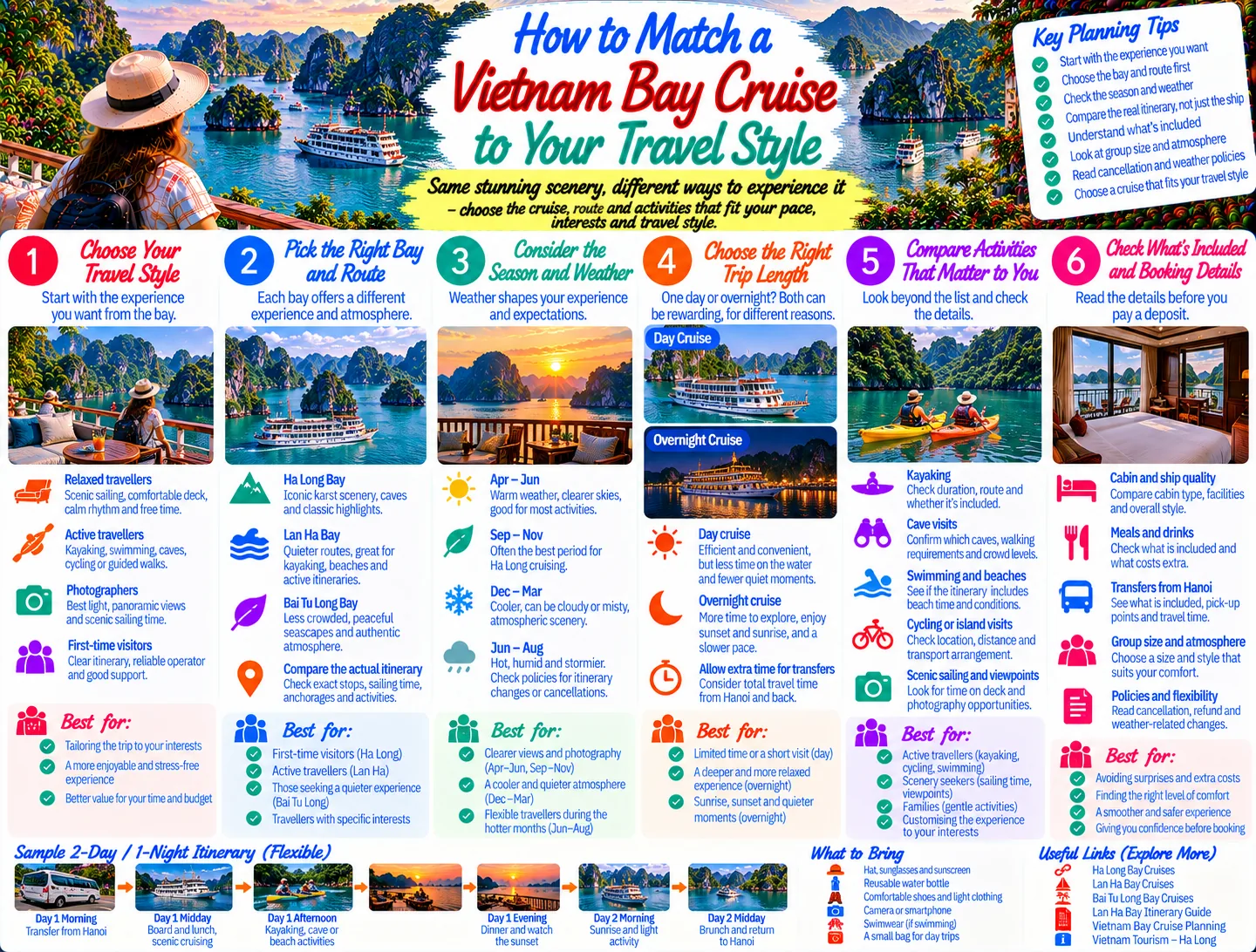
For a broader evaluation of routes, cabins, transfers, and booking terms, review a Vietnam bay cruise before booking. The policy is one part of the decision, not a replacement for checking the itinerary itself.
Compare policies with your actual trip plan
The best policy for one traveller may not be the best for another. A short trip with fixed flights may require flexible cancellation more than a longer trip with several spare days. A family group may care about rebooking and connecting transport, while a photographer may care more about route changes and time on the water.
Before paying, match a Vietnam bay cruise to your trip, including your season, available time, transfer plan, and comfort priorities. Then test the policy against realistic scenarios: you need to cancel five days before departure; the cruise is shortened after boarding; the port closes before embarkation; or your transfer is delayed.
A practical comparison table to make before booking
Put each shortlisted cruise in one row and record the same fields for every operator: route and scheduled length; final cancellation deadline and applicable time zone; refund or credit after an operator cancellation; treatment of itinerary changes and shortened sailings; transfer cancellation and missed-connection terms; notification method during disruption; who has authority to approve a refund or rebooking; and where the complete terms are stored.
This makes differences visible. A cheaper fare may be less useful if it excludes the transfer or offers only a credit after a disruption. A higher-priced booking may be easier to manage if its terms are specific and its communication process is clear.
Questions to send before you pay
- What is the exact cancellation deadline, including time zone?
- What refund applies if the operator cancels because of weather or an official port decision?
- What happens if the route or activities change but the boat still departs?
- Are transfers covered by the same terms?
- How and when will you notify passengers?
- Will the answer be included in the booking confirmation?
If the response conflicts with the published terms, ask which document controls. Avoid making a payment until the commercial terms are understandable and consistent.
Final checks before confirming a Vietnam bay cruise
Read the cancellation and weather sections together with the itinerary, inclusions, transfer details, and payment conditions. Save the confirmation, the version of the terms shown at checkout, and the operator’s contact details. Check the booking name, dates, passenger count, cabin type, pickup point, and the person responsible for handling changes.
A good policy cannot remove weather risk, but it can reduce uncertainty. Choose the cruise whose route and pace suit your trip, then choose the booking terms you can accept if the plan changes. That combination is more useful than comparing headline price alone.
JOIN THE CONVERSATION
Comments (0)
No comments yet. Be the first to share a thought.