Choosing a Vietnam bay cruise is rarely as simple as comparing a star rating or a starting price. Two itineraries can visit the same broad destination while offering very different sailing times, embarkation points, cabin layouts, transfer arrangements, and standards of organisation. A useful cruise review should help you understand what a trip will feel like, not merely repeat promotional adjectives.
This guide explains how to review a Ha Long Bay, Lan Ha Bay, or Bai Tu Long Bay cruise before you book. It focuses on the practical details that are easy to overlook: the route, the time actually spent on the water, what is included, how excursions are handled, and how the operator responds when weather or logistics change. Use it alongside this checklist for comparing cruise operators when you are narrowing down specific boats.
Start with the itinerary, not the boat photographs
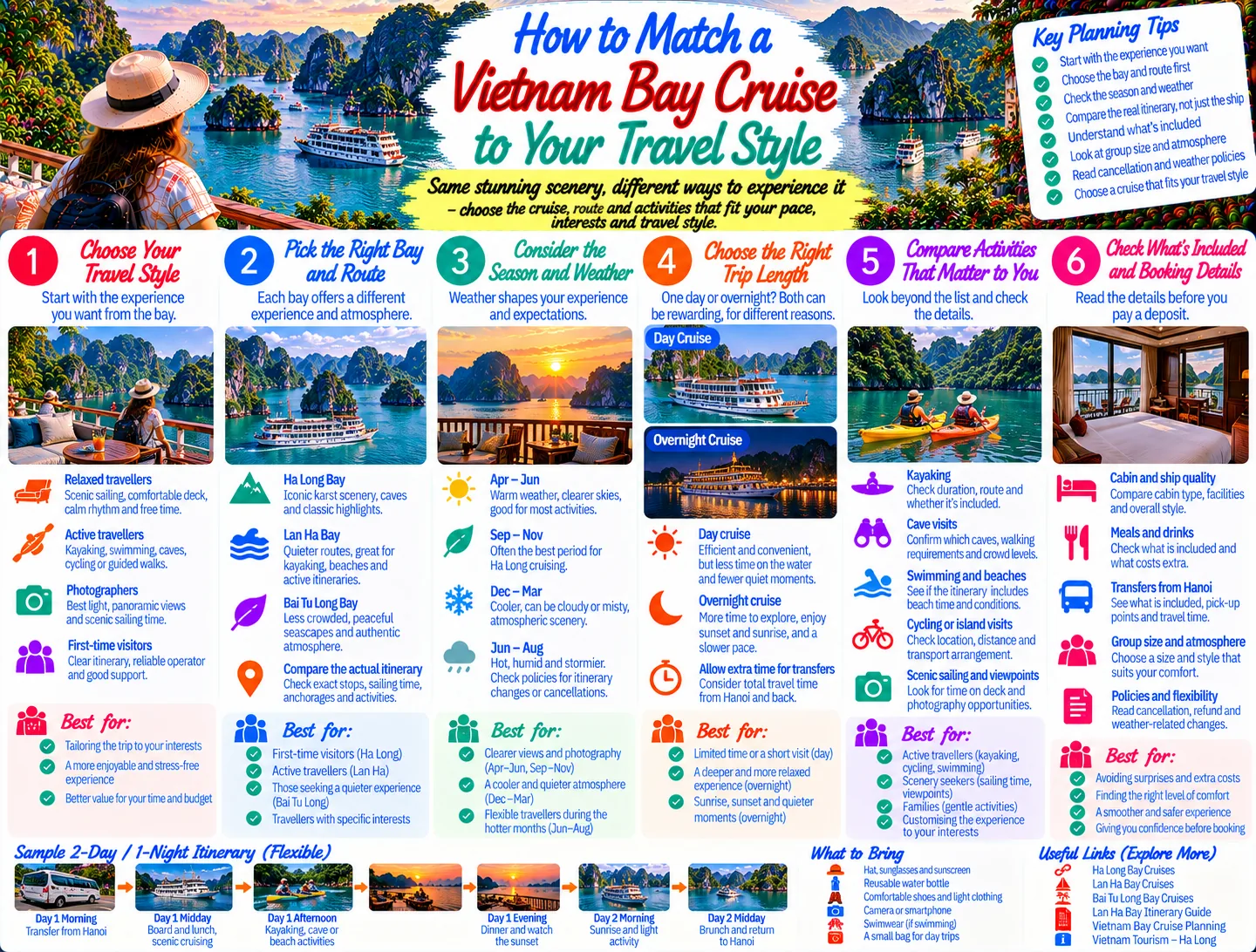
Beautiful images can tell you that a vessel is attractive; they cannot tell you whether its schedule suits your trip. Begin by identifying the exact itinerary name, the departure port, and the sequence of activities. A two-day, one-night cruise may include an afternoon transfer, boarding formalities, a short excursion, dinner, an early-morning activity, and disembarkation before lunch. That can still be worthwhile, but it is different from a full two days of exploration.
Check the route in practical terms
Look for the bay or island area the cruise actually visits. Ha Long Bay, Lan Ha Bay, and Bai Tu Long Bay are related destinations, but they are not interchangeable labels for the same experience. Read the daily schedule for named stops, tender or transfer arrangements, and whether the vessel changes anchorage between days. A route with fewer stops may be better if it gives you longer at one scenic location and less time moving between crowded activity points.
Also check whether the itinerary is a fixed route or an example schedule. Operators may adjust the order of activities because of tides, harbour instructions, weather, or conservation requirements. A trustworthy review treats flexibility as normal while still asking the operator to explain the likely alternatives.
Separate the cruise experience from the transfer
For many travellers, the first and last parts of the trip happen on a road rather than on a boat. The journey from Hanoi or another arrival point to the harbour affects the real value of the package. Review the transfer duration, pickup area, vehicle type, meal or rest stops, luggage handling, and the latest recommended arrival time. If a transfer is sold separately, find out who is responsible if traffic causes you to miss boarding.
Do not judge a cruise only by its advertised cabin rate if getting to the port requires an expensive private vehicle or an inconvenient overnight stay. Conversely, a slightly higher package price may be better value if it includes a reliable shared transfer, clear pickup communication, and a sensible return time.
Ask whether the transfer is door-to-door, hotel-zone limited, or collected from a central meeting point. Confirm the departure day and the time zone used in all messages. Small ambiguities create the most avoidable stress before a cruise.
Read the cabin description like a reviewer
“Ocean view,” “balcony,” and “suite” are useful starting points, not complete specifications. Check the cabin’s approximate size, deck location, bed configuration, bathroom arrangement, window or balcony type, and whether the view can be obstructed by railings, lifeboats, or structural features. If you are sensitive to motion or engine noise, ask which cabins are closest to the centre of the vessel and which are above public areas.
For families, confirm the maximum occupancy and the actual sleeping arrangement. A room described as suitable for three may use a sofa bed or an extra narrow berth. Ask about connecting rooms if privacy matters. For older travellers, check stair access, walking distances, and whether the vessel has lifts; do not assume that a compact cruise ship has the same accessibility as a large ocean liner.
Look beyond the room
A review should also cover the shared spaces. Is there an indoor dining area for poor weather? Is the sun deck large enough for the advertised activities? Are meals served at set times or in a flexible format? Are drinks, Wi-Fi, spa treatments, and special meals included or charged separately? These questions matter because a small vessel can feel intimate and calm or crowded and restrictive depending on its passenger load and layout.
Photographs should be treated as evidence to verify, not proof that every cabin has the same finish. Look for the date of the images, recent guest photographs, and consistent descriptions across booking pages. If the operator cannot explain a major discrepancy, consider that a review signal.
Evaluate excursions by time and supervision
Kayaking, cave visits, floating-village stops, beaches, cooking demonstrations, and morning tai chi can all sound appealing. The important question is how much time each activity receives and how it fits the day. A stop described as a “visit” may be a brief photo opportunity, while another may involve a tender ride, a walk, stairs, or a longer paddle.
Read the meeting instructions and difficulty level. Ask whether kayaking is optional, whether a local guide accompanies the group, where personal belongings are stored, and what happens if you prefer not to participate. A strong itinerary gives you meaningful alternatives rather than leaving you on board without explanation.
For a closer look at how to compare activity-heavy schedules, see our guide to kayaking, caves, and cruise stops. If your priority is a shorter visit, compare it with the practical advice in the day cruises category before choosing an overnight package.
Test the inclusions and exclusions
Price comparisons become misleading when each operator defines “included” differently. Make a simple table with the cruise fare, transfers, meals, drinking water, excursions, entrance or service charges, holiday supplements, and payment fees. Note whether the listed price is per person or per cabin, and whether it assumes two people sharing.
Pay special attention to the words “selected drinks,” “standard menu,” “shared transfer,” and “optional excursion.” Ask for the current supplement policy for solo occupancy, children, gala dinners, and dietary requests. If an itinerary uses a tender boat or a shuttle between vessels, ask whether that movement is included or arranged locally.
Value is not the same as the lowest headline price. A less expensive cruise can become costly if it excludes transfers, charges for activities you expected to be included, or offers a schedule that requires an additional hotel night. For a budget-focused comparison, use the budget cruises category and look for an itemised inclusions list rather than a discount percentage.
Review safety, weather, and cancellation communication
Bay cruises operate in a weather-sensitive environment. Your review should explain how the operator communicates changes, not promise that every planned stop will operate. Ask when final sailing decisions are normally made, how you will be notified, and what options apply if authorities restrict departures or the itinerary is shortened.
Read the cancellation terms before paying. Check the difference between a guest cancellation, a port closure, a delayed transfer, and an operator-initiated change. Find out whether a refund, rebooking, credit, or alternative land arrangement is offered, and which parts of a package are non-refundable. Keep written confirmation of the policy rather than relying on a verbal assurance.
On board, follow crew instructions around tenders, swimming, kayaking, and wet surfaces. Pack footwear with grip, protect electronics from spray, and keep essential medication in your hand luggage. These are simple precautions, but they matter more than adding another decorative item to your packing list.
Use reviews as evidence, not as a vote
Guest reviews are most useful when you group them by theme. Look for repeated comments about communication, food consistency, cabin maintenance, transfer punctuality, guide quality, and how the crew handled disruptions. A single complaint may reflect an unusual event; the same specific issue across several recent reviews deserves attention.
Give greater weight to reviews that describe the itinerary and timing clearly. “Amazing trip” is encouraging but not very diagnostic. A useful review tells you what was included, how long activities lasted, whether the cabin matched its description, and what the reviewer would choose differently. Compare recent feedback with the current itinerary because boats, management teams, routes, and menus can change.
Be cautious with absolute claims. “The quietest bay” or “the best luxury cruise” depends on date, route, weather, and personal preference. A balanced review explains who will enjoy the trip and who may prefer another format.
Match the cruise to your travel priorities
Before selecting a winner, rank your priorities. Couples may value a quieter deck, a private balcony, and an unhurried dinner. Families may care more about cabin configuration, swimming supervision, and a clear transfer plan. Photographers may prefer scenic cruising time over a long list of activities. Travellers with limited time may accept a busier itinerary to avoid an extra night away from Hanoi.
Use the destination pages for route-specific comparisons: Ha Long Bay cruises for the classic route, Lan Ha Bay cruises for alternative itinerary considerations, and Bai Tu Long Bay cruises when a quieter route is central to your decision. The right choice is the one whose compromises match your priorities, not the one with the longest amenities list.
A final pre-booking review checklist
- Can you name the departure port, route area, and likely daily stops?
- Does the schedule show how much time is spent cruising, transferring, and ashore?
- Are cabin size, bed type, view, balcony, and accessibility clearly described?
- Are meals, drinks, excursions, transfers, and mandatory supplements itemised?
- Do you understand the weather, cancellation, and rebooking policy?
- Is there a direct contact who can answer questions before payment?
- Do recent detailed reviews support the operator’s claims?
If several answers are unclear, pause before booking and request written clarification. A careful review is not about eliminating every uncertainty; it is about finding the uncertainties you can accept and exposing the ones that could change the trip.
Conclusion
The best way to review a Vietnam bay cruise is to follow the traveller’s real journey: reaching the harbour, boarding, using the cabin, joining excursions, handling meals and extras, and responding to weather or schedule changes. Compare complete itineraries and policies rather than isolated prices, and judge reviews by the detail they provide. With that approach, you can choose a cruise that fits your time, comfort level, and priorities before payment—not after the boat leaves the pier.
JOIN THE CONVERSATION
Comments (0)
No comments yet. Be the first to share a thought.