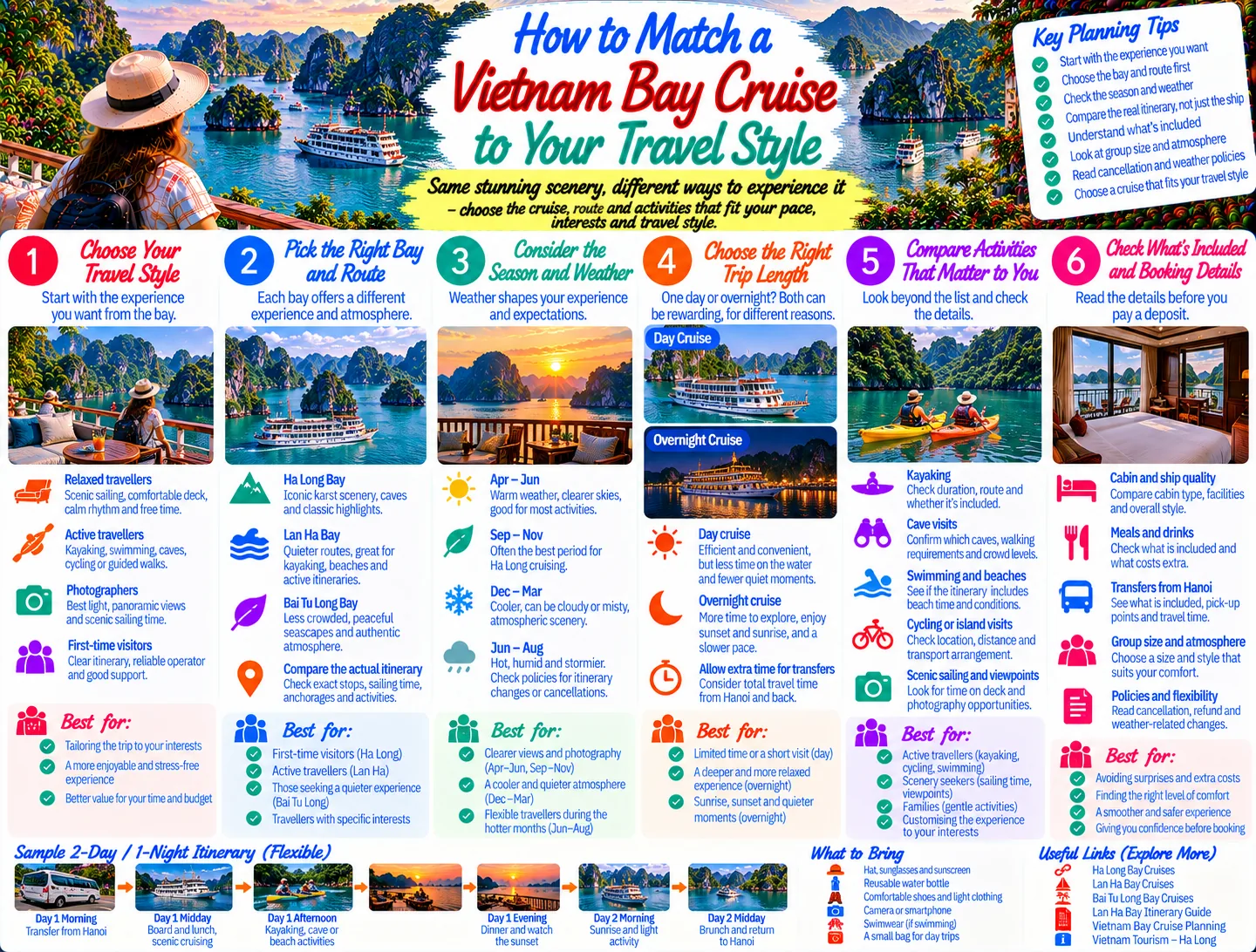
Choosing a Vietnam bay cruise is less about finding the longest list of facilities and more about matching the itinerary to the way you actually want to travel. A quiet overnight on the water, an activity-heavy route, and a short scenic escape can all be excellent choices, but they solve different travel problems. This guide gives you a practical way to compare a Vietnam bay cruise itinerary before you pay a deposit.
Start with the experience you want from the bay
Begin with a sentence rather than a ship name: “I want two relaxed days with scenery,” “I want to kayak and explore,” or “I want the easiest possible excursion from Hanoi.” That sentence becomes your filter when listings use similar words such as premium, authentic, secluded, or adventure.
Match the cruise to your pace
Relaxed travellers: Prioritise scenic sailing, a comfortable deck, a calm daily rhythm, and enough unstructured time. A schedule packed with transfers and activities may feel like a bus tour on water.
Active travellers: Look for clearly described kayaking, swimming, cave visits, cycling, or guided walks. Check whether each activity is included, optional, weather-dependent, or replaced by a shorter alternative.
Photographers and scenery seekers: Compare the route’s sailing windows, sunrise or sunset opportunities, and time spent at viewpoints rather than judging the itinerary by its number of stops.
First-time visitors: Choose clarity over novelty. A well-explained route, transparent transfer plan, and responsive operator usually matter more than a vague promise of a hidden lagoon.
The official Vietnam Tourism guide describes Ha Long as a place where cruises move among rugged islands and stop at caves, while also noting that quieter corners are possible. That distinction is useful: the headline destination may be familiar, but the feeling of the trip depends on route, timing, and how much time is spent off the main flow.
Choose the bay and route before comparing cabins
Route choice is the biggest decision many travellers postpone. Compare the destination first, then compare vessels operating there. On this site, the Ha Long Bay Cruises category is a useful starting point for the classic landscape, while the Lan Ha Bay Cruises category helps when a different route or activity mix is the priority.
Ha Long Bay
Ha Long Bay suits travellers who want the iconic karst landscape and a straightforward first introduction to bay cruising. The official destination guide highlights caves, floating communities, kayaking, and broad views from the water. Ask the operator exactly which attractions are part of the proposed route; “Ha Long Bay” in a title does not by itself tell you how long the boat sails, where it anchors, or how crowded a stop may feel.
Lan Ha Bay
Lan Ha Bay can appeal to travellers comparing a more activity-oriented or less familiar-feeling itinerary. Look beyond the bay name and inspect the actual program: time in a kayak, beach or swimming opportunities, transfer arrangements, and whether the cruise begins from the same port as the alternatives you are considering. The site’s Lan Ha Bay itinerary guide is useful for turning broad route language into specific questions.
Bai Tu Long Bay
Bai Tu Long Bay is worth comparing when your priority is a quieter atmosphere and a less standardised-feeling route. Do not treat “quieter” as a promise that every sailing will be empty. Instead, ask about the exact anchorages, excursion timing, group size, and how much time is spent travelling between points. The Bai Tu Long Bay Cruises category can help you explore that route without assuming it is automatically better for every traveller.
Use the season to set realistic expectations
Weather should shape your expectations, not just your packing list. Vietnam Tourism identifies September to November as a strong period for Ha Long cruising, while its broader weather guide describes April to June as warm with clearer skies and June to August as hot, humid, and stormier. December to March can be cool, cloudy, or misty. These are planning patterns, not guarantees for a particular departure date.
What seasonal differences mean onboard
Clearer, calmer periods: These may suit travellers who care most about expansive views, photography, and time on deck.
Hot and humid periods: Early starts, shaded seating, air-conditioning, and a realistic activity pace become more important.
Misty or cooler periods: The scenery can feel atmospheric, but visibility may be less predictable. Bring layers and avoid choosing a cruise solely for panoramic photographs.
Storm-sensitive periods: Ask how the operator handles itinerary changes, port restrictions, and cancellation or rescheduling decisions. Do not assume a substitute route will offer the same activities.
The official weather guidance also notes that tropical storms can sometimes cause cruise cancellations. A responsible comparison therefore includes the operator’s written policy, not just a price and a departure date. If your itinerary has a fixed international flight immediately afterward, leave more margin than you would for a flexible trip.
Decide whether one day or overnight is right
A day cruise is efficient when your time is limited or you are testing whether bay travel suits you. It can also mean a concentrated schedule, more road time relative to time on the water, and less opportunity to experience early morning or evening scenery. Read the site’s one-day cruise guide alongside the itinerary you are considering, then ask how much of the advertised duration is spent on transfers.
An overnight cruise usually offers a slower rhythm and more time for the vessel itself to become part of the experience. It may be a better fit if you value sunrise, a quiet deck, or a less hurried meal schedule. It is not automatically better value: compare the number and quality of included activities, cabin category, transfer time, and what happens if weather changes the plan. For preparation basics, the site’s first overnight cruise guide can help you identify practical questions before booking.
Use a simple time test
Write down the total door-to-door time, not just the advertised cruise duration. Include hotel pickup, road transfer, port check-in, tender or small-boat movements if mentioned, and the return journey. Then ask whether the remaining time matches your goal. A short trip may be ideal if it gives you one beautiful day without disrupting a larger itinerary; an overnight may make more sense when the bay is a central part of the holiday.
Compare the itinerary details that listings hide
Two programs can both promise caves, kayaking, and sunset while delivering very different days. Put each itinerary into the same checklist:
Where does the cruise depart and return?
How long is the road transfer, and is it shared or private?
Which activities are included in the base fare?
Are kayaking, swimming, or cave visits subject to weather or local operating decisions?
How large is the excursion group?
How much time is spent sailing versus anchored?
What cabin location and view are included at the quoted price?
What is the policy if the route changes or the cruise cannot sail?
Use the operator comparison checklist to evaluate service, communication, inclusions, and policies consistently. The goal is not to eliminate uncertainty—weather and local decisions will always matter—but to discover which uncertainties the operator explains clearly.
Match the cabin and service level to your priorities
A cabin is valuable when it solves a real need. If you expect to spend most of the day on deck or ashore, a practical cabin with a good layout may matter more than an expansive balcony. If you are travelling in a cooler or mistier season, indoor comfort, a useful window, and a pleasant common area may matter more than outdoor space.
Ask for the exact cabin category rather than relying on photos from the whole fleet. Confirm bed arrangement, deck position, accessibility, bathroom details, noise considerations, and whether the displayed room is representative. If you are travelling with children or a private group, compare the vessel’s room configuration and daily rhythm with the needs of everyone onboard; the site’s Private & Family Cruises category offers a separate angle for that planning.
Build a safer, less stressful booking decision
Good cruise planning is also contingency planning. Keep the operator’s contact details, written inclusions, pickup location, and cancellation terms together. Ask what identification or booking information is needed at check-in, where the transfer meets you, and how the company communicates a last-minute change. Do not rely on a social-media message or a verbal promise when a policy can be written down.
Transport timing deserves particular attention. Vietnam Tourism’s transport overview notes that travellers can underestimate distances and road conditions between destinations, and that flying may be sensible when time is limited. For a bay cruise, that means you should avoid building a tight same-day connection around an uncertain return time. If the cruise is part of a longer northern Vietnam route, treat the transfer as a real travel segment rather than invisible downtime.
A final decision framework
Before booking, score each candidate from one to five on route fit, seasonal fit, time efficiency, activity fit, cabin comfort, transfer clarity, and policy transparency. Weight the categories that matter most to you. A couple seeking quiet may give route and cabin comfort double weight; an active traveller may give excursions and timing more weight; a family may prioritise transfers and room configuration.
Then send the operator three final questions: What part of the itinerary is most likely to change in the expected conditions? Which included activity is commonly replaced, and by what? What happens financially and logistically if the cruise cannot operate? The quality and specificity of the reply is evidence about the booking experience.
If two options still look equal, choose the one that makes its limitations easier to understand. A precise note about weather substitutions or transfer timing is more useful than another superlative. Clear boundaries help you decide whether a cruise fits, and they make surprises easier to handle once you are travelling.
Conclusion
The best Vietnam bay cruise itinerary is not the one with the most impressive adjectives. It is the one whose route, season, pace, activities, cabin, transfer plan, and backup policies fit your actual priorities. Start with the experience you want, compare the bay and route, check seasonal reality, calculate door-to-door time, and ask precise questions about what is included. That process makes it easier to choose confidently without treating a brochure promise as a guarantee.
JOIN THE CONVERSATION
Comments (0)
No comments yet. Be the first to share a thought.