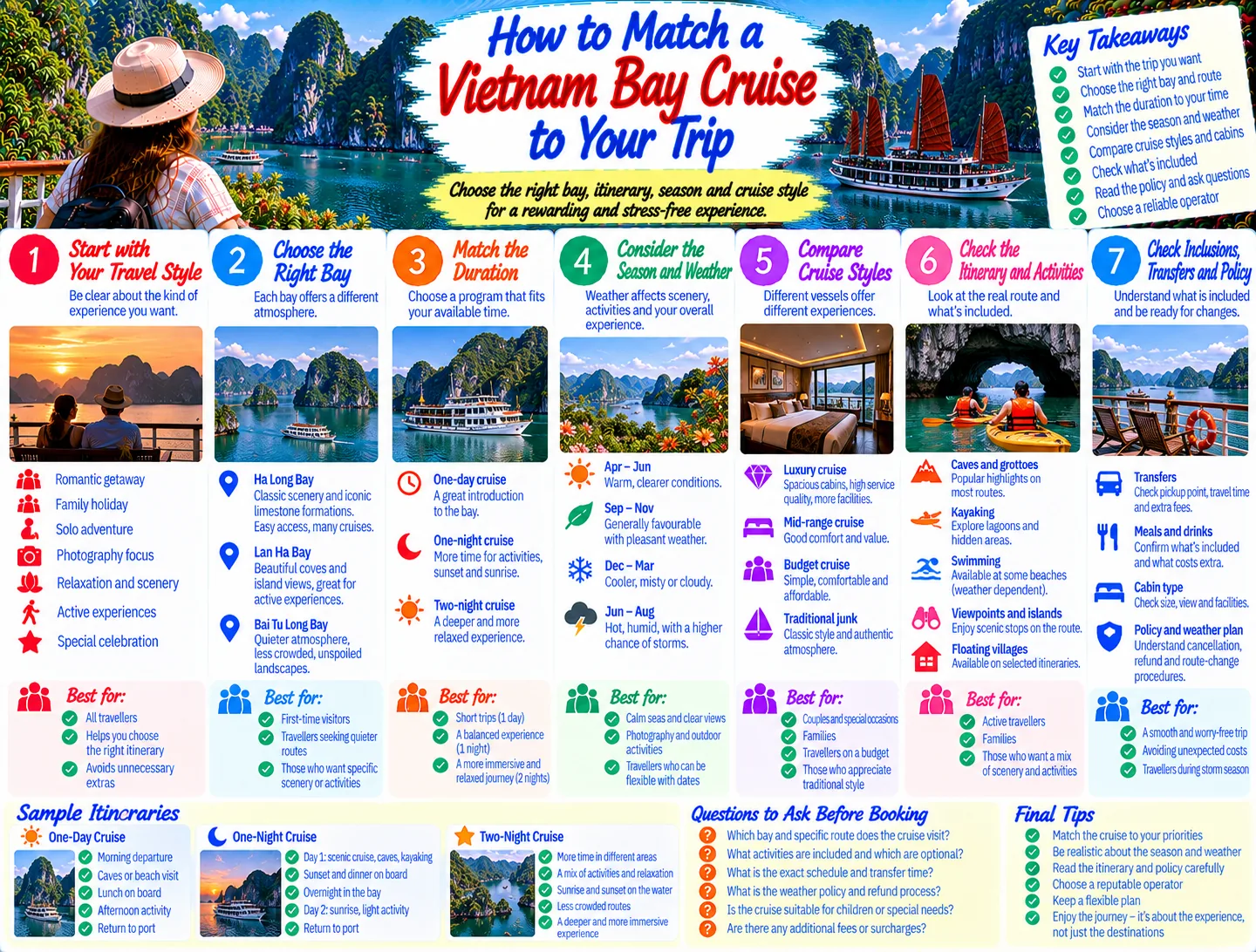
Choosing a Vietnam bay cruise is less about finding the most impressive-looking boat and more about matching an itinerary to the trip you are actually taking. A route that suits a photographer may frustrate a family with a short schedule, while a polished two-night program may be unnecessary for someone who wants one calm day on the water. The most useful decision is therefore not simply “Which cruise is best?” but “Which combination of bay, season, duration, transfers, activities, cabins, and onboard pace fits us?”
This guide offers a practical way to answer that question before you compare operators. It focuses on decisions that remain useful even when departure dates, weather, and cruise schedules change, and it complements our checklist for comparing cruise operators with a more itinerary-led approach.
Start with the trip you want, not the boat you saw online
Begin by writing down the experience you want in one sentence. You might want a first taste of the karst seascape, a quiet overnight escape, active excursions, a comfortable celebration, or a route that works smoothly between Hanoi and another destination. This simple statement prevents attractive extras from taking over the decision.
Then rank three priorities. For example, a couple may choose scenery, unhurried time, and a private balcony. A family may choose easy transfers, a short activity schedule, and flexible meal arrangements. A solo traveller may care more about a social atmosphere, kayaking, and transparent single-supplement terms. There is no universal best itinerary because each priority changes what “value” means.
Use a decision sentence
Try this format: “We want a [one-day, one-night, or two-night] Vietnam bay cruise in [season], with [quiet scenery, activities, comfort, or convenience] as our top priority, and we can tolerate [long transfers, fixed schedules, or weather risk].” If an itinerary cannot satisfy the first two parts, a lower headline price or a longer list of facilities will not rescue it.
For a broader look at the three main cruising areas, browse the site’s Ha Long Bay cruises, Lan Ha Bay cruises, and Bai Tu Long Bay cruises categories. Treat them as route research, then return to your own priorities before requesting a quote.
Match the bay to the kind of scenery and pace you prefer
Ha Long Bay is the familiar choice for travellers who want the classic image of Vietnam’s limestone seascape. Vietnam’s official tourism authority describes cruises among rugged islands and islets, with caves and floating communities forming part of the experience. Its destination guidance also notes that cruise transfers commonly use Tuan Chau and Bai Chay ports. That makes Ha Long a sensible starting point when iconic scenery and a straightforward first-time plan matter most.
Lan Ha Bay can appeal when you want a route framed around a different set of coves, island views, and active stops. Bai Tu Long Bay is often considered by travellers who place a higher value on a quieter atmosphere. These are not guarantees: the actual feel depends on the sailing date, vessel size, port arrangements, weather, and the exact route written in the booking terms. Ask for the named stops rather than relying on the bay name alone.
Questions that reveal the real route
Which bay does the vessel enter, and where does it spend the night?
Are caves, beaches, villages, or kayaking stops included, optional, or weather-dependent?
How long is spent on the main route compared with time at the port?
Does the itinerary return to the same port, and what happens if the route changes?
A route description that only says “Ha Long Bay cruise” may be too vague for a meaningful comparison. Look for a day-by-day outline and distinguish a scenic sailing area from a specific shore excursion. Our guide to what to look for in a Lan Ha Bay itinerary is useful when two programs use similar promotional language but offer different pacing.
Let the season influence the itinerary, not just the packing list
Weather should change your expectations and your cancellation questions. Vietnam Tourism’s Ha Long guidance identifies September to November as a favourable period, while also describing autumn and spring as generally clear and calm for cruising and summer as hot with a chance of storms. Its detailed climate guide gives a broader pattern: April to June can bring warm, clearer conditions; June to August can be hot, humid, and stormy; September to November is mixed; and December to March can be cool, misty, or cloudy.
The practical lesson is not to promise perfect weather in a particular month. It is to choose what you want to happen if the view is misty, a kayak stop is shortened, or a sailing plan changes. If photography and open-deck time are central, build in flexibility and avoid connecting the cruise to an important same-day flight. If atmosphere matters more than blue skies, a cooler or mistier period may still be rewarding, provided you understand the operational risk.
Ask weather questions before paying
What is the operator’s process when storms affect sailing?
Can an excursion be replaced, and is the replacement automatic or optional?
When is the final decision about route changes normally communicated?
Which parts of the fare are refundable, transferable, or non-refundable?
Read the written policy rather than relying on a sales message. Weather decisions are operational matters, so compare the clarity of the answer as part of your review of the operator.
Choose the duration by counting usable hours
A one-day cruise can work well when you want a compact introduction, have limited time, or prefer to sleep on land. The trade-off is that the day contains the transfer to the harbour, boarding procedures, the sailing program, and the return journey. A longer trip does not automatically mean more value, but it usually gives the itinerary more room for a relaxed meal, a second excursion, or time on deck without treating every hour as a scheduled event.
One overnight is often the middle ground: enough time to see the landscape in changing light and experience the rhythm of sleeping on the water, without committing a large part of a longer Vietnam itinerary. Two nights can suit travellers who want a slower pace or a more extensive route, but only if the program is genuinely different on the second day. Ask whether day two adds a new area or simply repeats the same activities with more leisure time.
Protect the day before and after
Do not judge duration in isolation. Add the road transfer from Hanoi, port check-in, and the time needed to reach your next hotel or airport. Vietnam Tourism’s transport guidance stresses that distances between destinations can be underestimated and that overland journeys may take longer than expected. For that reason, avoid placing a time-critical flight or train immediately after disembarkation unless the operator and your transport plan leave a substantial buffer.
Use our one-day bay cruise guide if you are comparing a day boat with an overnight product, and check the overnight cruises category when the sunset-and-sunrise experience is the main reason to stay aboard.
Compare transfers as part of the cruise, not as an afterthought
The cruise begins before you reach the pier. A transfer package may include hotel pickup, a shared vehicle, a premium vehicle, a waiting lounge, or only a meeting point. “Hanoi transfer included” is not enough information to compare two prices. Ask where pickup is available, whether the vehicle is shared, how many stops are expected, and whether the return transfer follows the same arrangement.
Also check the port name and the timing of the handover. A route can look economical until you add a taxi to the meeting point, a private ride for an early departure, or a night near the harbour. If you are travelling with older relatives, young children, or bulky luggage, fewer changes may be worth more than a slightly larger cabin.
Build a simple door-to-door comparison
Record the hotel pickup window and the expected arrival at the port.
Record what is included between port arrival and cabin access.
Note the disembarkation time and the earliest realistic arrival back in Hanoi.
Add any hotel night, taxi, or luggage cost created by the schedule.
This approach makes a premium-looking itinerary easier to evaluate honestly. It also exposes a common mismatch: a cruise may fit your preferred bay but not your wider route through northern Vietnam.
Choose activities by energy level and backup value
Kayaking, caves, swimming, cooking demonstrations, tai chi, and shore visits can all sound appealing in a short itinerary. The right question is how many activities you genuinely want to do and how much recovery time you need between them. A packed schedule may suit an active traveller, while someone booking the cruise for rest may prefer one strong excursion and generous open-deck time.
Look for the difference between an included activity and an activity that is merely available. Confirm whether kayaking is guided, whether equipment is supplied, whether a cave involves stairs, and whether a beach stop requires a tender or another boat. Do not assume every advertised activity runs on every departure: weather, water conditions, and local operating decisions can alter the program.
Review our article on comparing kayaking, caves, and cruise stops when activities are central to your choice. A strong itinerary has a worthwhile fallback. If rain interrupts a shore visit, there should still be a comfortable way to spend the time rather than a long list of cancelled promises.
Evaluate the cabin and service against the hours you will use them
Cabin size and balcony design matter, but so do the spaces between activities. Ask whether you expect to spend time privately in the room, whether you sleep lightly, and whether the dining and lounge areas offer places to sit when the weather turns. A balcony is more useful to a traveller who values quiet views than to someone who plans to join every excursion.
Review meal arrangements, dietary communication, accessibility, and the distinction between a private cabin and a private boat. If you are travelling with children or a group, confirm bed configuration and the age suitability of activities before paying. For a celebration, ask what is included in the package and what is charged separately rather than assuming a “special occasion” label covers every detail.
Price should be compared after the inclusions are clear: transfers, meals, excursions, drinks, port fees, and cabin category. Our guide to finding a good-value bay cruise can help you separate a low headline fare from a genuinely lower total cost.
Use a final scorecard before you book
Once you have two or three serious options, score each one from one to five on route fit, season fit, duration, transfer convenience, activity fit, cabin comfort, policy clarity, and total cost. Give double weight to the two factors you identified at the start. This keeps a dazzling brochure from overpowering a practical problem such as a risky connection or an unsuitable activity level.
Then send the same questions to each operator. Compare the specificity of the replies, not just the friendliness of the sales language. A clear answer about route changes, weather, transfers, and inclusions is evidence of a more manageable booking process. If an important detail remains vague, treat that uncertainty as part of the price.
Before confirming, save the itinerary, terms, pickup details, and contact information in one place. Recheck the departure date, passenger names, cabin category, and cancellation conditions. These final checks are simple, but they protect the experience you worked to match.
Conclusion: choose the itinerary that fits the whole journey
The best Vietnam bay cruise is the one that fits your complete travel plan: the bay matches your preferred atmosphere, the season matches your tolerance for weather uncertainty, the duration leaves enough usable time, and the transfers do not create avoidable stress. Start with your priorities, ask for a specific route, compare the door-to-door schedule, and judge activities and policies as carefully as the cabin. That method produces a more reliable choice than chasing a generic “best cruise” label—and it remains useful as operators and schedules change.
JOIN THE CONVERSATION
Comments (0)
No comments yet. Be the first to share a thought.